


WhatsApp has long stood as one of the world’s most beloved messaging apps a free, secure platform used by billions globally to send messages, share photos and videos, and make voice and video calls. But that status quo may be changing. Recent leaks from the WhatsApp Android beta version (2.26.3.9) suggest that Meta, the parent company of WhatsApp, is testing a paid subscription that allows users to remove all ads from the app for a monthly fee of around €4.
This apparent shift represents a major evolution in WhatsApp’s monetization strategy and raises urgent questions: Will users have to pay for a cleaner experience with no extra features? How will this affect user privacy, ad targeting, and the future of the platform? And what could this mean for messaging habits and competition with rival services like Signal or Telegram?
In this in-depth analysis, we’ll explore the emerging details, reactions from users and tech experts, regulatory contexts, parallels with other Meta products, and broader implications for WhatsApp’s future.
The Background: How WhatsApp Has Traditionally Been Free
Since its launch in 2009 and subsequent acquisition by Facebook (now Meta) in 2014, WhatsApp has been free to download and use. Its core promise of fast, secure, and end-to-end encrypted messaging attracted billions of users worldwide.
WhatsApp’s founders once insisted that the app would never show ads, emphasizing the importance of privacy and simplicity. In fact, the company for many years had no major revenue stream tied to ads, instead relying on services like WhatsApp Business, where companies pay for enhanced tools, and on Meta’s broader advertising ecosystem.
That changed in recent years as Meta sought sustainable ways to monetize WhatsApp:
Introduction of Ads in the Updates Tab
Ads first appeared within WhatsApp’s Updates tab (a space similar to Stories on other social platforms), where users view Status posts and browse Channels. These include Status Ads that appear between Status updates and Promoted Channels, which show recommended Channels to follow.
Crucially, ads are not shown in private chats or calls, preserving the app’s commitment to privacy and end-to-end encryption.
Why Ads Now? Meta’s Monetization Strategy
Meta has steadily expanded ad placements across its main platforms, Facebook, Instagram, and now WhatsApp, to diversify revenue streams. Ads across these apps are typically personalized based on factors like language, general location, and activity within specific sections like the Updates tab not by scanning private messages or call contents.
This means WhatsApp still respects message privacy, but uses general information to tailor ads. Ads help businesses reach users and help Meta offset the cost of maintaining and developing the platform.
Even with ads generating revenue, Meta appears to be responding to regulatory requirements in regions like the European Union and the United Kingdom, where laws demand that platforms offer users a choice between an ad-supported free version and a paid, ad-free alternative. Similar models are already in place for Facebook and Instagram in those regions.
What the New Subscription Actually Is
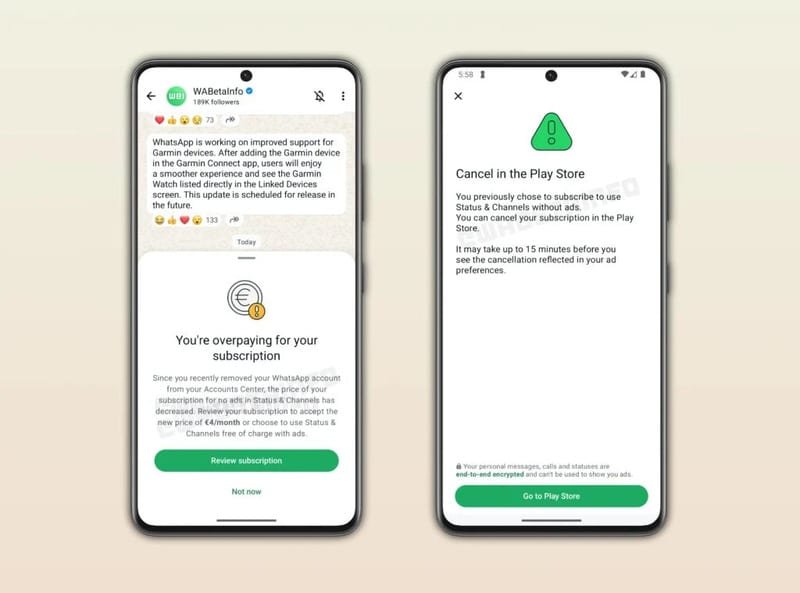
Optional Subscription for Ad-Free Use Around €4/Month
According to screenshots shared by WABetaInfo and reported in multiple outlets, WhatsApp is testing an optional subscription in the European Union and the UK that removes ads entirely from the Updates tab for paying users. The cost is suggested to be around €4 per month.
The clear purpose is not to charge for any new features; it’s solely to eliminate ads that non-subscribers would otherwise see, effectively creating a choice between paying to avoid ads or using the free, ad-supported version.
Here’s how it appears to work:
- Free Version: Users continue seeing ads in the Updates tab, including status ads and promoted channels.
- Paid Subscription (~€4/Month): All advertising elements disappear from the Updates tab, giving a clean browsing experience.
This subscription is completely optional. Core WhatsApp functions personal messaging, group chats, voice calls, and video calls, remain free for all users.
Optional Subscription Through In-App Purchases
The subscription would be purchased via in-app purchases through platforms like Google Play or the Apple App Store. Once a subscription is activated, it can take a short period (~15 minutes) for changes to apply within the app.
It’s currently unclear whether this subscription will be WhatsApp-only or part of a broader Meta Accounts Center package that could include services across Instagram, Facebook, and potentially other Meta apps.
Why Meta Is Doing This: Regulatory and Economic Forces
Regulatory Pressure in Europe and the UK
One major reason for this shift is regulatory pressure, particularly from the European Union’s Digital Markets Act (DMA) and similar UK laws, which require tech platforms to provide user choice between ad-supported and paid, ad-free experiences.
These regulations aim to protect user privacy and ensure that consent for ad tracking and personalization is truly voluntary. Meta has responded by creating paid alternatives on platforms like Facebook and Instagram. Now, WhatsApp appears to be next in line.
Economic Imperatives
Meta must also demonstrate viable monetization strategies for WhatsApp. Though advertising provides revenue, the company recognizes that some users strongly dislike ads, especially within messaging contexts where interruptions feel more intrusive than on social feeds.
A paid option makes sense commercially: it allows Meta to generate recurring revenue directly from users while continuing to benefit from ads shown to free users.
How This Changes the WhatsApp Experience
What Remains Free
Despite the introduction of a paid subscription, WhatsApp’s core functionalities are unchanged:
- Sending and receiving text messages
- Voice and video calls
- Group chats
- Media sharing (photos, videos, files)
These features remain completely free, even for users who choose not to pay for the ad-free experience.
Where Ads Appear and Don’t Appear
Ads are, and will remain, confined to the Updates tab, which includes:
- Statuses (temporary posts similar to stories)
- Channel recommendations and promotions
Importantly:
- No ads will appear in personal chats or group chats
- Voice and video calls remain ad-free
- End-to-end encryption continues to protect private interactions
This design reflects Meta’s efforts to balance monetization with user privacy and core functionality.
What Subscribers Get
For paying subscribers, the experience is:
- Completely free of paid promotions and ads in Updates
- Cleaner and uninterrupted browsing within Updates
- No additional technical or feature upgrades. This is purely an ad-free option
Some users have already reacted with mixed emotions, appreciating the cleaner experience but wondering why they should pay when WhatsApp has historically been free.
Reactions From Users and Tech Experts
User Sentiment: Love It or Hate It
Since news broke, online communities have been flooded with reactions, including:
- Supportive voices who say paying a small fee for an ad-free experience is reasonable
- Criticism and frustration from users who believe WhatsApp shouldn’t charge at all for something that feels like a basic expectation
- Comparison with competitors such as Signal, which remains ad-free without forced payments
Many users commented that WhatsApp’s dominance makes it hard to switch despite dissatisfaction with ads or subscriptions. Some even joked or complained about having no real alternative because all their contacts are on WhatsApp.
Tech Analysts: A Strategic Monetization Step
Tech experts see this as a logical move for Meta:
- Diversification of revenue streams
- Compliance with regional regulations
- Testing user willingness to pay for privacy and ad avoidance
Analysts note that Meta is already experimenting with premium subscriptions across Instagram, Facebook, and WhatsApp, suggesting a broader shift in Meta’s product strategy toward hybrid models combining free ad-supported access alongside optional paid tiers.
Comparisons With Other Platforms
Meta’s Other Premium Options
Meta has already begun offering ad-free subscriptions for:
These subscriptions provide users with the option to remove ads and sometimes gain additional features. WhatsApp’s potential subscription is similar in intent but solely focused on removing ads, not adding new tools.
Competitor Messaging Apps
Signal and Telegram are frequently mentioned as alternatives:
- Signal: Known for its strong privacy stance and ad-free experience without mandatory payments. Some users prefer Signal because it stays free without ads or subscriptions.
- Telegram: Offers a mix of free tools and optional premium features (e.g., larger file uploads, faster downloads), but does not charge just to remove ads (as it doesn’t have ads in the same way).
User loyalty to WhatsApp, however, remains strong because of vast networks of contacts, ease of use, and familiarity, making switching inconvenient for many despite frustrations with monetization changes.
Potential Future Developments
Will This Expand Beyond Europe and the UK?
Right now, the ad-free subscription is tied to regional regulations, so its rollout is primarily in Europe and the UK. However, if user adoption is strong and Meta sees revenue benefits, such a subscription could expand globally over time, albeit potentially with different pricing structures in various markets.
Will WhatsApp Add More Paid Features?
There’s speculation that future paid tiers could go beyond just removing ads — similar to how social platforms roll out premium features. Possible future enhancements might include:
- Advanced customization
- Enhanced privacy options
- Cloud backup controls
- Multi-device improvements
While nothing beyond the ad-free subscription has been confirmed, Meta’s broader premium strategy across apps suggests it could explore more offerings in the future.
Read More: Google introduces feature to change gmail address for the first time
FAQs
Will WhatsApp charge me just for messaging?
No. WhatsApp’s core messaging features, text, voice, and video calls, remain free. The subscription is only for removing ads from the Updates tab.
What does a WhatsApp ad-free subscription cost?
Early reports indicate around €4 per month for the ad-free option, though this price is not yet officially confirmed and may vary.
Will ads show in personal chats?
No. Ads only appear in the Updates tab personal chats, and calls remain ad-free.
Why is Meta introducing ads and subscriptions?
Meta is expanding monetization and responding to regulatory requirements that mandate a choice between ad-supported and paid options.
Can I cancel the subscription anytime?
Yes. The subscription is optional and can be canceled like other in-app purchases.
Conclusion
WhatsApp’s potential move to introduce a €4 monthly subscription for an ad-free experience marks a pivotal moment in the long-standing evolution of the platform. While ads are confined to the Updates tab and core messaging remains free, this model tests how willing users are to pay to avoid ads — a concept once unthinkable for WhatsApp but now increasingly common across digital services.
