


Oracle Japan Stock Climbs 7% Following Record First-Quarter Performance as investors welcomed faster cloud infrastructure growth, stronger earnings, and a larger contracted revenue backlog. The move reflected renewed confidence that Oracle’s artificial intelligence investments are beginning to produce sales momentum.
Although the headline refers to Oracle Japan, the reported 7% reaction concerned US-listed Oracle Corporation, not its listed Japanese subsidiary. The quarterly figures reveal the role of Oracle Cloud Infrastructure, AI contracts, and the financial risks investors are still evaluating.
Why Did Oracle Stock Rise 7%?
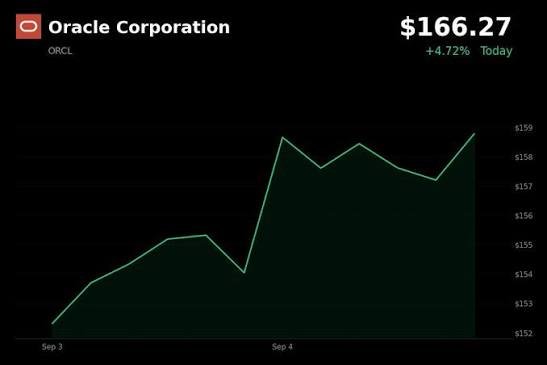
Oracle shares initially advanced more than 7% after the company released its fiscal first-quarter results for the period ending August 31, 2026. The market reaction reflected better-than-expected revenue and earnings, rapid cloud infrastructure expansion, and evidence that Oracle was turning its AI contract pipeline into recognized revenue.
The company reported quarterly revenue of approximately $19.3 billion, representing 30% year-over-year growth. Adjusted earnings reached $1.92 per share, exceeding the $1.74 average analyst estimate cited by Reuters.
Oracle’s results addressed an important investor question: whether its extensive spending on data centers and AI computing capacity could generate sufficient commercial returns. Strong infrastructure revenue suggested that the new capacity was attracting paying customers.
However, the initial share-price increase did not hold throughout the following trading session. Oracle rose as much as 7.8% before reversing direction and closing roughly 2% lower as concerns about spending, debt, and negative free cash flow returned.
Read More: The Biggest AI Trends of 2026 That Could Change How We Work
Oracle’s First-Quarter Results at a Glance
| Financial metric | Fiscal Q1 result | Year-over-year change |
|---|---|---|
| Total revenue | $19.3 billion | 30% increase |
| Net income | $4.76 billion | 60% increase |
| Adjusted earnings per share | $1.92 | Up from $1.47 |
| Cloud revenue | $11.61 billion | 62% increase |
| Cloud infrastructure revenue | $7.4 billion | 121% increase |
| Remaining performance obligations | $664 billion | Up $209 billion |
| Capital expenditure | $28.5 billion | Up from $8.5 billion |
The figures show that cloud infrastructure was the principal growth engine. Oracle’s traditional software business, meanwhile, recorded a 3% revenue decline as customers continued moving from on-premises products to cloud-based services.
Cloud Infrastructure Powered the Quarter
Oracle Cloud Infrastructure, commonly called OCI, generated approximately $7.4 billion in quarterly revenue. Its 121% year-over-year expansion substantially outpaced growth across the rest of the company.
OCI supplies computing, storage, networking, database, and artificial intelligence infrastructure through Oracle-operated data centers. Companies can use these resources to train AI models, operate enterprise applications, and process large volumes of data without maintaining every system internally.
Demand for AI training and inference capacity has helped Oracle compete more directly with Amazon Web Services, Microsoft Azure, and Google Cloud. Oracle is also expanding multicloud services that allow customers to use its database technology alongside competing cloud platforms.
The company brought approximately 850 megawatts of data-center capacity online during the quarter, demonstrating progress in building the infrastructure required to serve large AI contracts.
AI Contracts Strengthened Oracle’s Backlog
Oracle booked more than $30 billion in additional AI cloud contracts during the quarter. These agreements helped lift remaining performance obligations to $664 billion.
Remaining performance obligations, or RPO, represent contracted revenue that has not yet been recognized. This figure is not the same as current revenue or cash received, but it can indicate future demand when customers have made enforceable commitments.
The backlog increase mattered because investors had questioned whether Oracle’s expensive data-center expansion was supported by sufficient customer demand. A larger pipeline provided evidence that organizations were continuing to reserve Oracle’s cloud and AI capacity.
Oracle also said many of the new agreements would not require the company to finance all associated hardware itself. Some projects involve customer prepayments or customer-provided equipment, potentially reducing Oracle’s direct funding requirements.
Why the Earnings Beat Mattered to Investors
The first-quarter report improved sentiment for several reasons.
Revenue Growth Accelerated
Oracle’s 30% revenue expansion represented a substantial acceleration for a company historically associated with mature database and business-software products. The performance showed how cloud infrastructure is changing its overall growth profile.
Earnings Exceeded Expectations
Adjusted earnings of $1.92 per share surpassed the prevailing analyst expectation of $1.74. That combination of stronger revenue and higher earnings indicated that cloud expansion was contributing to more than headline sales growth.
Backlog Exceeded Market Forecasts
The $664 billion RPO balance was above the Visible Alpha consensus estimate reported by Reuters. A stronger-than-anticipated backlog offered greater visibility into potential future revenue, although the timing and profitability of that revenue remain important considerations.
Cash Burn Was Lower Than Feared
Oracle reported negative free cash flow of approximately $5.4 billion. Although still a significant outflow, it was better than the roughly $9.56 billion negative figure analysts had expected. Around $11.36 billion of first-quarter capital spending was offset by customer prepayments.
Oracle Raised Its Fiscal-Year Outlook
Following the results, Oracle increased its fiscal 2027 adjusted earnings forecast to at least $8.10 per share, compared with its earlier target of $8.05.
The company also maintained an annual revenue outlook of at least $90 billion. For the second quarter, management projected revenue growth of between 30% and 34%, alongside adjusted earnings of $1.85 to $1.93 per share.
Maintaining or increasing guidance can support a stock after earnings because it shows management expects recent momentum to continue. Nevertheless, forecasts are forward-looking estimates rather than guaranteed results.
Is “Oracle Japan Stock” the Correct Description?
The reported 7% move applied to Oracle Corporation shares traded in the United States under the ticker ORCL. It should not be confused with Oracle Corporation Japan, a separate publicly traded subsidiary listed in Tokyo.
Oracle Corporation Japan publishes its own financial statements and operates according to a May-ending fiscal year. Its investor-relations calendar listed September 24, 2026, for its fiscal 2027 first-quarter announcement—later than the September 10 results that moved US-listed Oracle shares.
This distinction is important because the two securities have different listings, financial reports, valuations, and market movements. Investors should always confirm the company name, exchange, and ticker before making a decision.
Risks Behind Oracle’s AI Growth Strategy
The earnings report was strong, but several risks remain.
Heavy Capital Expenditure
Oracle spent $28.5 billion on capital expenditure during the quarter, compared with $8.5 billion a year earlier. It maintained a fiscal-year capital expenditure forecast of $90 billion to $95 billion. Much of this funding supports data centers, networking systems, power capacity, and AI computing hardware.
Negative Free Cash Flow
Rapid infrastructure construction requires Oracle to spend cash before related contracts produce their full revenue. Negative free cash flow could remain a concern if capacity deployment is delayed or customer demand weakens.
Debt and Financing Pressure
Oracle has used debt, equity issuance, supplier financing, customer prepayments, and alternative hardware arrangements to support its expansion. These methods can reduce immediate funding pressure, but investors must consider interest costs, shareholder dilution, and long-term financial commitments.
Customer Concentration
A substantial portion of Oracle’s AI infrastructure demand comes from large customers. Major contracts can create rapid growth, but dependence on a limited number of clients increases the financial effect of delays, renegotiations, or reduced spending.
Execution Challenges
AI data centers require suitable land, electrical power, chips, cooling equipment, regulatory approvals, and construction labor. Problems in any of these areas could delay Oracle’s ability to convert its backlog into revenue.
What Investors Should Monitor Next
Investors evaluating Oracle after the first-quarter stock move should follow:
- OCI revenue growth and whether it remains substantially above the broader cloud market.
- The rate at which the $664 billion backlog converts into recognized revenue.
- Free cash flow as new data-center capacity becomes operational.
- Capital expenditure compared with customer prepayments.
- Debt levels, financing costs, and possible equity issuance.
- Profit margins generated by major AI contracts.
- Progress on data-center delivery and power availability.5
- Customer diversification beyond Oracle’s largest AI clients.
A rising backlog is encouraging, but sustainable shareholder value depends on Oracle converting contracted demand into profitable revenue and cash flow.
Frequently Asked Questions
Why did Oracle stock rise after first-quarter earnings?
Shares initially rose more than 7% because Oracle reported better-than-expected revenue and adjusted earnings, 121% cloud infrastructure growth, a $664 billion backlog, and lower-than-feared negative free cash flow.
Did Oracle Japan shares rise 7%?
The widely reported 7% earnings reaction referred to US-listed Oracle Corporation, ticker ORCL. Oracle Corporation Japan is a separately listed subsidiary with its own financial reporting schedule.
What was Oracle’s first-quarter revenue?
Oracle reported approximately $19.3 billion in fiscal first-quarter revenue, up 30% from the same period a year earlier.
How fast did Oracle Cloud Infrastructure grow?
OCI revenue increased 121% year over year to approximately $7.4 billion. This made infrastructure services the quarter’s most important growth contributor.
What does Oracle’s $664 billion backlog mean?
The figure represents remaining performance obligations—contracted business that Oracle has not yet recognized as revenue. It provides potential future revenue visibility but does not guarantee when or how profitably every contract will be fulfilled.
Is Oracle profitable despite its negative free cash flow?
Yes. Oracle reported net income of approximately $4.76 billion for the quarter. Negative free cash flow reflects the effect of heavy capital investment and other cash movements; it does not mean the company recorded a net accounting loss.
What are the main risks for Oracle stock?
Major risks include high capital spending, negative free cash flow, growing financing requirements, customer concentration, data-center construction delays, and uncertainty about the long-term profitability of AI infrastructure contracts.
Does a strong quarter make Oracle stock a guaranteed investment?
No. One quarter can improve the outlook, but it cannot eliminate valuation, financing, competitive, or execution risks. Investors should examine future earnings, cash flow, debt, and backlog conversion before reaching a decision.
Conclusion
Oracle’s fiscal first-quarter results showed that its AI infrastructure strategy is producing rapid cloud growth, stronger earnings, and an expanding contract pipeline. The headline “Oracle Japan Stock Climbs 7% Following Record First-Quarter Performance” captures the initial market enthusiasm, although the move concerned US-listed Oracle Corporation. Future performance will depend on converting its backlog into profitable revenue while controlling capital expenditure, debt, and cash burn.
