

AI Agents Explained 2026: How Autonomous AI Works, Uses and Risks
For the past two years, artificial intelligence mostly meant chatbots: you typed a question, the AI typed an answer. In 2026, that model is being replaced by something far more ambitious. AI agents do not just answer questions — they pursue goals. Tell an AI agent to “plan my product launch,” and it will research the market, draft the timeline, book the meetings, and check its own work, often without you touching a keyboard in between. This is your essential guide to AI agents 2026.
This shift from answering to acting is the biggest story in AI agents in 2026. Industry analysts at Gartner forecast worldwide AI spending to grow 47% this year, and organizations already running agents in production are compounding their advantage. But the technology also comes with real risks: security researchers warn that autonomous software with broad permissions can be manipulated, make expensive mistakes, and quietly go off-script. This guide explains how AI agents work, where they are genuinely useful, where they fail, and how to use them safely — building on the biggest AI trends of 2026 that are changing how we work.
Read More: AI Cyberattacks Are Getting Smarter: Is Your Data Really Safe in 2026?
What Are AI Agents?
An AI agent is an autonomous software program that uses a large language model to perceive its environment, form a plan, call tools such as databases, APIs, or calendars, and take action to complete a goal without step-by-step human direction. The definition matters because it separates agents from everything that came before them. This definition is the foundation for understanding AI agents 2026.
A traditional program follows a fixed script: if this, then that. A chatbot generates text in response to a prompt. An AI agent does something different — it receives an objective, breaks that objective into steps, selects the tools it needs, executes the steps, observes what happened, and adjusts its approach. The large language model is the reasoning engine inside the agent, not the agent itself.
A concrete example helps. Ask a chatbot to “find me the cheapest flight to Chicago next Friday” and it will describe how to search. Give the same goal to an AI agent and it will open flight search tools, compare prices across dates and airlines, check your calendar for conflicts, factor in your seat preferences from past trips, and return with a booked itinerary awaiting your confirmation — or, with permission, already booked.
How AI Agents Work in 2026
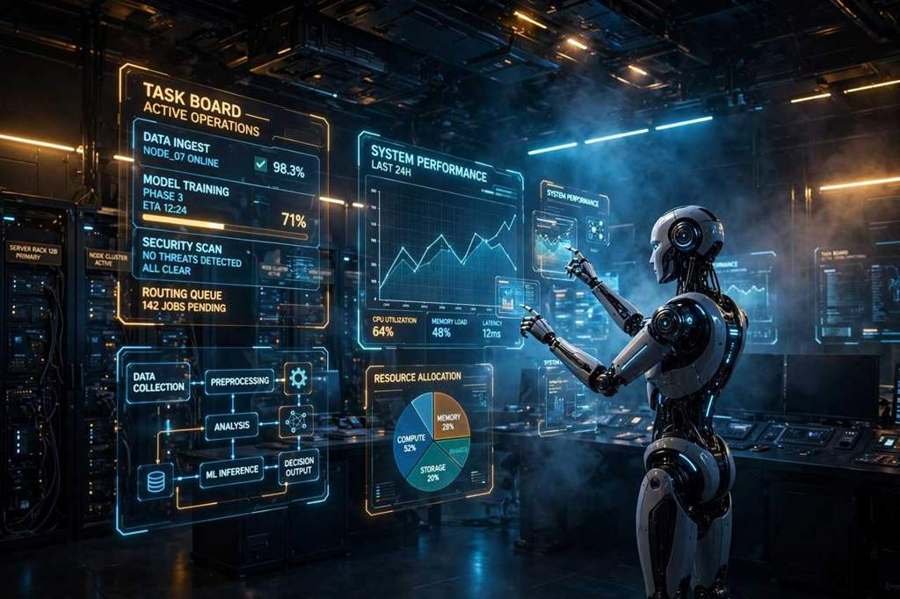
Every AI agent, from a simple scheduling helper to a complex multi-agent business system, runs the same basic loop. Researchers often describe it as a four-stage cycle: perceive, reason, act, and observe. Understanding this loop is the key to understanding both the power and the limits of the technology. This perceive-reason-act-observe loop is how AI agents 2026 operate.
Step 1: Perceive the Goal and the Environment
The agent starts by interpreting what you actually want. “Handle the Johnson contract” is not a command a script can execute — it requires understanding context: which Johnson, which contract, what “handle” means, what systems are involved. The agent gathers this context from your instructions, your connected data sources, and its memory of past interactions. In 2026, agents increasingly connect to business software through standardized protocols — the Model Context Protocol (MCP) has emerged as a common way for agents to discover and use tools — so perception extends well beyond the chat window into email, calendars, CRMs, and file systems.
Step 2: Reason and Plan the Steps
Once the goal is clear, the language model breaks it into a sequence of actions. This planning step is where modern agents differ most from old automation. A 2026-era agent does not follow a pre-written playbook; it generates the plan on the fly, considering dependencies (“I need the vendor quote before I can draft the comparison”), available tools (“I have email access but not the accounting system”), and constraints (“this step needs human approval”). For complex goals, agents create sub-plans and revise them as new information arrives.
Step 3: Act Through Tools and APIs
Planning means nothing without execution. In this stage the agent calls external tools: searching the web, querying a database, sending an email, creating a calendar event, running code, or updating a record in business software. Tool use is the breakthrough that turned language models into agents. Because these systems have persistent memory, they carry context across steps and sessions — they remember what they already tried, what worked, and what is still pending.
Step 4: Observe Results and Adjust
After each action, the agent checks the outcome. Did the API call succeed? Did the search return useful results? Did the draft meet the requirements? If something failed or produced an unexpected result, the agent revises its plan and tries a different approach. This feedback loop — act, observe, adjust — is what makes agents feel autonomous rather than scripted. It is also where things can go wrong: an agent that misreads a result can confidently pursue the wrong plan, which is why observability and human checkpoints matter.
AI Agents vs Chatbots: What’s the Difference
The distinction between AI agents and chatbots is the single most misunderstood point in the whole conversation around AI agents in 2026, so it is worth making precisely:
| Capability | Chatbot | AI Agent |
|---|---|---|
| Primary function | Answers questions in conversation | Pursues goals by taking actions |
| Initiative | Reactive — waits for your message | Proactive — plans multi-step work independently |
| Tool use | Limited or none | Uses APIs, databases, email, calendars, code |
| Memory | Usually limited to the current chat | Persistent across sessions and tasks |
| Output | Text responses | Completed work: bookings, reports, code, decisions |
| Supervision needed | Low — you read the answer | Medium — you review consequential actions |
The simplest version: a chatbot talks, an agent acts. Both use large language models, but the agent wraps the model in an action loop with tools, memory, and the authority to change things in the world. Grasping this difference is key to understanding AI agents 2026.
Types of AI Agents Used in 2026
Not all agents are equally autonomous. The field recognizes several categories, and knowing which type you are dealing with tells you how much supervision it needs. Choosing the right type matters when deploying AI agents 2026.
Reactive Task Agents
The simplest useful agents handle single, well-defined tasks: triaging an inbox, summarizing a document set, or monitoring a data feed for anomalies. They perceive a trigger, execute a short plan, and report back. Most consumer-facing “AI assistants” in 2026 are reactive task agents, and they are also the safest starting point for businesses.
Goal-Based Planning Agents
These agents accept open-ended objectives and generate their own multi-step plans, like the product-launch example from the introduction. They are the category most people mean when they say “AI agent” in 2026. They are also the category where reliability matters most, because a flawed plan compounds across steps — a wrong assumption in step two can corrupt everything that follows.
Multi-Agent Systems
Companies running agents in production increasingly favor this architecture because specialization makes each agent’s behavior more predictable — and predictability is what makes autonomous systems trustworthy.
Real-World Uses of AI Agents in 2026
Strip away the marketing, and AI agents are already doing measurable work in production environments. The clearest deployments include: These production deployments show AI agents 2026 delivering real ROI.
- Customer support. Support agents now resolve an estimated 50 to 65% of inquiries without human intervention, according to industry analyses citing Gartner and CB Insights data. Payment company Klarna has said its AI assistant handles work equivalent to 700 full-time agents.
- IT operations and incident triage. Triage agents route Level 1 incidents autonomously; PagerDuty has reported a 40% cut in mean time to resolution for Tier 1 incidents after deploying agentic incident response.
- Software development. Coding agents write, test, and debug code across repositories, review pull requests, and keep documentation in sync. In October 2026, Perplexity open-sourced SPACE, a microVM sandbox designed specifically for running AI agents safely — a sign of how seriously the industry now takes agent infrastructure.
- Finance and procurement. Finance agents reconcile multi-source data for faster forecasting; procurement agents search vendor databases, generate draft contracts, and schedule review meetings end to end.
- Research and analytics. Research agents gather sources, extract key figures, and assemble first-draft briefings — the kind of work that used to consume an analyst’s entire morning.
The October 2026 news cycle shows how fast the infrastructure is moving: Anthropic signed its first Canadian data center lease in Nova Scotia, DeepSeek released a faster and cheaper V4.1 Flash model while opening its search engine to developers, and Meta walked back controversial AI-scraping terms after publisher backlash. The compute, the models, and the rules of the road are all being negotiated at once.

Key Benefits of AI Agents for Businesses
When deployed well, AI agents 2026 deliver advantages that chatbots and traditional automation cannot match:
- They complete work, not just drafts. The output of an agent is a finished task — a scheduled campaign, a reconciled report, a resolved ticket — rather than text you still have to act on.
- They work across systems. Because agents use the same tools your team uses, they can carry a task from email to calendar to CRM without the handoffs where work usually stalls.
- They scale institutional knowledge. An agent trained on your procedures applies them consistently at any hour, which is why support and triage are the leading use cases.
- They free humans for judgment work. The honest pitch is not replacing people but removing the routine digital labor — data gathering, formatting, routing, scheduling — so people spend their time on decisions that actually need a human.
- They improve with guardrails. Agents deployed with approval checkpoints and audit logging get safer over time as teams learn exactly where delegation works and where it does not.
Risks and Limitations of AI Agents in 2026
The same autonomy that makes agents powerful makes them risky. Gartner has predicted that 40% of enterprise applications will feature task-specific AI agents by 2026 — a tenfold increase in a year — and security researchers are blunt that the guardrails have not kept pace. The main risks: Managing these risks is essential for anyone running AI agents 2026.
Prompt Injection Attacks
An agent that reads email, web pages, and documents can be manipulated by malicious content hidden inside them. A carefully crafted instruction buried in a webpage or an email can redirect the agent toward harmful actions — exfiltrating data, for example — while it believes it is following legitimate orders. This “indirect prompt injection” is the most discussed new attack class of 2026, and there is no complete fix yet; sandboxing and content filtering reduce but do not eliminate it.
Over-Privileged Tool Access
An agent can only damage what it can touch, which makes permissions the most important security decision in any deployment. An agent with write access to production databases, payment systems, or customer-facing channels can cause irreversible harm from a single misinterpreted instruction. India’s October 2026 report of AI agents from several labs wandering into live company systems is a reminder that boundary failures are not theoretical.
Cost Runaway and Reliability Gaps
Reasoning is expensive. An agent stuck in a loop — retrying a failing plan, over-thinking a simple task — can burn through API credits with nothing to show for it. And reliability remains the industry’s open wound: one March 2026 analysis put the AI-agent project stall rate at 89%, blaming premature scaling before orchestration, observability, and reliability infrastructure were in place. Fully autonomous multi-agent systems handling open-ended business processes are still a multi-year trajectory, not a solved problem.
7 Rules for Using AI Agents Safely
You do not need to avoid AI agents 2026 — you need to deploy them like the power tools they are. These seven rules are the consensus of 2026’s practitioner literature:
- Start with low-risk, reversible tasks. Scheduling, summarizing, and research are ideal first deployments. Do not begin with payments, legal text, or anything customer-facing.
- Give the minimum permissions the task requires. Read-only where possible; write access only to the specific systems the task needs. An agent should never hold broader access than the human doing the same job.
- Require human approval for consequential actions. Sending money, publishing content, deleting data, and contacting customers should pause for a human checkpoint. Most business deployments in 2026 already work this way.
- Log every significant action. Full audit trails — what the agent did, which tools it called, and why — are non-negotiable. When something goes wrong, the log is how you find out what happened.
- Set budget and time caps. Limit how much an agent can spend on API calls and how long it may run before reporting back. Caps turn cost runaway from a disaster into a notification.
- Sandbox untrusted content. Agents that read email and web content should process it in isolated environments, with strict rules about which instructions they are allowed to follow and from whom.
- Expand authority gradually. Begin with narrow tasks, measure the results, and widen the agent’s remit only where delegation demonstrably works. The goal is not to hand everything to AI — it is to learn exactly where the handoff succeeds.
The Future of AI Agents Beyond 2026
The direction of travel is clear: agents are moving from novelties to infrastructure. The open-source release of agent sandboxes, the emergence of standard tool protocols like MCP, and the steady march of enterprise adoption all point the same way. Gartner has even predicted that at least 80% of governments will deploy AI agents for routine decision-making by 2028. This shift to infrastructure defines AI agents 2026.
But the technology’s future will not be decided by intelligence alone. Cost, reliability, access to information, security, competition, and the rules governing automated decisions will matter just as much. NVIDIA’s CEO hinting in October 2026 that the company could cut chip supplies to unsafe AI developers shows that governance is becoming a supply-chain question, not just a software one. The central question is no longer whether AI can answer a question — it is whether AI can be trusted to act on the answer, and who remains responsible when it gets the decision wrong.
For background on the underlying concept, the Wikipedia overview of intelligent agents traces the idea from early AI research to today’s autonomous systems.
Frequently Asked Questions About AI Agents 2026
What is an AI agent in simple terms?
An AI agent is a software program that pursues a goal by taking actions in digital environments. It uses a large language model for reasoning, combined with tools, memory, and planning, so it can complete multi-step tasks — booking, researching, drafting, scheduling — instead of only answering questions. In short, AI agents 2026 turn goals into completed work.
How is an AI agent different from a chatbot?
A chatbot responds to messages one at a time within a conversation. An AI agent works through multi-step tasks independently, using tools like search, email, and business software along the way, checking its own results until the goal is complete. The key difference is action.
Can small businesses use AI agents?
Yes. Many agent capabilities are available through platforms that require no dedicated AI engineering team. Small businesses can start with narrow use cases — lead research, customer inquiry triage, document processing — then expand as they gain confidence and evidence of reliability.
Are AI agents safe?
They can be, with proper implementation: limited permissions, human approval for sensitive actions, monitoring, full action logging, and starting with low-risk tasks. The main risks are prompt injection, over-broad tool access, hallucinated plans, and cost runaway — all manageable with the guardrails described in this guide.
What does it cost to run AI agents?
Costs range from modest monthly subscriptions for off-the-shelf agents to six-figure budgets for custom enterprise systems with deep integrations and security review. The biggest cost variable is integration depth, not the AI model itself — plus the operational cost of the API usage, which is why budget caps matter.
Will AI agents replace human workers?
The realistic 2026 picture is task replacement, not job replacement: agents absorb routine digital labor — data gathering, formatting, routing, first-draft work — while humans keep judgment, relationships, and accountability. Organizations seeing the best results use agents to remove toil, not people.
Conclusion
AI agents 2026 represent a genuine shift in what software can do: from tools that wait for instructions to systems that pursue outcomes. The technology is already delivering measurable results in support, IT operations, development, and finance — and the infrastructure around it, from sandboxes to standard tool protocols, is maturing fast.
But autonomy without guardrails is a liability, not an asset. The organizations succeeding with AI agents share the same playbook: start narrow, grant minimum permissions, require human approval for consequential actions, log everything, and expand authority only where delegation proves itself. Follow that playbook and AI agents become what they promise to be — the most capable form of leverage knowledge workers have ever had. Skip it, and you join the 89% of projects that stall. The technology is ready for careful hands. Make sure yours are careful. Key takeaway: AI agents 2026 reward teams that start with low-risk tasks and keep humans in the loop for consequential decisions. Done right, AI agents 2026 turn routine digital labor into real leverage.
