


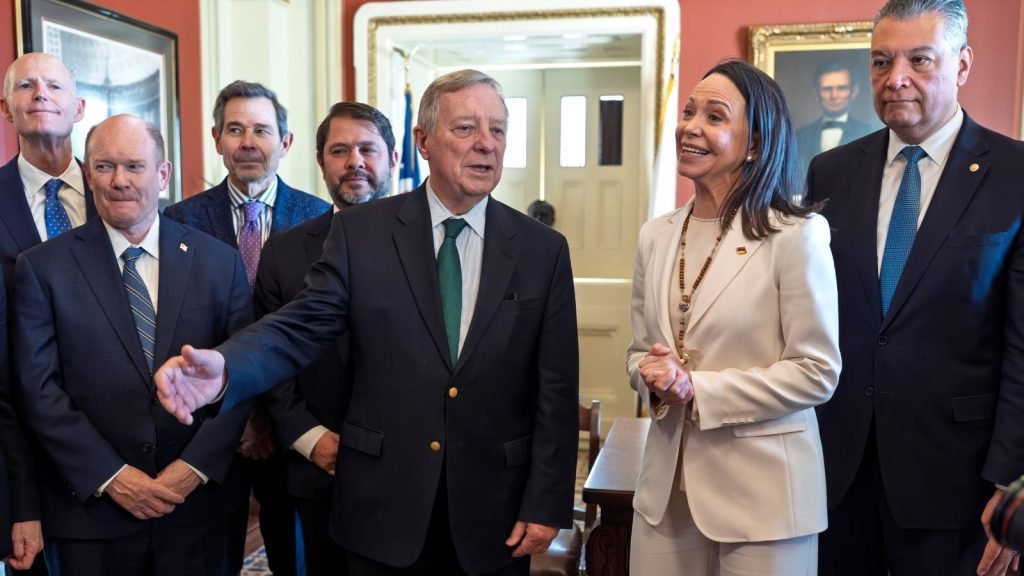
Opposition leader charged with symbolism and political calculation, Venezuelan opposition leader Maria Corina Machado presented her Nobel Peace Prize medal to U.S. President Donald Trump during a White House meeting on Thursday, a gesture that has ignited global debate about diplomacy, legitimacy, and the future of Venezuela.
The exchange took place in the Oval Office, where Trump and Machado met face-to-face for the first time. The meeting came at a pivotal moment for Venezuela, following the dramatic U.S.-led capture of longtime strongman Nicolás Maduro earlier this month, an operation that has reshaped the country’s political landscape almost overnight.
Trump later confirmed on social media that he would keep the gold Nobel medal, calling the gift “a wonderful gesture of mutual respect.” Machado, for her part, framed the act as recognition of Trump’s role in advancing what she described as “the freedom of the Venezuelan people.”
While the Nobel Peace Prize itself remains legally and symbolically Machado’s, as confirmed by the Norwegian Nobel Institute, the act of handing over the medal has taken on outsized political meaning, raising questions about power, gratitude, ambition, and the evolving relationship between Washington and Caracas.
The Oval Office Encounter: Optics and Intent
The meeting between Trump and Machado reportedly lasted just over an hour, a relatively lengthy Oval Office engagement that signaled the White House’s interest in hearing the opposition leader’s views, even as Trump has publicly expressed skepticism about her immediate political viability inside Venezuela.
A White House official confirmed that Trump intends to retain the medal, emphasizing that the gesture was accepted as a sign of respect rather than a claim to the prize itself.
Shortly after the meeting, Trump posted on his social media platform:
“Maria presented me with her Nobel Peace Prize for the work I have done. Such a wonderful gesture of mutual respect. Thank you, Maria!”The wording, while celebratory, carefully avoided claiming ownership of the prize — a notable distinction given Trump’s long history of expressing frustration at not receiving the Nobel Peace Prize himself.
Machado later described the meeting as “excellent,” though she declined to offer detailed remarks, fueling speculation about what was discussed behind closed doors.
Machado’s Calculated Gesture
For Machado, the decision to give Trump her Nobel medal was no spontaneous act. It was a deliberate and strategic move aimed at strengthening her standing with the most powerful political figure shaping Venezuela’s immediate future.
Since receiving the Nobel Peace Prize last month for her decades-long struggle against authoritarianism, Machado has become one of the most internationally recognized faces of Venezuela’s opposition. Yet recognition abroad has not automatically translated into uncontested authority at home.
By offering Trump the medal, the physical symbol of her moral legitimacy, Machado appeared to be signaling:
- Gratitude for U.S. intervention against Maduro
- Alignment with Trump’s vision for Venezuela
- A willingness to share symbolic capital to gain political leverage
In her brief public comments, Machado said the gift reflected Trump’s “commitment to freedom and democracy” and his role in opening a new chapter for Venezuela.
Trump and the Nobel Peace Prize: A Longstanding Obsession
Trump’s interest in the Nobel Peace Prize is no secret.
Over the years, he has repeatedly pointed to diplomatic achievements, including Middle East normalization efforts, negotiations with North Korea, and crisis interventions, as evidence that he deserved the honor. He has also openly complained about being overlooked, particularly when compared to former President Barack Obama, who received the prize early in his presidency.
Last month, Trump publicly praised Machado after she won the Nobel Prize, even suggesting that her victory reflected the success of U.S. pressure on authoritarian regimes. Yet he stopped short of congratulating her without qualification, later remarking to reporters that “a lot of people do great things, but the Nobel is very political.”
When asked earlier this week whether he wanted Machado to give him the prize, Trump told Reuters:
“No, I didn’t say that. She won the Nobel Peace Prize.”That statement now appears carefully calibrated in hindsight, as the medal transfer allowed Trump to symbolically associate himself with the Nobel legacy without formally claiming the award.
The Legal Reality: The Prize Cannot Be Transferred
Despite the headlines, the Norwegian Nobel Institute was quick to reiterate a crucial fact:
The Nobel Peace Prize cannot be transferred, shared, sold, or revoked.
Machado remains the sole laureate. The medal itself is a ceremonial object, and its transfer carries no legal or institutional meaning under Nobel statutes.
Still, history suggests that symbolic gestures often matter more than legal technicalities in politics. By accepting the medal, Trump has effectively tied his presidency and his Venezuela policy to Machado’s Nobel-backed moral authority.
Trump’s “Realistic” View of Venezuelan Leadership
Despite the warm optics, Trump has remained publicly cautious about Machado’s political future.
White House press secretary Karoline Leavitt said during Machado’s visit that while Trump “looked forward” to meeting her, he continues to believe she lacks the broad internal support necessary to lead Venezuela in the short term.
This assessment reflects a recurring tension:
- Machado is widely admired internationally
- Inside Venezuela, power dynamics remain fragmented
- The post-Maduro vacuum has created intense competition
Trump has previously dismissed the idea of immediately installing Machado as Venezuela’s leader, instead signaling support for a more gradual, coalition-based transition, one that protects U.S. strategic interests.
Venezuela After Maduro: A Nation in Flux
The capture of Nicolás Maduro earlier this month marked one of the most dramatic geopolitical developments in Latin America in decades.
The U.S.-led operation described by officials as a “snatch-and-grab” removed a figure who had ruled Venezuela with an iron grip for more than a decade. The fallout has been swift and chaotic:
- Rival opposition factions are jockeying for influence
- Interim governing arrangements remain unclear
- The military’s long-term loyalty is uncertain
- Millions of Venezuelans remain economically displaced
In this volatile environment, Machado is competing not only with remnants of Maduro’s apparatus but also with technocrats, military figures, and diaspora-backed leaders who see themselves as better positioned to stabilize the country.
Trump’s Strategic Priority: Venezuelan Oil
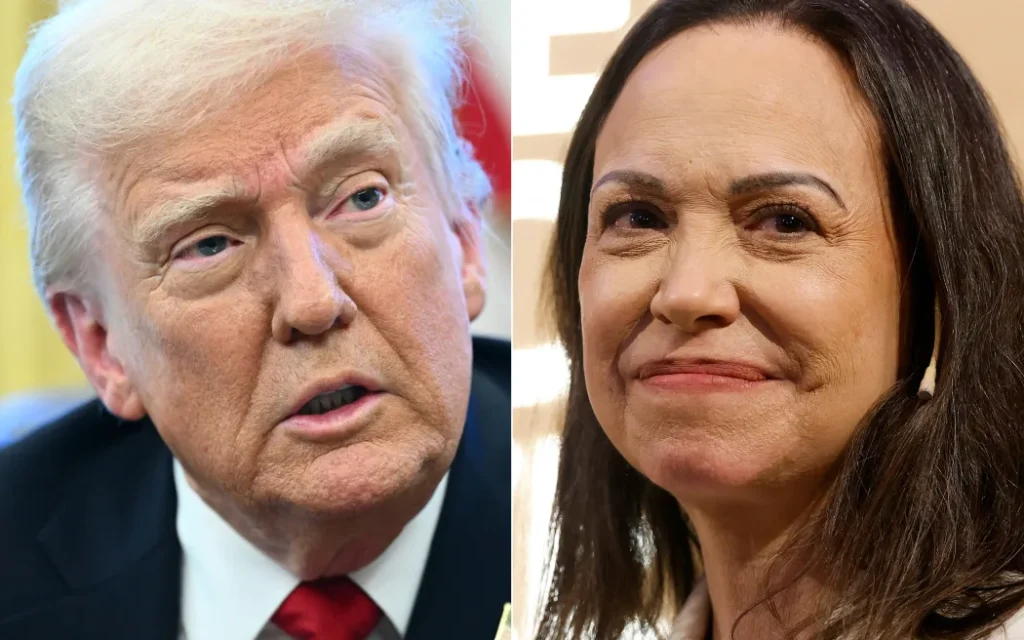
Beyond democracy and human rights, Trump’s Venezuela policy is shaped by a powerful economic reality: oil.
Venezuela possesses the world’s largest proven oil reserves, and Trump has made no secret of his desire to restore U.S. access to Venezuelan energy resources both to stabilize global markets and to reduce reliance on hostile suppliers.
Sources familiar with the administration’s thinking say Trump is focused on:
- Securing production guarantees
- Ensuring favorable terms for U.S. companies
- Preventing Chinese and Russian dominance in the sector
Machado, who favors market reforms and Western investment, aligns broadly with these goals — but she is not the only actor willing to make such promises.
Machado’s Daring Escape and Political Resurgence
Machado’s presence in Washington is itself remarkable.
In December, she fled Venezuela in a daring seaborne escape, evading security forces amid rising tensions. The dramatic exit only added to her international profile, reinforcing her image as a defiant opponent of authoritarian rule.
Since then, she has embarked on a high-profile diplomatic tour, meeting lawmakers, think tanks, and regional leaders. After her White House meeting, Machado held discussions with more than a dozen U.S. senators, both Republicans and Democrats, where she has generally found warmer support than in the executive branch.
A Divided Opposition and the Struggle for Legitimacy
The Venezuelan opposition has long been plagued by internal divisions, and Maduro’s removal has only intensified those fractures.
Key fault lines include:
- Exiled leaders vs. domestic organizers
- Civilian politicians vs. military-linked figures
- Gradual reformists vs. rapid-transition advocates
Machado’s Nobel Prize has elevated her standing, but critics argue that symbolic recognition does not automatically translate into administrative competence or popular consensus.
Trump, known for his transactional approach to politics, appears unwilling to fully commit to any single figure until a clearer power structure emerges.
International Reactions and Regional Implications
The medal handover has drawn mixed reactions across Latin America and beyond.
Supporters see it as:
- A powerful endorsement of U.S. intervention
- A recognition of Trump’s role in dismantling authoritarianism
- A hopeful sign for democratic restoration
Critics, however, argue that:
- The gesture politicizes the Nobel Prize
- It reinforces U.S. dominance over Venezuelan affairs
- It risks sidelining Venezuelan self-determination
Several regional leaders have urged caution, warning that Venezuela’s transition must not be dictated solely from Washington.
Read More: Trump sees Iranian crackdown easing, Tehran denies man to be executed
FAQs
Did Trump win the Nobel Peace Prize?
No. Maria Corina Machado is the official laureate. Trump received the physical medal as a symbolic gift.
Can a Nobel Prize be transferred?
No. The Norwegian Nobel Institute prohibits transferring, sharing, or revoking the prize.
Why did Machado give Trump the medal?
She said it was to honor his commitment to Venezuelan freedom and democracy and to acknowledge his role in recent events.
Does Trump support Machado as Venezuela’s next leader?
Not explicitly. He has said she lacks sufficient short-term domestic support.
What does Trump want from Venezuela?
Access to oil, regional stability, and reduced influence from rival powers like China and Russia.
Conclusion
The image of Maria Corina Machado handing her Nobel Peace Prize medal to Donald Trump will likely endure as one of the most striking political moments of 2026. To supporters, it symbolizes gratitude, alliance, and shared commitment to freedom. To critics, it underscores power imbalance, political theater, and the uneasy fusion of moral recognition with geopolitical ambition.
