


Few substances have shaped human civilization as profoundly and controversially as sugar. From fueling ancient trade routes to defining modern food systems, sugar has long been a cornerstone of the human diet and culture. Yet today, it is also one of the most scrutinized ingredients in the world, blamed for contributing to obesity, diabetes, cardiovascular disease, and widespread dental decay.
For decades, scientists, food manufacturers, and public health experts have searched for an alternative that could satisfy humanity’s deep-rooted craving for sweetness without triggering the health consequences associated with conventional sugar. Artificial sweeteners promised much but delivered mixed results. Natural alternatives improved perceptions but often fell short on taste, stability, or scalability.
Now, researchers at Tufts University believe they may be closer than ever to achieving what many call the “holy grail” of sugar substitutes: a sweetener that tastes almost exactly like table sugar, provides far fewer calories, has minimal impact on blood glucose, and may even offer benefits for oral and gut health.
At the center of this breakthrough is tagatose, a rare naturally occurring sugar that scientists have long viewed as promising but previously impractical to produce at scale. A newly developed biosynthetic method, published in Cell Reports Physical Science, could finally change that equation.
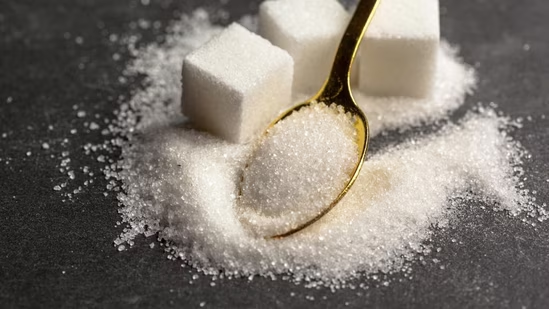
Why Sugar Is So Hard to Replace
To understand why this discovery is significant, it helps to understand why replacing sugar has been so difficult.
Sugar does far more than make food sweet. It affects:
- Texture and mouthfeel
- Caramelization and browning
- Preservation
- Fermentation
- Emotional satisfaction and satiety
Most sugar substitutes fail because they address only one aspect of sweetness while disrupting others.
Artificial sweeteners such as saccharin, aspartame, and sucralose are intensely sweet but often leave bitter or metallic aftertastes. Sugar alcohols like xylitol and erythritol cause digestive discomfort in some people. Natural sweeteners like stevia and monk fruit appeal to health-conscious consumers but lack sugar’s functional versatility in cooking and baking.
As a result, the food industry has struggled to find a substitute that can truly function as sugar’s equal.
A Century-Long Scientific Pursuit
The quest for a better sugar alternative is not new.
- Late 1800s: Saccharin becomes the first artificial sweetener
- Mid-1900s: Cyclamates and aspartame enter the market
- Late 20th century: Concerns over artificial sweeteners grow
- Early 2000s: Natural alternatives like stevia gain popularity
Each wave promised a breakthrough—and each came with trade-offs.
According to nutrition scientists, the ideal sweetener must meet five criteria:
- Taste nearly identical to sucrose
- Provide fewer calories
- Have minimal glycemic impact
- Be safe for long-term consumption
- Be affordable and scalable
Until now, no single sweetener met all five.
Enter Tagatose: A Rare but Remarkable Sugar
Tagatose is a monosaccharide that closely resembles fructose in structure but behaves very differently in the body.
Why Scientists Are Excited About Tagatose
- Taste: Nearly identical to table sugar
- Calories: About 38% of the calories of sucrose
- Glycemic response: Very low
- Dental health: Does not promote tooth decay
- Gut health: May act as a prebiotic
Unlike many sugar substitutes, tagatose is not synthetic. It occurs naturally, albeit in extremely small amounts.
Where Tagatose Occurs in Nature
Tagatose exists in trace quantities in:
- Milk and dairy products (when lactose breaks down)
- Fermented foods like yogurt and kefir
- Fruits such as apples, oranges, and pineapples
In most cases, tagatose makes up less than 0.2% of total sugars, making natural extraction impractical.
This scarcity has historically been the biggest obstacle to widespread use.
The Production Problem: Why Tagatose Never Took Off
Although tagatose was identified more than a century ago, producing it efficiently has always been difficult.
Traditional production methods relied on:
- Galactose, a relatively expensive and less abundant sugar
- Multiple enzymatic steps
- High energy inputs
- Low yields
As Nik Nair, associate professor of chemical and biological engineering at Tufts, explains:
“There are established processes to produce tagatose, but they are inefficient and expensive.”These limitations kept tagatose confined to small-scale applications and niche research.
The Breakthrough: Turning Bacteria into Sugar Factories
The Tufts University team approached the problem from a different angle: synthetic biology.
Instead of extracting tagatose from nature, they asked:
What if we could teach microorganisms to make it for us?
Engineering E. coli for Sweetness
The researchers genetically engineered Escherichia coli, a well-studied bacterium, to function as a microscopic factory capable of converting abundant glucose into tagatose.
Key advantages of this approach:
- Glucose is cheap and widely available
- The process uses fewer steps
- Higher yields reduce cost
- Scalable for industrial production
“We developed a way to produce tagatose by engineering bacteria to process abundant glucose into tagatose,” Nair explained. “This is far more economically feasible.”Why This Method Changes Everything
This biosynthetic method addresses the biggest barriers that previously held tagatose back:
| Challenge | Old Methods | New Method |
| Raw material | Expensive | Abundant glucose |
| Yield | Low | High |
| Cost | Prohibitive | Potentially affordable |
| Scalability | Limited | Industrially viable |
For the first time, tagatose could realistically be produced at scale, making it suitable for mainstream food manufacturing.
Health Benefits: More Than Just Fewer Calories
Blood Sugar Control
Tagatose is absorbed slowly and metabolized differently than sucrose, resulting in:
- Minimal blood glucose spikes
- Reduced insulin response
This makes it particularly appealing for people with diabetes or insulin resistance.
Weight Management
With fewer calories and slower digestion, tagatose may help:
- Reduce total caloric intake
- Improve satiety
- Lower risk of weight gain
Oral Health
Unlike sucrose, tagatose does not fuel cavity-causing bacteria in the mouth. Some studies suggest it may even inhibit harmful oral microbes.
Gut Health
Tagatose may act as a prebiotic, nourishing beneficial gut bacteria and supporting digestive health.
Taste: The Deciding Factor
For consumers, health benefits mean little if taste disappoints.
In sensory studies, tagatose has repeatedly scored very close to sucrose, without the bitterness or aftertaste common to other sweeteners.
This makes it uniquely suited for:
- Baked goods
- Beverages
- Dairy products
- Confectionery
- Sauces and condiments
Food Industry Implications
If tagatose production becomes cost-effective, it could transform the global food system.
Potential Applications
- Reduced-sugar soft drinks
- Healthier desserts
- Diabetic-friendly foods
- Children’s snacks with lower cavity risk
Major food companies are closely watching developments, as pressure mounts to reduce added sugars worldwide.
Regulatory and Safety Considerations
Tagatose is already approved for limited use in several regions, including recognition as generally safe in certain applications.
However, widespread adoption will require:
- Expanded safety studies
- Regulatory approvals across markets
- Clear labeling standards
Environmental Impact
Compared to sugar cane and corn syrup production, microbial biosynthesis may:
- Use less land
- Consume less water
- Reduce agricultural emissions
This aligns with broader sustainability goals in food production.
Ethical and Public Perception Challenges
As with any genetically engineered process, public acceptance will be critical.
Although the final product contains no live bacteria, transparency about production methods will be essential to avoid consumer mistrust.
What Still Needs to Be Solved
Despite the excitement, challenges remain:
- Scaling production efficiently
- Ensuring consistent taste and stability
- Competing on price with subsidized sugar
- Navigating regulatory pathways globally
The Bigger Picture: Rethinking Sweetness
This breakthrough reflects a broader shift in food science from replacing sugar outright to reengineering sweetness itself.
Instead of artificial shortcuts, researchers are now harnessing biology to mimic nature more closely.
Read More: The Best Time to Eat Dates for Energy and Digestion
FAQs
What is tagatose?
Tagatose is a naturally occurring sugar that tastes like sucrose but has fewer calories and a lower glycemic impact.
Is tagatose artificial?
No. It is a real sugar found in small amounts in nature, though produced industrially.
Is it safe for diabetics?
Early research suggests it is suitable for people managing blood sugar, but medical advice is recommended.
Will it replace sugar completely?
Unlikely. It may significantly reduce sugar use rather than eliminate it.
Does it cause digestive issues?
Most studies suggest good tolerance, especially compared to sugar alcohols.
Conclusion
For over a century, humanity has searched for a way to enjoy sweetness without paying the metabolic price. The discovery of an efficient, scalable method to produce tagatose may finally bring that vision within reach. While challenges remain, this breakthrough represents a major milestone in food science, one that could reshape how we think about sugar, health, and sustainability
