


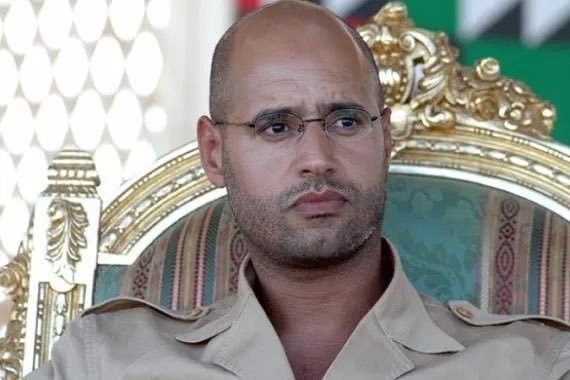
Saif al-Islam Gaddafi, the son of Libya’s former ruler Colonel Muammar Gaddafi and once the most prominent political figure of the Gaddafi dynasty after his father, has reportedly been shot dead, according to Libyan and international media.
The death of the 53-year-old figure long regarded as both a potential reformer and a symbol of the brutal repression that defined the final years of his father’s rule was confirmed on Tuesday by the head of his political team, according to the Libyan News Agency. However, competing versions of events and the absence of independent verification have underscored the uncertainty surrounding the circumstances of his reported killing.
His lawyer told the AFP news agency that Saif al-Islam was assassinated at his home in the western Libyan city of Zintan by a four-man commando unit. In contrast, his sister told Libyan television that he died near Libya’s border with Algeria, raising questions about where he was at the time of his death and who may have been responsible.
If confirmed, Saif al-Islam Gaddafi’s death would mark the symbolic end of the Gaddafi family’s direct involvement in Libya’s political future and could have far-reaching implications for a country still fractured more than a decade after the collapse of the regime that ruled it for over 40 years.
A Figure Who Loomed Over Post-Gaddafi Libya
For years after the overthrow and killing of Muammar Gaddafi during the 2011 uprising, Saif al-Islam remained one of the most enigmatic and controversial figures in Libya.
To supporters of the former regime, he represented continuity, stability, and a lost era of national unity. To his critics, he embodied impunity, repression, and the unaddressed crimes of the past.
Even in the absence imprisoned, hidden, or politically sidelined, Saif al-Islam’s name carried weight. His reported death, therefore, resonates far beyond the immediate circumstances of the alleged assassination.
Conflicting Accounts of His Death
Confirmation From Political Associates
According to the Libyan News Agency, the head of Saif al-Islam’s political team confirmed his death on Tuesday. The statement did not immediately provide details regarding the location, timing, or perpetrators of the shooting.
This confirmation was treated by Libyan media as significant, given the political team’s longstanding role in coordinating Saif al-Islam’s limited public engagements and legal defense.
Lawyer’s Account: Assassination in Zintan
In a separate account, Saif al-Islam’s lawyer told AFP that his client was killed in a targeted assassination at his home in Zintan, a mountain city in western Libya.
According to the lawyer:
- A four-man commando unit carried out the attack
- The shooting occurred at Saif al-Islam’s residence
- The perpetrators fled the scene
The lawyer did not identify who might have ordered or carried out the assassination, nor did he provide evidence linking the attackers to a specific militia, government, or foreign actor.
Family Version: Death Near the Algerian Border
Adding to the confusion, Saif al-Islam’s sister told Libyan television that he died near Libya’s border with Algeria a claim that directly contradicts the account of a killing in Zintan.
Libyan analysts say such discrepancies are not uncommon in a country where weak institutions, rival armed groups, and fragmented authority often make reliable information difficult to obtain.
Who was Saif al-Islam Gaddafi?
Early Life and Education
Born in 1972, Saif al-Islam Gaddafi was the second-youngest son of Muammar Gaddafi and was widely regarded as the most politically influential of the former leader’s children.
Unlike some of his siblings, Saif al-Islam received a Western education and cultivated an image as a modernizer:
- He studied architecture and engineering
- He earned a PhD in philosophy
- He spoke fluent English and moved comfortably in Western political and academic circles
This background helped shape his reputation as the possible bridge between his father’s authoritarian rule and a more open Libya.
The Heir Apparent In All but Name
Although Muammar Gaddafi insisted that Libya was a “state of the masses” without formal succession, Saif al-Islam was widely seen as the de facto heir.
His Influence Inside the Regime
Despite holding no official government position, Saif al-Islam:
- Shaped key domestic policies
- Led sensitive diplomatic negotiations
- Acted as an intermediary with Western governments
Foreign diplomats and analysts often described him as the most influential person in Libya after his father.
Architect of Libya’s Rapprochement With the West
From around 2000 onward, Saif al-Islam played a central role in Libya’s attempt to re-enter the international community after years of sanctions and isolation.
Key Achievements
He was involved in negotiations that led to:
- Libya is abandoning its nuclear weapons programme
- Compensation for victims of past terrorist attacks
- The lifting of international sanctions
These moves transformed Libya’s relations with the United States and Europe and opened the door to foreign investment.
Some Western officials and academics came to see Saif al-Islam as a reformist figure — an “acceptable face” of a changing Libya.
The Arab Spring and the Collapse of the Gaddafi Regime
From Reformer to Enforcer
When anti-government protests erupted in Libya in early 2011, Saif al-Islam’s image shifted dramatically.
In a televised speech that shocked many observers, he warned protesters of chaos, civil war, and bloodshed if the regime fell, remarks that critics later cited as evidence of his role in repression.
Human rights groups accused him of:
- Encouraging violent crackdowns
- Playing a key role in suppressing dissent
These allegations would later form the basis of international legal action against him.
Capture, Imprisonment, and Legal Limbo
Arrest by Zintan Militia
After the fall of Tripoli and the killing of Muammar Gaddafi in October 2011, Saif al-Islam attempted to flee Libya but was captured by a militia in Zintan.
He was held there for nearly six years, largely beyond the control of Libya’s central authorities.
International Criminal Court Charges
The International Criminal Court (ICC) sought Saif al-Islam’s arrest and trial on charges of crimes against humanity, accusing him of involvement in the violent suppression of protesters.
Libya’s post-revolutionary authorities argued that he should be tried domestically, but legal proceedings remained stalled amid political chaos.
Death Sentence and Amnesty
In 2015, a court in Tripoli sentenced Saif al-Islam to death in absentia for his role in the 2011 crackdown. At the time, the court operated under the authority of the UN-backed government in western Libya.
However:
- He was not present in court
- His Zintan captors refused to hand him over
In 2017, a rival authority in eastern Libya announced his release under an amnesty law, further highlighting the country’s fragmented legal system.
Libya’s Fragmented State
Since the overthrow of the Gaddafi regime, Libya has struggled to form a unified government.
A Country Divided
Libya is currently:
- Split between rival administrations
- Dominated by competing militias
- Lacking a unified national army
This fragmentation has allowed figures like Saif al-Islam to remain politically relevant despite legal rulings and international warrants.
A Surprise Political Comeback Attempt
In 2021, Saif al-Islam announced he would run for president in Libya’s long-delayed elections — a move that stunned many observers.
Although the elections were later postponed indefinitely, his candidacy demonstrated:
- Continued support among some Libyans
- Nostalgia for the pre-2011 era
- Deep dissatisfaction with the post-revolution political order
What His Reported Death Means for Libya
If confirmed, Saif al-Islam Gaddafi’s death could have profound implications.
Political Impact
- Ends any realistic prospect of a Gaddafi-linked political comeback
- Removes a unifying figure for former regime loyalists
- Alters the balance among Libya’s rival factions
Symbolic Significance
For many Libyans, Saif al-Islam represented unresolved questions about justice, reconciliation, and accountability.
His death may close one chapter but without resolving those deeper issues.
Read More: US shoots down Iranian drone ‘aggressively’ approaching aircraft carrier, official says
International Reactions and Unanswered Questions
As of now, no official statements have been issued by Libya’s rival governments, and international reactions remain cautious.
Key unanswered questions include:
- Who ordered the killing?
- Was it politically motivated?
- Could it trigger retaliation or unrest?
FAQs
Was Saif al-Islam Gaddafi officially confirmed dead?
His death was confirmed by the head of his political team, but details remain disputed.
Where did he die?
Accounts differ: his lawyer says he was killed in Zintan, while his sister says he died near the Algerian border.
Who killed him?
No group or individual has claimed responsibility.
Was he still wanted by the ICC?
Yes, the ICC sought his trial for crimes against humanity.
Did he have political support?
Yes, particularly among Libyans dissatisfied with post-2011 instability.
Conclusion
Saif al-Islam Gaddafi lived in the shadow of one of the Middle East’s most polarizing leaders and died amid the same uncertainty and division that have defined Libya since 2011. Once hailed as a reformer, later condemned as an enforcer, and ultimately recast as a symbol of unfinished justice, his life mirrors Libya’s own turbulent journey.
