


As the second phase of the United States–brokered ceasefire in Gaza formally begins, President Donald Trump has issued a new and forceful ultimatum to Hamas, intensifying international pressure on the Palestinian armed group to surrender its weapons and return the remains of the final Israeli captive believed to be in its custody. The intervention comes at a moment of deep fragility, with core elements of the first phase of the truce still only partially implemented and the humanitarian situation in Gaza continuing to deteriorate.
In a late-night statement posted on his Truth Social platform, Trump framed the moment as a decisive turning point, warning Hamas that refusal to comply with disarmament demands would carry severe consequences. His message underscored a sharp escalation in rhetoric, signalling that the focus of US diplomacy has moved beyond halting hostilities toward reshaping Gaza’s political, military, and administrative future.
“Hamas must IMMEDIATELY honor its commitments, including the return of the final body to Israel, and proceed without delay to full demilitarization,” Trump wrote. “As I have said before, they can do this the easy way or the hard way.”
The statement has reverberated across the region, heightening tensions between Hamas, Israel, and international mediators just as negotiations enter their most contentious phase.
A Ceasefire Under Strain
The ceasefire, which came into effect in October last year following months of devastating warfare, was designed as a multi-stage process. The first phase focused on halting large-scale combat operations, securing limited prisoner exchanges, and facilitating the entry of humanitarian aid. While violence has reduced compared with the height of the war, the truce has remained fragile and uneven.
Israeli military operations have continued in a more limited form, and Palestinian medical authorities report that at least 451 Palestinians have been killed since the ceasefire began. Airstrikes, targeted raids, and sporadic exchanges of fire have persisted, particularly in central and southern Gaza, undermining confidence in the durability of the agreement.
Against this backdrop, the launch of the second phase marks a shift from crisis management to long-term transformation. The stated goals now include the disarmament of Hamas, the withdrawal of Israeli forces from key areas, the expansion of humanitarian access, and the creation of a transitional governance framework to oversee Gaza’s reconstruction and political future.
It is this second phase, particularly the question of Hamas’s weapons, that has proven most divisive.
The Central Dispute: Disarmament of Hamas
Hamas has categorically rejected calls to disarm, viewing its weapons as both a symbol of resistance and a guarantee of political relevance. For the group, surrendering arms without a sovereign Palestinian state or firm security guarantees would amount to political suicide.
Trump, however, has made clear that disarmament is non-negotiable. US officials say the plan envisages the complete surrender of Hamas’s heavy weaponry, including rockets, mortars, and anti-tank systems, alongside the dismantling of its extensive tunnel network beneath Gaza.
According to sources familiar with the discussions, Washington is exploring a multi-layered approach. This would include regional backing from Egypt, Turkey, and Qatar, countries that maintain varying degrees of influence over Hamas, as well as international monitoring mechanisms to verify compliance.
One of the more controversial proposals under consideration is a so-called “buy-back” programme for small arms. Under this scheme, individuals would be offered financial compensation in exchange for surrendering rifles, pistols, and machine guns. While proponents argue this could reduce the proliferation of weapons at the community level, critics question whether such a programme could meaningfully weaken an organised militant movement.
No detailed enforcement mechanism has yet been publicly outlined, raising doubts about how disarmament could realistically be achieved without renewed conflict.
The Question of the Final Israeli Captive
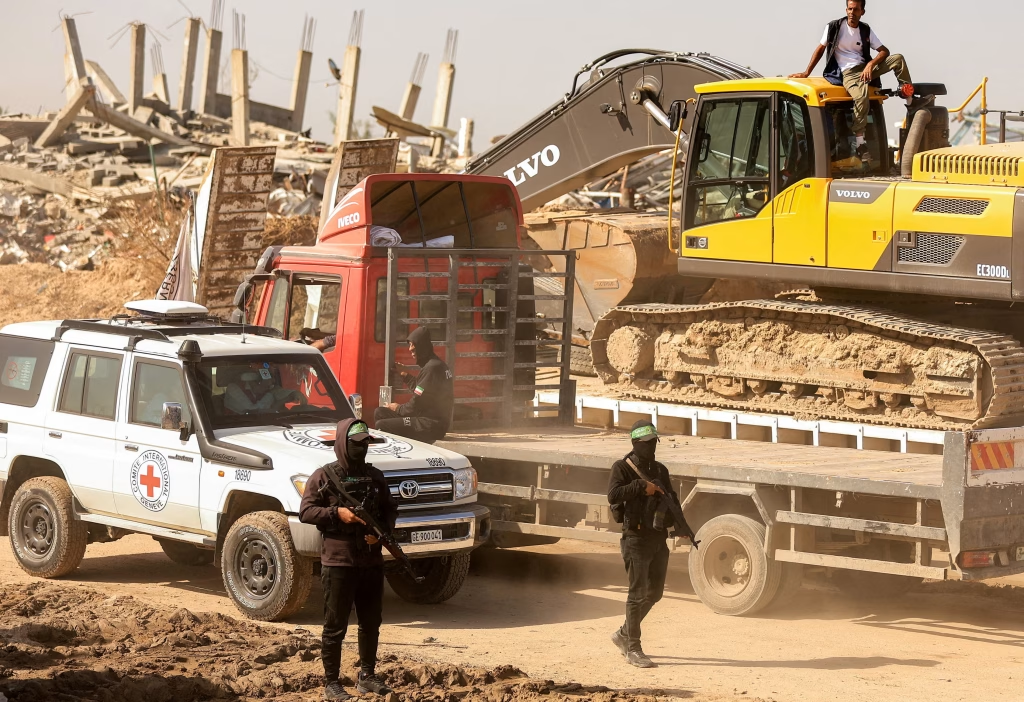
Trump’s ultimatum also renewed focus on the fate of the last Israeli captive whose remains are believed to be held by Hamas. The issue carries immense emotional and political weight in Israel, where the return of captives alive or dead has been a central demand throughout the conflict.
Israeli officials have accused Hamas of deliberately withholding the remains as leverage, while Hamas insists that the issue is tied to broader negotiations over prisoners, ceasefire terms, and guarantees for Gaza’s future.
By publicly linking the return of the remains to disarmament, Trump has raised the stakes, signalling that symbolic and humanitarian gestures alone will no longer suffice in the absence of structural concessions.
Governance and the “Board of Peace”
Perhaps the most ambitious and controversial element of the second phase is the proposed governance framework for Gaza. Trump has announced plans to chair what has been described as a “board of peace,” tasked with overseeing reconstruction, economic recovery, and the political transition in the territory.
According to multiple diplomatic sources, the initiative would operate alongside a separate executive board expected to include former UK prime minister Tony Blair, Trump’s senior advisers Jared Kushner and Steve Witkoff, and Nickolay Mladenov, a former United Nations Middle East envoy who is likely to assume a central operational role on the ground.
At the Palestinian level, the board would supervise a 15-member technocratic body known as the National Committee for the Administration of Gaza (NCAG). Formally designed to be apolitical, the committee is intended to manage civil affairs during the transition period, sidelining both Hamas and traditional Palestinian factions.
Ali Shaath, a former deputy minister in the Palestinian Authority, has been appointed to lead the NCAG. Supporters argue that technocratic governance is the only viable path to stabilisation, while critics warn that excluding established political actors risks undermining legitimacy and sustainability.
A Territory in Ruins
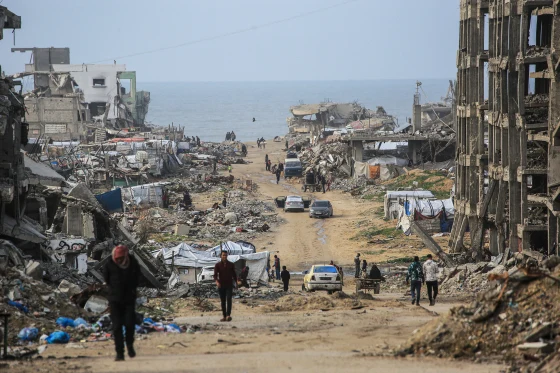
The scale of devastation in Gaza poses an almost unimaginable challenge. The United Nations estimates that reconstruction will cost more than $70bn (£53bn) and could take decades to complete.
After visiting Gaza this week, Jorge Moreira da Silva, UN undersecretary general and executive director of the UN Office for Project Services, described the destruction as unprecedented in his experience.
“The level of destruction is overwhelming,” he said. “Homes, schools, clinics, roads, water, and electricity systems have been levelled or severely damaged.”
According to UN figures, Gaza is now buried under more than 60 million tonnes of rubble—the equivalent capacity of nearly 3,000 container ships. On average, each resident is surrounded by approximately 30 tonnes of debris. Clearing the rubble alone is expected to take more than seven years.
While the announcement of the second phase has raised hopes that reconstruction might finally begin, UN officials stress that early recovery efforts, such as restoring water, electricity, and basic healthcar,e cannot wait.
Continuing Violence and Humanitarian Crisis
Despite the ceasefire, life in Gaza remains precarious. On Thursday, medical sources at al-Aqsa Martyrs Hospital in Deir al-Balah reported that six Palestinians were killed in two Israeli airstrikes. Such incidents, though fewer than before, continue to puncture claims of stability.
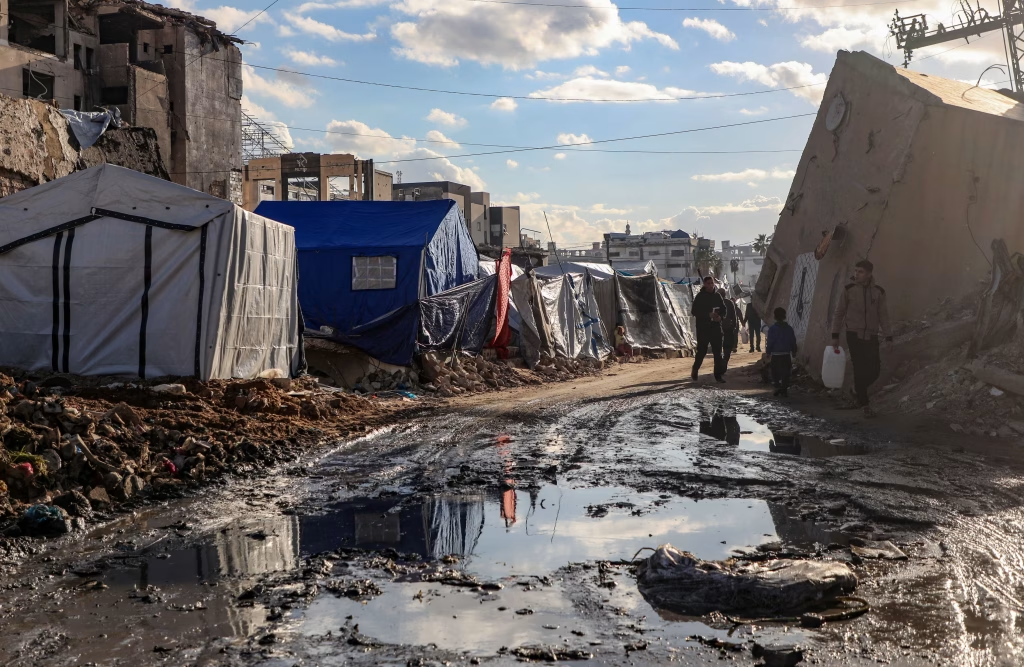
Compounding the crisis, severe winter storms have devastated displacement camps across the territory. Strong winds and heavy rain have caused makeshift shelters to collapse, killing at least four people earlier this week. Flooding has spread disease and contaminated scarce water supplies.
Unicef reported that at least 100 children have been killed since the ceasefire began, including six who died from hypothermia, an indictment, aid agencies say, of the dire living conditions facing Gaza’s youngest residents.
International Reactions and Regional Stakes
Reactions to Trump’s ultimatum have been mixed. Israeli leaders have broadly welcomed the emphasis on disarmament, viewing it as essential to long-term security. Arab governments, while supportive of a ceasefire, have expressed concern that forced demilitarisation without a political horizon could reignite violence.
European officials have urged caution, stressing the need for inclusive political dialogue and adherence to international law. Humanitarian organisations warn that prioritising security objectives over civilian protection risks prolonging suffering.
For regional actors such as Egypt and Qatar, the coming weeks will be critical. Both countries have invested heavily in mediation efforts and now face the challenge of reconciling US demands with Hamas’s entrenched positions.
Read More: Trump accepts Nobel medal from Venezuelan opposition leader Machado
FAQs
Why is Hamas disarmament central to the second phase of the ceasefire?
The US and Israel argue that lasting peace is impossible while Hamas retains military capability. Disarmament is seen as essential to preventing renewed conflict and enabling reconstruction.
Has Hamas ever agreed to disarm before?
No. Hamas has consistently rejected disarmament, viewing its weapons as integral to resistance and political leverage.
What is the proposed weapons “buy-back” programme?
It is a plan under consideration whereby individuals would receive money in exchange for surrendering small arms. Its effectiveness remains highly disputed.
What is the “board of peace”?
It is a proposed international body, chaired by Trump, intended to oversee Gaza’s transition, reconstruction, and governance during the post-conflict period.
How severe is the humanitarian situation in Gaza?
Extremely severe. Tens of thousands remain displaced, infrastructure is largely destroyed, and basic services such as water and electricity are scarce.
Is the ceasefire holding?
Partially. Large-scale fighting has decreased, but airstrikes, raids, and civilian deaths continue.
What role does the UN play?
The UN is involved in humanitarian relief, damage assessment, and early recovery planning, but it does not control security or political decisions.
Conclusion
The launch of the second phase of the Gaza ceasefire represents a defining and perilous moment. President Trump’s renewed ultimatum to Hamas underscores a shift from crisis containment to structural transformation, one that seeks not only to end violence but to reshape the political and security landscape of Gaza entirely .Yet the path forward is fraught with uncertainty. Disarmament without consensus risks renewed war; reconstruction without political legitimacy risks collapse; and governance imposed from outside risks rejection by the population it seeks to serve.
