


Vietnam Travel Guide 2026: Best Time to Visit, Costs and Itinerary Tips
Vietnam welcomed a record 21.2 million international visitors in 2025 and is targeting 25 million in 2026 — and it is easy to see why. This Vietnam travel guide 2026 covers everything a first-timer needs: the 90-day e-visa rules, the best month to visit each region of this 1,600-kilometer-long country, real daily budgets in dollars and dong, the must-see destinations from Hanoi to Phu Quoc, and a practical 14-day itinerary. All figures are drawn from 2026 travel research, not guesswork.
One of Vietnam’s biggest advantages is how well it pairs with its neighbors. The 90-day multiple-entry e-visa lets you hop over to Cambodia’s Angkor Wat or Thailand and return without new paperwork — and our Thailand travel guide 2026 shows exactly how to combine both countries into one Southeast Asia trip.
Vietnam Travel Guide 2026: Visa and Entry Rules
Vietnam’s visa system is more generous than it has ever been. Since August 2023, citizens of virtually every country can apply for an electronic visa valid for up to 90 days with single or multiple entries — a reform this Vietnam travel guide 2026 confirms is still fully in force for 2026 travel.
The 90-Day E-Visa: Your Main Option
- Validity: up to 90 days from your stated arrival date, single or multiple entry.
- Cost: US$25 for single entry, US$50 for multiple entry — paid online, non-refundable even if refused.
- Where to apply: only through the Immigration Department’s official portal, evisa.gov.vn. Lookalike sites charge extra fees; the official portal is the only safe route.
- Processing: 3–5 business days standard; apply at least two weeks ahead in the December–February peak season.
- Entry port: you must enter through the port listed on your visa (e.g., Noi Bai Airport in Hanoi, Tan Son Nhat in Ho Chi Minh City, Da Nang airport, or land borders like Moc Bai to Cambodia).
The multiple-entry version is the smart pick for regional travelers: visit Vietnam, fly to Thailand or Cambodia, and re-enter freely within your 90-day window. Note that tourist e-visas generally cannot be extended inside Vietnam — overstaying brings heavy fines and possible blacklisting.
45-Day Visa-Free Entry
Citizens of around 13–22 countries — including the UK, France, Germany, Spain, Italy, Japan and South Korea — can enter visa-free for up to 45 days per entry. The old rule forcing a 30-day gap between visa-free entries has been abolished, so you can exit and re-enter immediately. Phu Quoc island additionally offers its own 30-day visa exemption.
| Option | Stay | Entries | Cost | Best for |
|---|---|---|---|---|
| E-visa (single) | Up to 90 days | 1 | US$25 | One continuous Vietnam trip |
| E-visa (multiple) | Up to 90 days per entry | Unlimited | US$50 | Multi-country Southeast Asia trips |
| Visa-free (eligible nationalities) | 45 days | Multiple, no gap rule | Free | Short European/Japanese/Korean trips |
| Phu Quoc exemption | 30 days | Island only | Free | Beach-only holidays |
Best Time to Visit Vietnam in 2026
Vietnam stretches over 1,600 kilometers, so its weather varies more by region than by season — there is always somewhere with good weather. The single biggest planning mistake this Vietnam travel guide 2026 can help you avoid is treating the whole country as one climate.
| Region | Best months | Avoid |
|---|---|---|
| North (Hanoi, Ha Long Bay, Sapa) | October–April (peak: Oct–Nov, Mar–Apr) | May–September (hot, humid, rainy) |
| Central (Hue, Hoi An, Da Nang) | February–August (sweet spot: Feb–May) | September–December (typhoons, floods Oct–Nov) |
| South (Ho Chi Minh City, Mekong Delta, Phu Quoc) | December–April (dry season) | May–November (wet season afternoons) |
North Vietnam: October to April
October–November is widely considered the finest window for Hanoi: cool, dry days perfect for walking the Old Quarter and the lakes. December–February brings damp, chilly weather — Ha Long Bay turns misty and poetic but visibility drops, and Sapa in the mountains can approach freezing, so pack layers. March–April is the other sweet spot, with comfortable temperatures and the countryside at its greenest.
Central Vietnam: February to May
The central coast — Hue, Da Nang, Hoi An — dries out from February, offering idyllic beach weather through August. This is the critical region to time correctly: from September to December, typhoons and flooding hit the central coast, with October and November the worst months. Do not plan a Hoi An beach trip in October without checking forecasts.
South Vietnam: December to April
Ho Chi Minh City, the Mekong Delta and Phu Quoc enjoy warm, sunny dry-season weather from December to April. The May–November wet season means daily afternoon downpours rather than all-day rain — travel is still very possible, and prices drop. For a classic north-to-south trip covering all three regions, March to April is the best compromise month in 2026.
How Much Does a Vietnam Trip Cost in 2026?
Vietnam remains one of Asia’s best-value destinations, and this Vietnam travel guide 2026 prices everything in both dollars and dong so you can plan on the ground. 2026 guides put daily costs roughly 12–40% higher than 2024 as record arrivals pushed accommodation prices up. The dong trades around ₫26,000 to US$1 (late 2026), so a ₫1,000,000 note is only about $38 — watch the zeros. All figures below exclude international flights, the e-visa fee and travel insurance.
| Travel style | Per day (USD) | Per day (VND) | What it includes |
|---|---|---|---|
| Backpacker | $25–50 | 600,000–1,200,000 | Hostel dorm, street food, sleeper buses, GrabBike |
| Mid-range | $60–130 | 1,550,000–3,360,000 | Private 3-star room, mixed dining, Grab cars, daily activity |
| Comfort | $80–150+ | 2,000,000–4,000,000+ | 4-star hotels, private transfers, two activities daily |
What Things Actually Cost
- Bowl of phở: ₫40,000–50,000 (about $1.50–1.90); a street-cart bánh mì runs ₫20,000–50,000.
- Hostel dorm bed: $8–15 a night in Hanoi’s Old Quarter or Hoi An.
- 3-star hotel: $35–70 a night; a 4-star double in Hanoi’s Old Quarter runs about $42–62.
- Hanoi airport to the city: Bus 86 costs ₫45,000 (cash, ~50 minutes) versus $23–25 for a metered taxi.
- Domestic flights: Hanoi to Da Nang on VietJet costs around $45 one-way — book 3+ weeks ahead.
- Hanoi to Sapa night bus: about $18 (₫400,000) — and you save a night’s accommodation.
- 30-day tourist SIM: $4–8 with generous data.
For two weeks on the ground, budget roughly $350–550 (9–16 million VND) backpacker or $900–1,400 (22–35 million VND) mid-range, per person. Prices jump 35–50% during July–August and the Tet holiday (late January/early February 2026) — book at least four weeks ahead for those periods.
Top Places to Visit in Vietnam in 2026
From karst seascapes to lantern-lit old towns, this Vietnam travel guide 2026’s must-see list covers the destinations that define a Vietnam trip:
Hanoi — The Capital
Start in the 1,000-year-old capital: the chaotic Old Quarter, Hoan Kiem Lake at dawn, the Temple of Literature, and arguably the country’s best street food — phở, bún chả and egg coffee. Two to three days is ideal.
Ha Long Bay — The Icon
The UNESCO-listed bay of nearly 2,000 limestone islands is Vietnam’s signature sight. An overnight cruise (from about $80–150 mid-range) beats a rushed day trip — you get sunset, sunrise and a kayak session among the karsts.
Ninh Binh — “Ha Long Bay on Land”
Two hours south of Hanoi, Ninh Binh’s river valleys wind between the same limestone karsts. Row through Tam Coc’s caves, cycle between rice paddies, and climb to the Mua Cave viewpoint at sunset. One of Vietnam’s best-value stops.
Sapa — Mountain Terraces
In the far north, Sapa’s terraced rice fields and ethnic-minority villages (Hmong, Dao) offer Vietnam’s best trekking. Visit September–November for golden harvest terraces; winter brings mist and cold. The overnight train or sleeper bus from Hanoi is part of the experience.
Hoi An — The Lantern Town
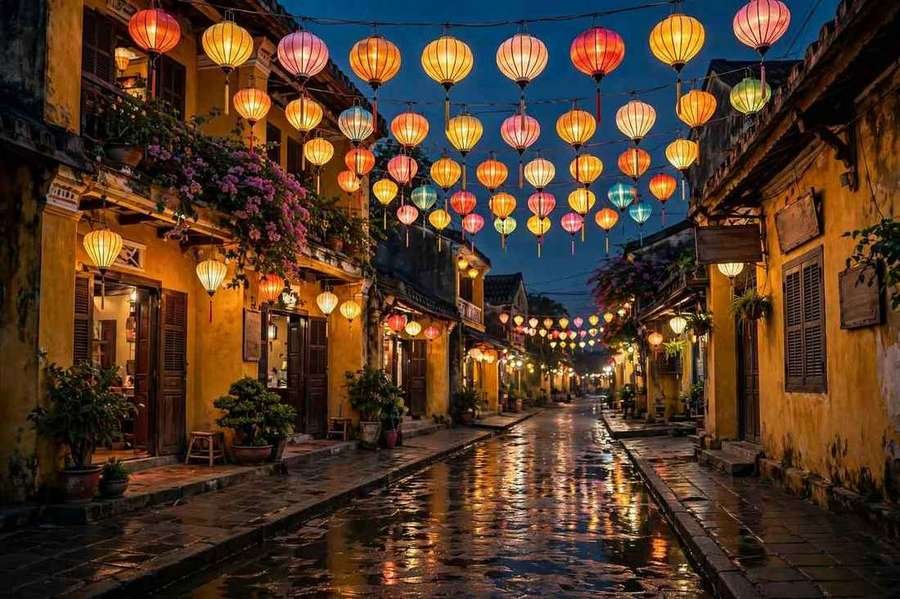
The UNESCO ancient town glows with thousands of lanterns after dark. Get clothes tailor-made in 24 hours, take a cooking class, cycle to An Bang beach, and time your visit for the monthly full-moon lantern festival. Best February–May.
Ho Chi Minh City — The Energy
Vietnam’s southern megacity moves at double speed: the War Remnants Museum, Ben Thanh Market, rooftop bars in District 1, and day trips to the Cu Chi Tunnels and the Mekong Delta. Two days minimum; the city rewards night owls.
Phu Quoc — The Beach Escape
Vietnam’s largest island offers white-sand beaches and spectacular sunsets, plus its own 30-day visa exemption. It is the priciest destination in the country (mid-range $130–220/day in peak season, November–March), so budget accordingly.
Vietnam 14-Day Itinerary: North to South
This Vietnam travel guide 2026’s classic 14-day route uses the 90-day e-visa with room to spare and hits every highlight above:
- Days 1–3 — Hanoi. Arrive via Noi Bai Airport, settle into the Old Quarter, do a street-food tour, visit the Temple of Literature and Ho Chi Minh Mausoleum complex.
- Days 4–5 — Ha Long Bay. Overnight cruise with kayaking and a cave visit; return to Hanoi in the evening of day 5.
- Days 6–7 — Ninh Binh. Tam Coc boat ride, Trang An grottoes, Mua Cave viewpoint; overnight in a riverside homestay.
- Days 8–9 — Sapa. Sleeper bus or train north; two days trekking terraced valleys with a local guide and a village homestay night.
- Days 10–11 — Hoi An. Fly Hanoi to Da Nang (~$45), transfer to Hoi An; lantern-lit old town, tailors, An Bang beach.
- Days 12–13 — Ho Chi Minh City. Fly south; War Remnants Museum, Ben Thanh Market, Cu Chi Tunnels half-day trip.
- Day 14 — Mekong Delta or departure. A Delta day trip (floating markets, coconut candy workshops) or a final morning in the city before flying home.
Traveling south-to-north works just as well — simply reverse the order. The domestic flight network (Vietnam Airlines, VietJet, Bamboo Airways) makes the long distances painless.
Money, Transport and Staying Connected in Vietnam
Currency and Cash
This Vietnam travel guide 2026’s rule of thumb: the Vietnamese dong (VND) is cash-heavy outside major cities — always carry small notes for street food, markets and taxis. ATMs typically cap withdrawals at 2–5 million VND per transaction with local bank fees of ₫30,000–50,000. Cards work in hotels and upscale restaurants in Hanoi, Da Nang and Ho Chi Minh City. Exchange at gold shops or banks for better rates than the airport.
Getting Around
For cities, this Vietnam travel guide 2026 recommends the Grab app (ride-hailing) as essential — it eliminates taxi scams and shows the price upfront; GrabBike motorbike taxis are the fastest way through traffic. Between cities, sleeper buses are comfortable and cheap, the Reunification Express train from Hanoi to Ho Chi Minh City is a classic slow-travel experience, and budget airlines cover long hops for around $40–60 booked in advance.
SIM Cards and Internet
Buy a tourist SIM at the airport on arrival — about $4–8 for 30 days with generous 4G/5G data from Viettel, Vinaphone or Mobifone. Coverage is excellent even in rural areas. Cafes everywhere offer fast free Wi-Fi, and Vietnam’s cafe culture (try cà phê trứng, egg coffee) doubles as your remote-work infrastructure.
Vietnam Travel Safety: Tips Worth Knowing
Vietnam is generally safe for tourists, and this Vietnam travel guide 2026’s safety advice boils down to a few street-smart habits that pay off. Bag-snatching by passing motorbikes is the most common crime — wear your daypack in front and keep phones off the curb side. Agree Grab prices upfront or use the app; metered-taxi scams persist at airports. Only drink bottled or filtered water. When crossing streets in Hanoi or Ho Chi Minh City, walk slowly and steadily — the motorbikes flow around you; hesitation causes the danger.
Food safety is mostly common sense: eat where locals queue, avoid raw salads at dubious stalls, and peel fruit. Travel insurance ($30–100 for a trip) is non-negotiable — motorbike accidents are the leading cause of serious tourist injuries, and hospital bills add up fast.
For official tourism statistics and the country’s tourism development background, see Tourism in Vietnam on Wikipedia.
Frequently Asked Questions
Do I need a visa for Vietnam in 2026?
Most nationalities need an e-visa: apply at evisa.gov.vn for up to 90 days (US$25 single entry, US$50 multiple entry), processed in 3–5 business days. Citizens of about 13–22 countries including the UK, France, Germany, Japan and South Korea get 45 days visa-free.
What is the best month to visit Vietnam?
For a north-to-south trip, March to April 2026 is the best compromise: the north is pleasant, the central coast is dry, and the south is sunny. October–November is best for the north alone; February–May for the central beaches; December–April for the south.
How much does a 2-week Vietnam trip cost?
On the ground (excluding international flights and visa): roughly $350–550 per person backpacker-style, or $900–1,400 mid-range. Daily budgets run $25–50 backpacker and $60–130 mid-range, with the dong at about ₫26,000 to $1.
Is Vietnam safe for tourists?
Yes — Vietnam is generally safe, with petty theft (bag-snatching) and taxi scams the main concerns rather than violent crime. Use Grab, keep valuables secure, drink bottled water, and get travel insurance.
What is the currency in Vietnam?
The Vietnamese dong (VND). Cash dominates outside major cities; ATMs cap withdrawals at 2–5 million VND with fees around ₫30,000–50,000. Cards are accepted in hotels and upscale restaurants in the big cities.
How many days do you need in Vietnam?
Ten to fourteen days covers the highlights comfortably (Hanoi, Ha Long Bay, Hoi An, Ho Chi Minh City). The 90-day e-visa makes slower three-to-four-week trips easy, and three weeks lets you add Sapa, Hue, the Mekong Delta and Phu Quoc.
Conclusion
Vietnam in 2026 is that rare destination where everything lines up: a 90-day e-visa that welcomes nearly every passport, record-breaking tourism infrastructure, world-class sights from Ha Long Bay to Hoi An, and daily costs that still undercut almost everywhere else in Asia. Time your regions right — north in autumn or spring, central coast from February, south in the dry season — budget $25–50 a day backpacking or $60–130 mid-range, and let the country’s north-to-south rhythm do the rest. Few trips deliver this much wonder per dollar, which is exactly the promise this Vietnam travel guide 2026 was written to keep.
