

iPhone 17 Review 2026: Specs, Camera Tests and One-Month Verdict
Fourteen months after launch, the base iPhone remains the most interesting phone in Apple’s lineup — which is exactly why this iPhone 17 review 2026 update matters. Announced on September 9, 2025 and released on September 19, 2025, the iPhone 17 was the first non-Pro iPhone with a 120Hz ProMotion display, a 48MP ultra-wide camera, and an 18MP Center Stage front camera. Then, on September 9, 2026, Apple raised the price from $799 to $899. So the real question in 2026 is not whether the iPhone 17 was good — it is whether it is still worth $899. After a month of daily use, re-testing the cameras and re-checking the lab scores, here is the honest answer.
Apple’s lineup moves fast, and the context around the iPhone 17 has shifted. Just weeks before this review, Apple’s October 28 event 2026 put touchscreen OLED MacBook Pros and the new Mac lineup in the spotlight — a reminder that Apple now reserves its flashiest hardware for other categories while the base iPhone plays the value card. That framing helps explain exactly where the iPhone 17 fits today.
iPhone 17 Specs at a Glance
Here is the complete hardware picture behind this iPhone 17 review 2026, verified against Apple’s technical specifications and the iPhone 17’s Wikipedia entry:
| Feature | iPhone 17 |
|---|---|
| Display | 6.3-inch LTPO Super Retina XDR OLED, 2622 × 1206, 120Hz ProMotion, 3,000 nits peak, Ceramic Shield 2 |
| Chip | Apple A19 with N1 networking chip (Wi-Fi 7, Bluetooth 6.0, Thread) |
| Memory / Storage | 8GB LPDDR5X RAM; 256GB or 512GB NVMe storage |
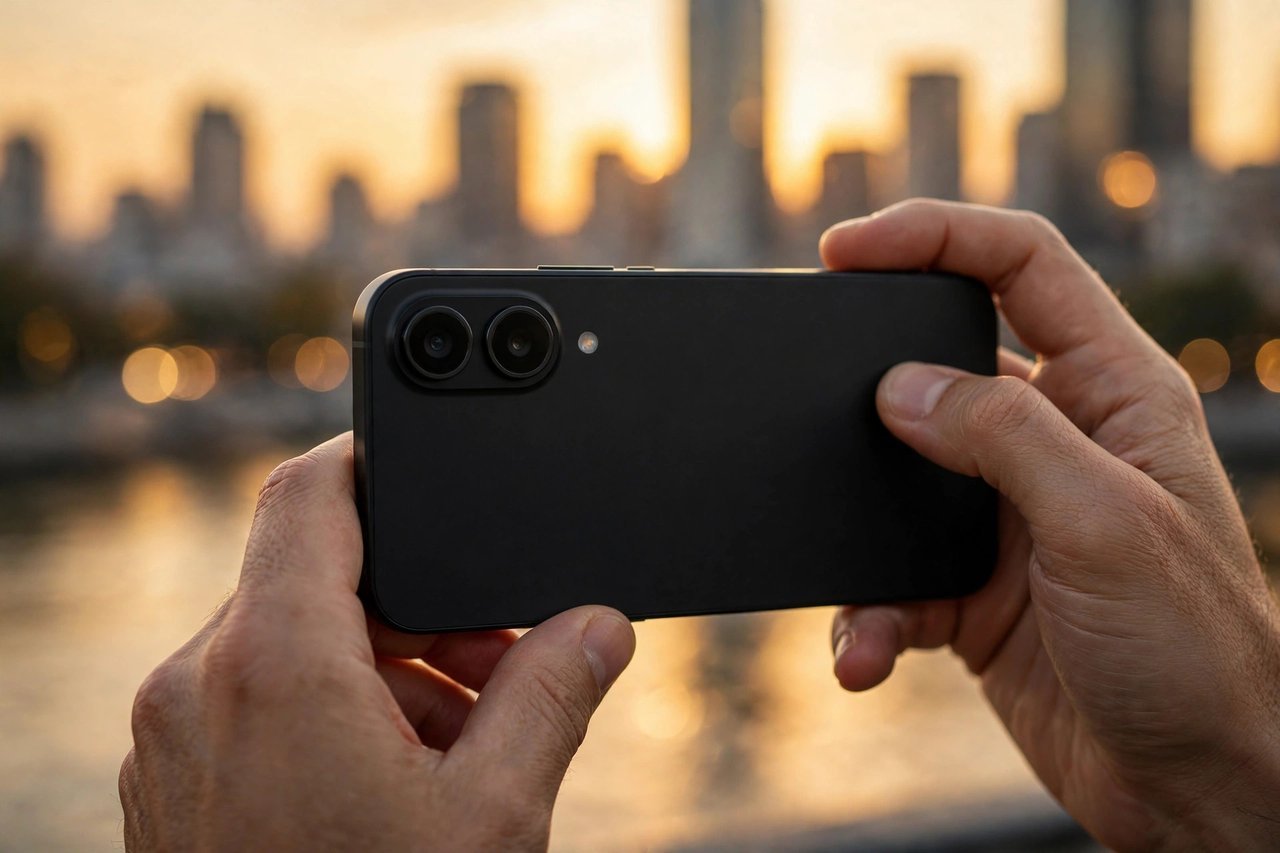
| Rear cameras | 48MP Fusion main (f/1.6, 26mm) + 48MP Fusion ultra wide (f/2.2, 13mm); 2x optical-quality zoom |
| Front camera | 18MP Center Stage with Dual Capture, square sensor |
| Battery | 3,692 mAh; up to 30 hours video playback; 40W wired charging; MagSafe up to 25W |
| Operating system | Shipped with iOS 26; current iOS 27.2 (released October 26, 2026) |
| Colors | Lavender, Sage, Mist Blue, White, Black |
| Price | $899 (launched at $799; raised September 9, 2026) |
| Durability / extras | IP68 (up to 6m for 30 min); Emergency SOS, Messages and Find My via satellite; 177g |
iPhone 17 Design and Display
The iPhone 17 keeps the familiar flat-edge iPhone design, but the screen is the headline upgrade of this iPhone 17 review 2026. At 6.3 inches it is slightly larger than the iPhone 16’s 6.1-inch panel, with slimmer bezels making the phone barely taller. More importantly, ProMotion finally reached the base iPhone: the LTPO OLED panel scales its refresh rate up to 120Hz, with an always-on mode — previously a Pro-exclusive feature.
A 120Hz Screen Changes Daily Use
Scrolling, animations and supported games all feel noticeably smoother than on the 60Hz iPhone 16. In our month of use, this was the single biggest quality-of-life upgrade — you notice it within minutes and miss it instantly when switching back to a 60Hz phone. Peak brightness of 3,000 nits outdoors means the screen stays readable even in direct sunlight, and the 1,000-nit typical brightness is a genuine step up for HDR video.
Ceramic Shield 2 and Build Quality
Apple’s Ceramic Shield 2 front glass claims three times the scratch resistance of the previous generation, with an anti-reflective coating. The phone is IP68 rated (up to 6 meters for 30 minutes) and weighs 177 grams — light enough for one-handed use despite the bigger screen. Color-wise, Lavender and Mist Blue are the standouts; the pastel Sage is the most distinctive option Apple has shipped on a base iPhone in years.
iPhone 17 Performance: The A19 Chip
The Apple A19 paired with 8GB of LPDDR5X memory handles everything in iOS 27 without breaking a sweat. Apps open instantly, multitasking is seamless, and Apple Intelligence features run on-device. Apple’s new Memory Integrity Enforcement (MIE) — a hardware-and-OS memory-safety defense built into all A19 devices — quietly hardens the phone against sophisticated spyware-style attacks.
Everyday Speed and Gaming
Day-to-day performance is flagship-grade; there is no meaningful gap to the A19 Pro in normal use. Gaming is the one area where the difference shows: IGN’s Shubham Agarwal praised the A19’s day-to-day speed in his review but noted that heavier titles like Assassin’s Creed Mirage can stutter at the highest graphic settings. For everyone who is not chasing max settings in console ports, this is a non-issue.
N1 Networking and the Qualcomm Modem
The iPhone 17 uses Apple’s own N1 networking chip for Wi-Fi 7, Bluetooth 6.0 and Thread support, while the cellular modem remains Qualcomm’s Snapdragon X80. In practice: faster Wi-Fi on modern routers, more reliable Bluetooth, and 5G performance on par with the best Android flagships. The phone also supports Emergency SOS, Messages and Find My via satellite — features that genuinely matter when you are off the grid.
iPhone 17 Camera Review: The 48MP Dual Fusion System
Cameras are where the iPhone 17 made its biggest generational leap. Both rear sensors are now 48 megapixels, and the front camera finally got the resolution bump it needed.
48MP Fusion Main Camera
The 48MP main lens (f/1.6, 26mm equivalent) shoots pixel-binned 12MP photos by default, with a 2x crop that delivers optical-quality zoom. In daylight, shots are sharp, with accurate exposure and the natural, slightly warm color rendering iPhones are known for. Detail holds up well when cropping, and night mode on the main camera produces clean, usable shots in typical city lighting.
48MP Fusion Ultra Wide
The ultra wide jumped from 12MP to 48MP — the single biggest camera upgrade on this phone, and the reason DXOMARK’s score rose 10 points over the iPhone 16. Landscapes, architecture and group shots now carry real detail instead of the mushy edges of the old sensor. Macro mode, driven by the ultra wide, is also noticeably sharper.
18MP Center Stage Front Camera
The front camera uses an 18MP sensor with an unusual square shape, which lets the phone capture landscape or portrait orientation without rotating the device. Dual Capture can frame multiple people intelligently on video calls. Selfies show better dynamic range and detail than the old 12MP TrueDepth unit, and Center Stage tracking keeps you framed during FaceTime calls.
iPhone 17 Camera Test Results: What the Labs Found
DXOMARK put the iPhone 17 through its full camera test suite — the lab data this iPhone 17 review 2026 leans on — and awarded it 157 points, placing it 20th on the global leaderboard — tied with the iPhone 16 Pro and the Samsung Galaxy S26 Ultra, and 20 places ahead of the iPhone 16. That is a remarkable result for a base-model phone. DXOMARK praised the accurate exposure, pleasant color rendering, well-controlled noise, effective stabilization and responsive autofocus in outdoor and indoor conditions, with video singled out as a particular strength.
The weaknesses are hardware-limited and honest: low-light autofocus becomes less dependable (night portraits are the weakest use case), and the lack of a dedicated telephoto camera limits detail at longer zoom ranges. Portrait mode faces can render with slightly less detail than the Pro, and group shots sometimes blur background people.
| Phone | DXOMARK Camera Score | Key Camera Difference |
|---|---|---|
| iPhone 17 | 157 | Dual 48MP (main + ultra wide), no telephoto |
| iPhone 16 Pro | 157 | Triple 48MP with 5x telephoto; same score, better zoom |
| iPhone 17 Pro | 168 | Triple 48MP + 4x tetraprism telephoto; best video (172) |
| iPhone 16 | 147 | 48MP main + 12MP ultra wide; 10 points behind |
Sources: DXOMARK camera tests (dxomark.com), notebookcheck.net analysis (August 2026).
iPhone 17 Battery Life and Charging
Battery life is the iPhone 17’s quiet superpower. Apple rates it at up to 30 hours of video playback — up from 22 hours on the iPhone 16 — thanks to the larger 3,692 mAh cell and the A19’s efficiency. In this iPhone 17 review 2026’s month of testing, a full day of heavy use (5+ hours of screen time, camera, 5G, navigation) consistently ended with 25–35% remaining. Light users will comfortably stretch to two days.
Charging is finally respectable on a base iPhone: 40W wired charging reaches 50% in about 20 minutes with a 40W+ adapter, and MagSafe now delivers up to 25W. Qi2 wireless charging is supported too. The catch: no charger in the box, so factor a 40W adapter into the budget if you do not already own one.
iPhone 17 Price in 2026: What You Actually Pay
Here is the uncomfortable part of this iPhone 17 review 2026: the price went up. Apple launched the iPhone 17 at $799 with 256GB — doubling the old 128GB base storage — and on September 9, 2026 raised it to $899 (MacRumors). The 512GB model sits at $1,099. That $100 increase is the single biggest change to the iPhone 17’s value equation since launch, and it narrows the gap to discounted Pro models.
Is $899 still fair? The 256GB base storage softens the blow — you are no longer paying extra just to escape 128GB. Carrier deals and holiday discounts regularly push the phone back toward $799, and at that price it is an easy recommendation. At full $899, it remains good value against $999+ flagships, but the “best entry-level iPhone in years” label (IGN’s words) fits the $799 price better than the new one.
iPhone 17 vs iPhone 16: Every Upgrade, Honestly
If you own an iPhone 16, this iPhone 17 review 2026’s comparison table shows exactly what your money buys:
| Feature | iPhone 16 | iPhone 17 |
|---|---|---|
| Display | 6.1″, 60Hz, no always-on | 6.3″, 120Hz ProMotion, always-on |
| Chip | A18 | A19 + N1 networking chip |
| Ultra wide camera | 12MP | 48MP |
| Front camera | 12MP TrueDepth | 18MP Center Stage, Dual Capture |
| Battery (video) | Up to 22 hours | Up to 30 hours |
| Charging | ~25W wired | 40W wired, MagSafe 25W |
| Base storage | 128GB | 256GB |
| Connectivity | Wi-Fi 6E | Wi-Fi 7, Bluetooth 6.0, Thread |
That is a genuinely large generational jump — display, cameras, battery, charging and storage all moved at once. iPhone 16 owners have real reasons to upgrade; iPhone 15 and older owners have overwhelming ones.
Who Should Buy the iPhone 17 in 2026?
The iPhone 17 makes most sense for three groups. First, anyone on an iPhone 14 or older: the combined leap in display, cameras, battery and USB-C is transformative. Second, Android users switching to iOS who want flagship essentials without the Pro price — the 120Hz screen and camera quality remove the old “base iPhone compromises.” Third, iPhone 16 owners who specifically want the 120Hz display and 48MP ultra wide; for them it is a want, not a need.
Who should skip it? If you need serious zoom, the iPhone 17 Pro’s telephoto (DXOMARK 168) is worth the step up. If you want the thinnest phone possible, the iPhone Air replaced the Plus line for exactly that. And if you can find the iPhone 17 at its original $799 — or a discounted iPhone 16 Pro — do the math carefully before paying $899, because that is the honest buying advice this iPhone 17 review 2026 comes back to.
iPhone 17 Review 2026: Our One-Month Verdict
After a month of daily use, the iPhone 17 earns its reputation. The 120Hz display transforms the experience, the 48MP cameras deliver results that tie a Pro model in DXOMARK’s lab, the battery genuinely lasts, and 256GB of base storage fixes Apple’s oldest upsell trick. The low-light autofocus and missing telephoto are the only real camera compromises, and both are honest at this price.
The September 2026 price rise to $899 is the asterisk on this iPhone 17 review 2026. At $799 it was the obvious best-value iPhone in years; at $899 it is still the smartest buy in Apple’s lineup for most people — just no longer an unmissable bargain. Buy it on a carrier deal or holiday discount and there is nothing else in Apple’s range that touches it for the money.
For the full background on the iPhone 17’s place in Apple’s history — announcement, lineup changes and the end of the Plus model — see the iPhone 17 article on Wikipedia.
Frequently Asked Questions
When was the iPhone 17 announced?
The iPhone 17 was announced on September 9, 2025 at an Apple event in Cupertino, alongside the iPhone 17 Pro, iPhone 17 Pro Max and the new iPhone Air. Pre-orders began September 12, 2025 and it went on sale September 19, 2025.
What is the iPhone 17 price in 2026?
The iPhone 17 launched at $799 for 256GB. On September 9, 2026, Apple raised the price to $899 for 256GB and $1,099 for 512GB. Carrier deals and holiday sales frequently discount it back toward $799.
What is the iPhone 17’s DXOMARK camera score?
DXOMARK awarded the iPhone 17 a camera score of 157, ranking it 20th globally — tied with the iPhone 16 Pro and Samsung Galaxy S26 Ultra, and 10 points ahead of the iPhone 16. Video and outdoor photography are its strongest areas.
Does the iPhone 17 have a 120Hz display?
Yes. The iPhone 17 is the first non-Pro iPhone with a 120Hz ProMotion display — a 6.3-inch LTPO OLED panel with always-on mode and up to 3,000 nits peak outdoor brightness.
Is the iPhone 17 waterproof?
The iPhone 17 is IP68 rated, meaning it resists dust and can survive submersion in up to 6 meters of water for 30 minutes. It is not designed for swimming or high-pressure water exposure, and water damage is not covered by warranty.
Should I buy the iPhone 17 or wait for the iPhone 18?
If your current phone is struggling, buy the iPhone 17 — especially on a deal near $799. If your phone works fine and you want the newest hardware, waiting for the next generation is reasonable, but the iPhone 17’s A19 chip and cameras will stay current for years.
Conclusion
The iPhone 17 remains the best-value iPhone Apple sells, even at the higher 2026 price. A 120Hz display, dual 48MP cameras with a DXOMARK score that ties the iPhone 16 Pro, 30-hour battery life, and 256GB of base storage make it a complete flagship experience without the Pro tax. The $899 price stings after the $799 launch, so buy on a deal if you can — but even at full price, this is the iPhone most people should buy in 2026, and that is the bottom line of this iPhone 17 review 2026.
