


Europe’s CERN physics laboratory has announced the discovery of a new particle, marking a milestone in the ongoing exploration of the fundamental constituents of matter. Named the Xi-cc-plus (Ξcc⁺), this particle is the 80th baryon identified to date at the world’s most powerful particle accelerator, the Large Hadron Collider (LHC).
Baryons, such as protons and neutrons, are the particles that form the nuclei of atoms and, consequently, all visible matter in the universe. The discovery of Xi-cc-plus offers scientists an unprecedented opportunity to study the behavior of quarks under conditions that are otherwise impossible to observe.
Understanding the Xi-cc-plus
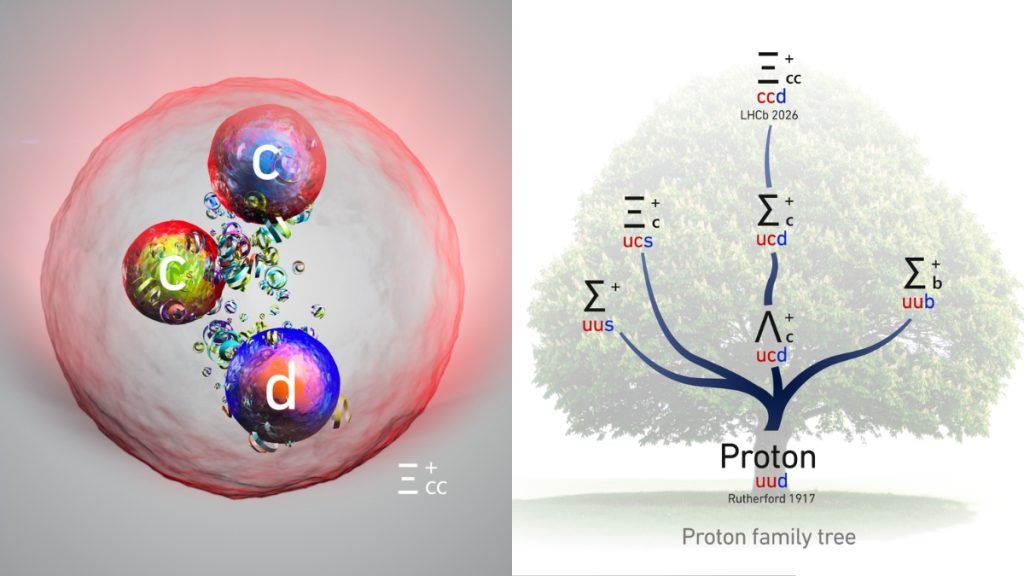
The Xi-cc-plus is an exotic baryon composed of two charm quarks and one down quark. In contrast, the more familiar proton consists of two up quarks and one down quark. The presence of two heavier charm quarks makes the Xi-cc-plus roughly four times heavier than a proton, giving it unique properties that are of immense interest to theoretical physicists.
Quarks, the fundamental building blocks of matter, come in six flavors: up, down, charm, strange, top, and bottom. Each quark has its own mass, electric charge, and quantum characteristics. While protons and neutrons contain only up and down quarks, heavier quarks, such as charm and bottom, can form more massive and exotic baryons.
Left: An artist’s illustration of the new exotic particle. Right: A “proton family tree” traces how heavier relatives are formed by replacing the proton’s quarks with strange (s), charm (c), or bottom (b) quarks. The Ξcc⁺ sits near the very top, where both of the proton’s up quarks have been swapped for charm quarks. (CERN)
How the Discovery Was Made
The discovery of Xi-cc-plus was made possible thanks to the upgrades completed in 2023 to the LHCb detector, part of the LHC specifically designed to study heavy quarks. The LHC accelerates protons to near-light speeds within its 27-kilometer (17-mile) underground ring, located approximately 100 meters below the border of France and Switzerland. When these protons collide, they create extreme energy conditions that briefly recreate the environment just after the Big Bang.
By analyzing the debris from these collisions, physicists can reconstruct the properties of short-lived particles. The Xi-cc-plus is exceptionally fleeting, with a lifetime approximately six times shorter than a previously observed similar particle. Detecting it required precise instrumentation and the upgraded capabilities of the LHCb experiment.
Vincenzo Vagnoni, spokesperson for the LHCb experiment, commented:
“This is only the second time a baryon with two heavy quarks has been observed. The Xi-cc-plus will help theorists test models of quantum chromodynamics, the theory of the strong force that binds quarks into not only conventional baryons and mesons but also more exotic hadrons such as tetraquarks and pentaquarks.”The Importance of Quarks and Quantum Chromodynamics
Quarks interact via the strong nuclear force, described by the theory of quantum chromodynamics (QCD). QCD predicts the existence of numerous exotic combinations of quarks, some of which are extremely rare and difficult to observe in laboratory conditions.
The Xi-cc-plus is particularly intriguing because its two charm quarks offer a unique testing ground for QCD models. By studying how it decays and interacts with other particles, scientists can refine their understanding of the strong force, which is fundamental to the structure of matter.
In 2017, the LHCb experiment discovered a similar baryon composed of two charm quarks and one up quark. Comparing the decay patterns and lifetimes of these particles allows physicists to probe the subtle dynamics of quark interactions at an unprecedented level.
Xi-cc-plus and the Future of Particle Physics
The discovery of Xi-cc-plus comes as CERN prepares to push the boundaries of particle physics even further. Plans are underway to construct the Future Circular Collider (FCC), an accelerator significantly larger than the LHC. The FCC aims to explore energy scales far beyond the reach of current facilities, potentially revealing new fundamental particles and forces that shape the universe.
The LHC itself has already changed the landscape of physics. Its most famous achievement, the discovery of the Higgs boson in 2012, confirmed the mechanism by which particles acquire mass. Now, with the Xi-cc-plus, the LHC continues to provide insights into the behavior of matter under extreme conditions.
Read More: Instagram is getting rid of end-to-end encrypted DMs that ‘very few’ people used
FAQs
What exactly is a baryon?
A baryon is a type of subatomic particle made up of three quarks. Protons and neutrons are the most familiar baryons, but there are many exotic baryons, like Xi-cc-plus, which contain heavier quarks such as charm or bottom. Baryons are held together by the strong nuclear force.
Why is the Xi-cc-plus important?
The Xi-cc-plus is significant because it contains two charm quarks, making it one of the rare heavy baryons ever observed. Studying it allows scientists to test and refine quantum chromodynamics (QCD), deepening our understanding of how quarks interact.
How does the LHC detect such short-lived particles?
When protons collide in the LHC, they create a shower of particles. Detectors like LHCb track these decay products, allowing physicists to reconstruct the original particle even if it exists for only a fraction of a second.
What are quarks and their flavors?
Quarks are elementary particles and come in six types or “flavors”: up, down, charm, strange, top, and bottom. Each has a distinct mass, charge, and set of quantum properties. The combination of quarks determines the type of baryon or meson formed.
What’s next for particle physics after this discovery?
CERN plans to build the Future Circular Collider, which will explore energy scales beyond the LHC. Discoveries like Xi-cc-plus pave the way for new research into the fundamental forces and the possible existence of unknown particles.
Conclusion
The identification of the Xi-cc-plus is a monumental achievement for particle physics. Not only does it expand the catalog of known baryons, but it also provides a rare glimpse into the behavior of heavy quarks and the forces that govern them. With this discovery, the LHC demonstrates its continued relevance as the world’s leading particle accelerator and sets the stage for future explorations into the fundamental structure of matter. As CERN and the global scientific community push toward more powerful experiments, the Xi-cc-plus reminds us that the universe still holds secrets at the smallest scales—secrets that could reshape our understanding of reality itself.
