


As Bangladesh’s election campaign entered its final hours on Monday, the country’s political landscape crackled with intensity, emotion, and unresolved questions about its future. Across the capital, Dhaka, and beyond, tens of thousands of supporters flooded the streets, waving party flags, chanting revolutionary slogans, and rallying behind rival leaders invoking the memory of the 2024 uprising that dramatically reshaped the nation’s political order.
Thursday’s election will determine the composition of Bangladesh’s 350-seat parliament and, more significantly, the direction of a country still reeling from the collapse of long-standing autocratic rule. With the Awami League banned from contesting and its former leader, Sheikh Hasina, overthrown and sentenced in absentia, the vote marks the first genuine test of Bangladesh’s post-uprising political reality.
At the heart of the contest are two dominant forces: the Bangladesh Nationalist Party (BNP), led by Tarique Rahman, and Jamaat-i-Islami, led by Shafiqur Rahman and allied with the student-led National Citizen Party (NCP). Both claim to represent the true spirit of the revolution — and both promise justice, stability, and reform to a population exhausted by years of repression, corruption, and political violence.
A Nation at a Political Crossroads
Bangladesh’s election comes less than two years after the dramatic events of August 5, 2024, when mass protests erupted across the country, culminating in the fall of Sheikh Hasina’s government after 15 years in power. What began as student-led demonstrations against political repression and economic hardship rapidly evolved into a nationwide uprising.
Security forces’ violent crackdowns only intensified public anger. Hundreds were killed, thousands arrested, and international pressure mounted. Ultimately, Hasina fled the country, and an interim government assumed control, pledging free elections and accountability for past abuses.
For many Bangladeshis, this week’s vote is not merely about choosing lawmakers; it is about validating the sacrifices of the uprising and ensuring that authoritarianism does not return under a new guise.
Dhaka Becomes the Epicentre of Political Theatre
On the final day of campaigning, Dhaka transformed into a mosaic of political colours. Streets were lined with banners, loudspeakers blasted slogans, and supporters packed open grounds and major intersections for rival rallies.
Despite tight security, the atmosphere was charged rather than chaotic. Police were deployed in large numbers, stationed atop buildings and encircling stages as leaders addressed their supporters.
For voters, the rallies were both a celebration of newfound political freedom and a reminder of what is at stake.
BNP’s Campaign: Experience, Stability, and Legacy
The Bangladesh Nationalist Party entered the final day of campaigning with confidence. Widely viewed as the frontrunner, the BNP has sought to project itself as the only party capable of governing a complex nation of 170 million people.
At a massive rally, Tarique Rahman, often referred to as Tarique Zia bounded onto the stage to thunderous applause. Supporters waved BNP flags emblazoned with the party’s symbol, a sheaf of rice, and greeted their leader with near rock-concert fervour.
“The BNP alone has a plan to run the country and the experience to do so,” Rahman told the crowd, invoking the legacies of his parents, former president Ziaur Rahman and former prime minister Khaleda Zia.
“No other parties have that.”
Rahman, 60, assumed leadership of the BNP following his mother’s death in December 2025 at the age of 80. His return to Bangladesh in December, after 17 years in exile, marked a symbolic moment for the party and its supporters.
The BNP’s campaign message has focused on economic recovery, restoring democratic institutions, and leveraging its historical experience in governance. Party leaders argue that while the uprising was necessary, governing requires expertise, not slogans.
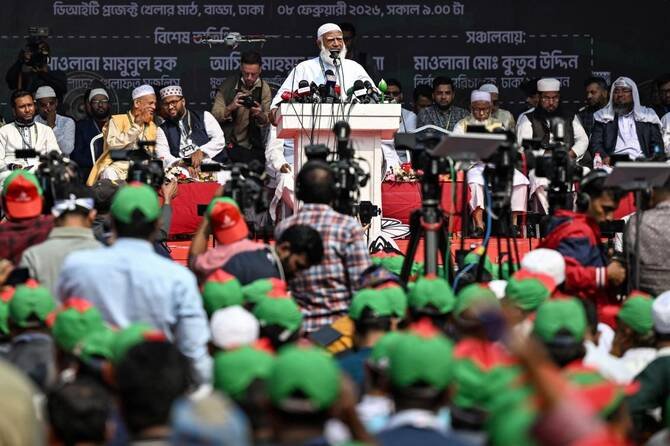
Jamaat-i-Islami and the Promise of “Justice”
Challenging the BNP’s claim to leadership is Jamaat-i-Islami, Bangladesh’s largest Islamist party, which has emerged as a formidable force in the post-Hasina era.
Led by Shafiqur Rahman, Jamaat has allied itself with the National Citizen Party — a new political force formed by student leaders who played a central role in the 2024 uprising.
Under the symbol of weighing scales, Jamaat’s rallies drew massive crowds, particularly among young voters and those disillusioned with traditional parties.
“If Jamaat comes to power, extortion and violence will reduce,” said Ashikuzzaman Shaon, a 21-year-old student attending one rally. “They’ll establish justice.”
Justice has become Jamaat’s defining campaign theme. Rahman repeatedly accused both the former ruling Awami League and returning political elites of perpetuating corruption and abuse.
“A section of the oppressed turned into oppressors just a day after August 5,” Rahman told supporters. “Common people, business owners — even beggars — are now fed up. Justice has been sent into exile.”
The Role of the National Citizen Party
The National Citizen Party represents one of the most significant developments in Bangladesh’s political evolution. Formed by student activists who spearheaded the uprising, the NCP has positioned itself as a moral watchdog — skeptical of all traditional parties.
Its leader, Nahid Islam, has been vocal in condemning decades of what he describes as shared criminal enterprises among major political actors.
“For years, the businesses of extortion and crime were quietly divided,” Islam told supporters. “This must end.”
Islam framed the election as a continuation of the revolution, warning that defeat would represent a betrayal of those who died in 2024.
“If we lose, August 5 will also lose.”
Supporters echoed chants born during the uprising:
“Long live the revolution!”
“Slavery or freedom?” — “Freedom! Freedom!”
The Absence of the Awami League
Perhaps the most striking feature of this election is who is not participating.
The Awami League, which dominated Bangladeshi politics for more than a decade, was banned by the interim government from contesting the polls — a decision sharply criticised by international rights groups.
Former prime minister Sheikh Hasina, now 78, was sentenced to death in absentia in November 2025 for crimes against humanity linked to the violent suppression of protesters. She remains in hiding in India.
For supporters of the ban, the exclusion represents long-overdue accountability. Critics argue it risks undermining democratic inclusivity and sets a dangerous precedent.
Either way, the absence of the Awami League has fundamentally reshaped the political battlefield.
Voices from the Streets
Among the crowds was Tota Mia, a 58-year-old rickshaw puller who had attended rallies for multiple parties before making up his mind.
“I’ve seen everyone,” he said quietly. “And this time I will vote for Jamaat. It doesn’t matter if I eat more or I eat less — I just want peace.”
His words reflect a common sentiment among voters: fatigue with chaos, corruption, and confrontation.
Security, Turnout, and Election Readiness
Authorities have promised tight security for election day, deploying police, paramilitary forces, and observers nationwide. The interim government has urged calm and participation, framing the vote as a historic step toward democratic renewal.
Turnout is expected to be high, driven by the emotional weight of the uprising and the unprecedented political realignment.
What Is at Stake
This election will shape:
Bangladesh’s democratic trajectory
- The balance between secular and Islamist political forces
- Accountability for past human rights abuses
- Economic recovery and investor confidence
- The role of youth movements in governance
For many, it will determine whether the spirit of August 5 can be translated into lasting reform — or whether power politics will once again dominate.
Read More: Pakistan agree to play India at T20 Cricket World Cup after scrapping boycott
FAQs
Why is this election considered historic?
It is the first national election since the 2024 uprising and the fall of Sheikh Hasina’s long-standing government.
Who is expected to win?
The BNP is widely seen as the frontrunner, though Jamaat-i-Islami and its allies pose a serious challenge.
Why was the Awami League banned?
The interim government banned the party following Hasina’s overthrow and prosecution for crimes against humanity.
What role do students play in this election?
Student leaders formed the National Citizen Party and remain influential, especially among young voters.
What are voters most concerned about?
Peace, justice, economic stability, corruption, and preventing a return to authoritarian rule.
Conclusion
As campaigning ends and Bangladesh prepares to vote, the nation stands at a defining crossroads. The rallies, slogans, and promises of the final day reflect not just political competition but a deeper struggle over identity, justice, and the meaning of freedom.
