


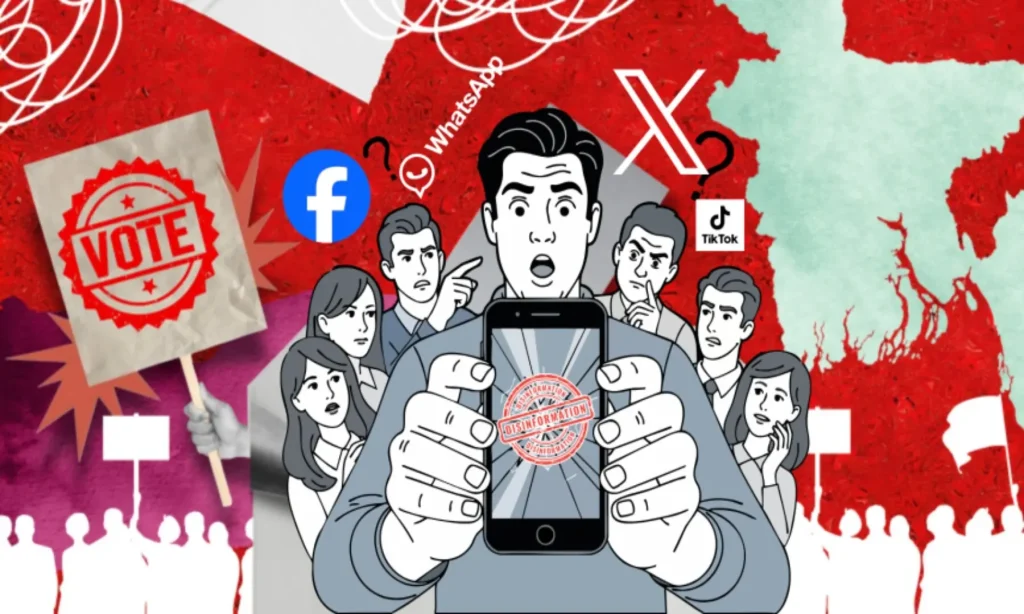
As Bangladesh heads into its general election on February 12, 2026, the political contest has unfolded not only on campaign trails and television screens but, more intensely, across social media platforms—especially Facebook. In the weeks leading up to the vote, the digital space has become saturated with fabricated quotes, doctored images, misleading photocards, conspiracy narratives, and AI-generated videos designed to provoke, polarize, and persuade.
What might once have been isolated rumors or fringe propaganda has evolved into a systematic and data-driven campaign of online manipulation. Political actors and their aligned entities have deployed disinformation as a central tactic to shape voter perception, undermine rivals, and energize supporters. The scale, speed, and sophistication of these efforts reflect a broader transformation of electioneering in Bangladesh, where the fight for public opinion increasingly hinges on viral reach rather than verified truth.
This investigation examines patterns of disinformation circulating in the month before the election, identifies key actors and tactics, and explores the implications for voters, democracy, and the integrity of public discourse.
A Digital Battleground Before the Ballot
From mid-December 2025 to mid-January 2026, 220 verified cases of election-related disinformation were documented from a monitored watchlist of 615 Facebook pages and profiles known for spreading misleading or hateful content.
These 220 posts generated more than 2 million engagements—likes, shares, and comments—within the first 24 hours of publication. The rapid spread highlights the power of algorithm-driven virality and the vulnerability of voters to emotionally charged, misleading narratives in a highly polarized environment.
The findings reveal that entities aligned with Jamaat-i-Islami led both in the volume of disinformation and in engagement levels. Of the 220 documented cases:
- 96 were linked to pro-Jamaat entities
- 78 to pro-Awami League (AL) actors
- 38 to Bangladesh Nationalist Party (BNP)-aligned pages
- The remainder came from unaffiliated or mixed sources
In terms of engagement share, the dominance of pro-Jamaat entities was even more pronounced. They accounted for more than 1.8 million interactions—over 90 percent of the total engagement measured. Pro-Awami League actors generated approximately 5 percent, while BNP-aligned entities accounted for just under 4 percent.
The numbers suggest that beyond producing content, certain actors have mastered amplification strategies, either through coordinated networks, algorithmic advantage, or highly provocative messaging that drives user interaction.
The Intent Behind Disinformation
Experts argue that disinformation campaigns are not random noise but deliberate psychological strategies.
Dr. Din M. Sumon Rahman, Head of Media Studies and Journalism at the University of Liberal Arts Bangladesh (ULAB), explains that the primary objective of disinformation is to manipulate voting choices.
According to him, disinformation feeds confirmation bias among committed supporters while targeting undecided or swing voters who lack strong political alignment. These voters are particularly susceptible to emotionally charged narratives that exploit religion, nationalism, fear of violence, or moral outrage.
The strategy often unfolds in three stages:
- Amplify existing grievances or suspicions.
- Insert fabricated or distorted evidence.
- Frame the narrative as urgent and morally compelling.
The result is not merely confusion but calculated persuasion.
Targeting Rivals: The Politics of Character Assassination
The data indicate that disinformation campaigns are sharply targeted rather than broadly scattered.
Jamaat vs BNP
Entities aligned with Jamaat directed 78 percent of their disinformation at the BNP. Although the two parties were once allies, the current election cycle has positioned them as principal rivals. Jamaat-linked pages frequently portrayed BNP leaders as extortionists, criminals, or morally corrupt figures.
One widely circulated example involved an AI-generated video depicting a staged interview with an elephant handler who falsely accused the BNP of being the “real extortionist.” The video appeared authentic but was digitally fabricated.
Similarly, a high-engagement post falsely alleged that BNP Secretary General Mirza Fakhrul Islam Alamgir and his brother operated a multimillion-taka smuggling scheme to assist Awami League leaders in fleeing across the border. No evidence accompanied the claim.
BNP’s Counter-Campaign
BNP-aligned actors responded in kind, directing roughly 80 percent of their disinformation content toward Jamaat. Their narratives often focused on questioning Jamaat’s religious legitimacy and portraying the party as a threat to minority communities, particularly Hindus.
One fabricated post accused Chhatra Shibir activists of celebrating and drinking alcohol after inciting unrest over the killing of Osman Hadi. The allegation lacked proof but circulated widely.
Awami League-Focused Narratives
Pro-Awami League entities concentrated their messaging on undermining the interim government and student coordinators. A notable false claim alleged that Chief Adviser Dr. Muhammad Yunus was planning a civil war. Another viral post suggested student coordinators attended a DJ party following a funeral—an emotionally provocative narrative intended to frame them as insensitive and immoral.
Unlike the Jamaat-BNP rivalry, AL-aligned disinformation leaned more heavily toward portraying instability and foreign interference.
Defamation as the Dominant Weapon
Of the 220 documented cases, 155 were categorized as defamatory content. Defamation emerged as the primary tool of digital political warfare.
Nearly 90 percent of defamatory posts from Jamaat-aligned entities targeted the BNP. Conversely, almost all defamatory content from BNP-aligned actors focused on Jamaat.
The accusations frequently revolved around:
- Criminal conspiracies
- Smuggling and corruption
- Moral degradation
- Betrayal of national interests
- Foreign allegiance
Such narratives aim to erode trust in opponents’ character rather than debate policy differences.
Manipulation vs Fabrication
Disinformation in this election cycle falls into multiple categories.
Manipulative Content
Approximately 59 percent of analyzed posts were manipulative, meaning they contained partial truths twisted into misleading narratives.
For example, a post distorted findings from the Commission of Inquiry on Enforced Disappearances. While the official report stated that most individuals still missing were affiliated with the BNP, the post reframed this information to suggest a secret understanding between the Awami League and Jamaat, alleging that Jamaat-linked detainees had been quietly released.
This technique relies on selective emphasis rather than outright lies.
Decontextualization
Twenty-seven posts used real images or videos but stripped them of context. In one case, a video claimed to show a BNP leader harassing a freedom fighter. The footage appeared instead to show someone asking another individual to change seats.
By removing context, actors constructed entirely new narratives from authentic material.
Fabricated Documents and Quotes
Seventy-five instances involved forged documents or fabricated quotations attributed to political leaders. These posts often appeared in photocard format, designed to resemble legitimate news graphics.
Such posts are difficult to verify quickly and are easily shared.
AI-Generated Content
Fifty-eight cases involved deepfakes or AI-generated visuals. These included fabricated interviews, staged meetings, and conspiracy-themed graphics.
Pro-Jamaat entities produced the highest number of AI-generated content (27 instances), followed by BNP (17) and AL (14).
The rise of AI tools has lowered the cost and skill barrier for producing convincing synthetic media, making it harder for average users to distinguish fact from fiction.
The Medium Matters: Videos and Photocards
Videos remain the dominant vehicle of disinformation, accounting for 104 of the 220 documented posts. Video content tends to generate stronger emotional reactions and longer engagement times.
Photocards’ static images styled like news headlines accounted for 44 posts and are growing in popularity. They are easier to produce and share, and often mimic established media branding.
Short-form content optimized for Facebook’s algorithm proved especially effective in reaching large audiences quickly.
Minority Narratives and Geopolitical Framing
Some pro-Awami League entities emphasized narratives of minority persecution, amplifying isolated incidents into claims of widespread violence. These posts sometimes invoked calls for foreign intervention, introducing a geopolitical dimension into domestic politics.
Similarly, conspiracy narratives suggested foreign influence or secret agreements between rival parties. One fabricated claim alleged that a political leader had agreed not to purchase weapons without India’s approval.
Such content taps into historical sensitivities and nationalist sentiment.
Methodology Behind the Findings
The 220 posts were identified through systematic monitoring of a watchlist of 615 Facebook pages and profiles.
The watchlist was compiled through:
- Manual review
- Keyword-based searches
- Cross-referencing with independent fact-checking resources
Political alignment was determined by reviewing the most recent 30 posts of each page prior to the data collection period. Official party affiliations were not examined.
Within the watchlist:
- 27.4 percent appeared AL-aligned
- 25.57 percent Jamaat-aligned
- 14.5 percent BNP-aligned
The remainder included smaller parties, meme pages, foreign entities, and unaffiliated creators
This methodology ensured a political party-blind selection process focused on behavior rather than declared affiliation.
The Democratic Consequences
Disinformation does not merely mislead individuals; it reshapes democratic culture.
When voters encounter repeated falsehoods, several consequences follow:
- Erosion of Trust: Public trust in institutions, media, and electoral processes declines.
- Polarization: Communities become entrenched in opposing realities.
- Delegitimization: Election results risk being disputed based on false narratives.
- Normalization of Manipulation: Fabrication becomes accepted as routine political practice.
The cumulative effect is a weakened democratic ecosystem.
Read More: Netanyahu to meet Trump as Iran nuclear talks reach critical stage
FAQs
What qualifies as disinformation?
Disinformation refers to false or misleading information deliberately created and shared to deceive or manipulate audiences. It differs from misinformation, which may be shared unintentionally.
How does disinformation influence elections?
Disinformation shapes perceptions about candidates’ character, competence, and integrity. It can sway undecided voters, suppress turnout, and deepen partisan divisions.
Why are swing voters particularly targeted?
Swing voters lack firm political commitments and are more susceptible to emotionally persuasive content. Campaigns often tailor disinformation to exploit uncertainty or confusion.
What is the difference between manipulation and fabrication?
Fabrication involves completely false content. Manipulation uses real facts but distorts or reframes them to create misleading conclusions.
How are AI tools being used in political disinformation?
AI tools generate realistic fake videos, images, and audio clips that depict events or statements that never occurred. These deepfakes can spread rapidly before verification occurs.
Conclusion
The 2026 Bangladesh general election demonstrates how digital platforms have become central arenas of political competition. Disinformation is no longer peripheral it is strategic, organized, and technologically sophisticated. The dominance of certain actors in both volume and engagement underscores how narrative control can overshadow traditional campaigning. With more than two million engagements generated within a single day across documented posts, the velocity of misinformation far outpaces corrective fact-checking efforts.
