


Cyclone Arnab 2026: Landfall, Impact and Safety Updates
Cyclone Arnab 2026 made landfall on the Andhra Pradesh coast early on Wednesday, October 28, crossing the shoreline as a very severe cyclonic storm with sustained winds of 125 to 135 kmph and gusts reaching 150 kmph. The India Meteorological Department (IMD) said the landfall process began around 1:20 a.m. and took more than six hours to complete, with the storm’s centre moving fully inland by about 8 a.m. before weakening into a severe cyclonic storm at 8:30 a.m.
More than 180,000 people were evacuated across Andhra Pradesh and Odisha before the storm arrived, in one of the largest pre-landfall evacuation operations on India’s east coast this year. Heavy rain lashed the coastal districts, flights were cancelled, and at least one death was reported in Visakhapatnam. This guide brings together the latest verified updates on Cyclone Arnab 2026 — where it made landfall, which areas were hit hardest, how the evacuation worked, and what residents should do now. Large-scale disaster evacuations like this one depend on the same early-warning and shelter systems used in other major natural disasters, as seen in our coverage of the Tibet earthquake 2026 rescue and relief operation.
Read More: Greece Wildfire Risk 2026: Attica, Boeotia and Evia on Alert — how authorities prepare communities for fast-moving natural disasters, from early warnings to evacuation shelters.
Cyclone Arnab 2026 Landfall: What Happened on October 28
Cyclone Arnab crossed the Andhra Pradesh and Yanam coasts between Bapatla and Visakhapatnam, close to the south of Yanam, the IMD said in its bulletins on October 28. At the time of landfall, the storm’s centre was located about 20 kilometres east of Narsapur, 40 kilometres south-southwest of Yanam, 60 kilometres south-southwest of Kakinada and 90 kilometres east-northeast of Machilipatnam.
The landfall process was unusually slow. The system remained practically stationary close to the shoreline, which stretched the crossing over six hours and prolonged the period of damaging winds and intense rainfall for coastal communities. The IMD’s 9:50 a.m. bulletin confirmed that “the landfall process has been completed with the central region moving completely into land.”
Arnab made landfall as a “very severe” cyclonic storm — the third-highest category on the IMD’s scale — with maximum sustained wind speeds of 125 to 135 kmph and gusts up to 150 kmph. By 8:30 a.m., the system had weakened into a “severe” cyclonic storm as it moved inland, and it was expected to weaken further while continuing to bring heavy rain to parts of Andhra Pradesh, Yanam and adjoining regions.
Cyclone Arnab 2026: Rainfall, Storm Surge and Worst-Hit Districts
The heaviest rain fell across north coastal Andhra Pradesh. Visakhapatnam recorded the highest rainfall at 315 mm by 8:30 a.m. on October 28, followed by Vizianagaram at 301 mm, Anakapalli at 275 mm, Srikakulam at 257 mm and Krishna at 223 mm. The northern coastal districts — Visakhapatnam, Anakapalli, Vizianagaram, Srikakulam, Kakinada and Dr B.R. Ambedkar Konaseema — experienced heavy to extremely heavy rainfall along with strong winds.
The IMD warned of a storm surge of 1 to 1.5 metres above the normal tide, likely to inundate low-lying areas of Andhra Pradesh. Local officials warned of a higher surge of 1.5 to 2.5 metres near Kakinada, Yanam and the Godavari river mouth. Chief Minister N Chandrababu Naidu said heavy rain could cause flooding in the Nagavali and Vamsadhara rivers in north coastal Andhra, and that teams had been told to act immediately to restore tanks in the event of breaches.
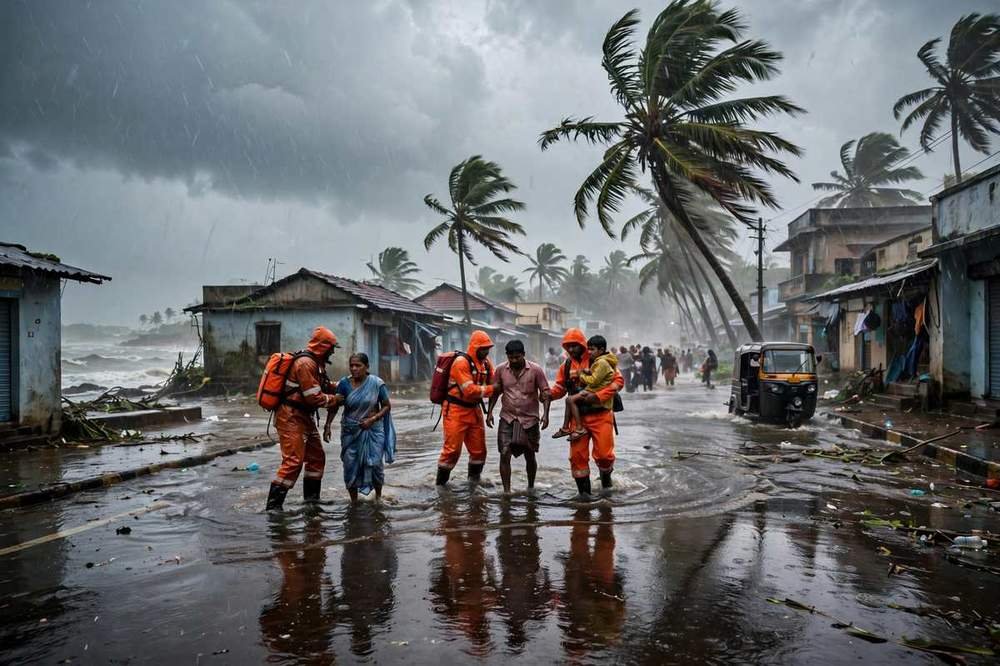
One death was reported in Visakhapatnam, where a 65-year-old man died after coming into contact with snapped live electrical wires. Fallen trees blocked roads in several districts, including a large tree that blocked a road in Kakinada, and power lines were damaged across the coastal belt.
| District | Rainfall by 8:30 a.m., Oct 28 | Main impact |
|---|---|---|
| Visakhapatnam | 315 mm | Heaviest rain; one death from a snapped live wire; flights cancelled |
| Vizianagaram | 301 mm | Extremely heavy rain; schools closed |
| Anakapalli | 275 mm | Heavy rain; schools closed |
| Srikakulam | 257 mm | Heavy rain; coastal flooding risk |
| Krishna | 223 mm | Heavy rain; river-level watch |
| Kakinada | 118 mm (by 5:30 a.m.) | Landfall zone; fallen trees; storm surge risk |
How the Cyclone Arnab 2026 Evacuation Worked
Authorities in Andhra Pradesh and Odisha evacuated more than 180,000 people before Cyclone Arnab arrived. In Andhra Pradesh, Chief Minister N Chandrababu Naidu said 290 shelters were set up and 84,396 people had been shifted to them. The state had identified 2,199 cyclone shelters in total, and 2,360 pregnant women were shifted to medical facilities as a precaution.
The scale of the official response was large. Naidu held a meeting with 32,000 officials and directed them to clear fallen trees within two hours, restore power quickly, and protect tanks and canals from breaches. Twelve teams of the National Disaster Response Force (NDRF) and ten teams of the State Disaster Response Force (SDRF) were deployed to the districts, with police, fire services and medical teams mobilised, and the Indian Navy and Coast Guard on standby.
Odisha, which braced for heavy rainfall as the system moved north and northwest towards Malkangiri, deployed 313 response teams across the state — 60 Odisha Disaster Rapid Action Force (ODRAF) teams, nine NDRF teams and 244 fire and emergency teams. The state kept 2,037 shelters ready, shifted high-risk pregnant women to safety, and ensured all fishing boats had returned to shore. The Andhra Pradesh government allocated Rs 27 crore to 20 districts for cyclone preparedness, and schools in Visakhapatnam, Anakapalli and Alluri Sitharama Raju districts were ordered closed on October 27 and 28.
Cyclone Arnab 2026 Travel Disruption: Flights, Trains and Roads
Transport across the affected region was severely disrupted. Airlines cancelled flights to Visakhapatnam and Vijayawada for Wednesday, October 28, and dozens of trains were cancelled or delayed. Roads were blocked by fallen trees in several districts, and the chief minister directed officials to ensure that trees fallen on national highways were removed in real time.
Residents in cyclone-affected areas were advised to stay indoors while the storm crossed the coast, and authorities urged people to postpone travel in the affected areas. Konaseema District Collector R. Mahesh Kumar reviewed precautionary measures and directed officials to remain on high alert to ensure public safety and minimise damage.
Travellers with plans in coastal Andhra Pradesh or Odisha should check with their airline or railway operator before setting out, as services were still being restored through the day. Road travel in the worst-hit districts remained risky while fallen trees and waterlogging were being cleared.
Cyclone Arnab 2026: IMD Warning Levels Explained
The IMD classifies cyclonic storms in the North Indian Ocean on a scale that runs from depression to super cyclonic storm. Cyclone Arnab reached the “very severe cyclonic storm” category, the third-highest on that scale, which covers sustained wind speeds of 118 to 165 kmph. Understanding these categories helps residents judge how seriously to take a warning.
| IMD category | Sustained wind speed | What it means |
|---|---|---|
| Cyclonic storm | 62–88 kmph | Strong winds, heavy rain, localised damage |
| Severe cyclonic storm | 89–117 kmph | Widespread damage to trees, power lines and weak structures |
| Very severe cyclonic storm | 118–165 kmph | Major damage, storm surge, large-scale evacuation needed |
| Extremely severe cyclonic storm | 166–220 kmph | Catastrophic damage, mass evacuation essential |
| Super cyclonic storm | Above 220 kmph | Devastating impact across a wide area |
Arnab’s peak sustained winds of 125 to 135 kmph put it in the lower half of the very severe category, but its slow movement made it dangerous in a different way: the long landfall process kept the same districts under damaging winds and intense rain for six hours, raising the risk of flooding, tree falls and power failures even without record-breaking wind speeds.
What to Do During and After Cyclone Arnab 2026
The danger does not end when the winds drop. Heavy rain continues after landfall, rivers can flood hours later, and damaged power lines and weakened trees remain hazards. Authorities have asked residents to follow official advisories from the IMD and the Andhra Pradesh State Disaster Management Authority (APSDMA) rather than relying on social media rumours.
Stay indoors until the all-clear
Do not go outside during the storm or immediately after the winds ease. The calm in the middle of a cyclone’s passage can be misleading, and winds can return suddenly. Wait for the official all-clear from district authorities before leaving a shelter or your home.
Avoid floodwater and fallen power lines
Never walk or drive through floodwater — it can hide open drains, debris and live electrical wires. The one reported death in Visakhapatnam was caused by contact with a snapped live wire. Report fallen lines to the electricity department and keep children and animals away from them.
Check on vulnerable neighbours
Elderly people, pregnant women, children and people with disabilities were prioritised in the evacuation for a reason. Once it is safe to move, check on neighbours who may need help, and share verified information about shelter locations, medical aid and power restoration.
Do not return to shelters’ homes too early
Chief Minister Naidu directed officials to ensure that people in cyclone shelters are sent home only after the situation has fully settled, with adequate food, drinking water and medical care provided in the meantime. Evacuees should wait for the official instruction to return, and check that their home is structurally safe and free of waterlogging before re-entering.
Document damage for claims
Photograph any damage to your home, vehicle or crops before clearing debris, and keep receipts for emergency repairs. This documentation is essential for insurance claims and government relief applications.
Cyclone Arnab 2026: What Happens Next
After moving inland, Cyclone Arnab was expected to weaken rapidly but continue producing heavy rainfall in parts of Andhra Pradesh, Yanam and adjoining regions, including southern Odisha districts such as Malkangiri. The focus now shifts from the wind threat to flooding, as rivers swollen by more than 300 mm of rain in some districts drain towards the coast.
The restoration effort is the next test. Clearing 32,000 officials’ worth of fallen trees, restoring power to coastal towns, and reopening roads and rail lines will take days in the worst-hit areas. The state government has said fallen trees must be cleared within two hours and power restored quickly, but residents should expect intermittent outages while repair crews work through the damage.
For the longer term, Cyclone Arnab is another reminder of why the Bay of Bengal coast invests so heavily in early warning and evacuation. The storm’s slow, six-hour landfall could have been far more deadly; the fact that more than 180,000 people were moved to safety before it arrived is the main reason the casualty count stayed low. The full damage assessment — homes, crops, fishing boats and infrastructure — will take several days to complete.
For background on how these storms form and are classified, see the tropical cyclone article on Wikipedia.
Frequently Asked Questions About Cyclone Arnab 2026
When did Cyclone Arnab make landfall?
Cyclone Arnab began making landfall near Yanam, close to Kakinada in Andhra Pradesh, at around 1:20 a.m. on Wednesday, October 28, 2026. The landfall process lasted more than six hours and was completed by about 8 a.m., when the storm’s centre had moved fully inland.
How strong was Cyclone Arnab at landfall?
Arnab crossed the coast as a very severe cyclonic storm with maximum sustained winds of 125 to 135 kmph and gusts up to 150 kmph. It weakened into a severe cyclonic storm at 8:30 a.m. on October 28.
Which areas were worst affected by Cyclone Arnab?
North coastal Andhra Pradesh took the heaviest rain, led by Visakhapatnam with 315 mm by 8:30 a.m., followed by Vizianagaram (301 mm), Anakapalli (275 mm), Srikakulam (257 mm) and Krishna (223 mm). The landfall zone around Kakinada and Yanam faced the strongest winds and a storm surge of 1 to 1.5 metres, with higher surge warnings near the Godavari river mouth.
How many people were evacuated because of Cyclone Arnab?
More than 180,000 people were evacuated across Andhra Pradesh and Odisha. In Andhra Pradesh, 84,396 people were shifted to 290 shelters, while Odisha kept 2,037 shelters ready and deployed 313 response teams.
Was anyone killed by Cyclone Arnab?
One death was reported in Visakhapatnam, where a 65-year-old man died after coming into contact with a snapped live electrical wire. Authorities continued to assess damage across the affected districts.
Are flights and trains running after Cyclone Arnab?
Flights to Visakhapatnam and Vijayawada were cancelled for October 28, and dozens of trains were cancelled or delayed. Services were being restored through the day, but travellers should confirm their bookings with the airline or railway before travelling.
Conclusion
Cyclone Arnab 2026 was a powerful and unusually slow-moving storm that crossed the Andhra Pradesh coast on October 28 with winds of up to 150 kmph in gusts and rainfall of more than 300 mm in the worst-hit districts. Its six-hour landfall tested the region’s disaster systems, and the early evacuation of more than 180,000 people kept the human cost low despite the scale of the disruption.
The immediate priorities now are safety and restoration: staying indoors until the all-clear, avoiding floodwater and fallen power lines, and giving repair crews time to restore power, roads and rail services. The full damage picture will emerge over the coming days, but the lesson of Cyclone Arnab is already clear — early warnings, ready shelters and a fast evacuation save lives when a very severe cyclone comes ashore.
