

India Census 2026: Phases, Timeline and What to Expect
The India Census 2026 is the country’s biggest administrative exercise of the decade — the first population count since 2011, the first to go fully digital, and the first to include caste enumeration. After being postponed in 2021 because of the COVID-19 pandemic, the exercise will finally roll out in two phases: a houselisting operation from April 1 to September 30, 2026, followed by population enumeration in February 2027. If you’ve followed how the Election Commission of India conducts nationwide votes, the census is a similarly massive logistical operation — only this time, instead of polling booths, enumerators with mobile apps will visit every household in the country.
This guide explains the full timeline, what each phase covers, how the digital self-enumeration option works, and what citizens should keep ready when the enumerator knocks.
India Census 2026: Key Facts at a Glance
Here is everything you need to know about the census in one snapshot — the schedule, the officials in charge, and what makes this count different from every previous one.
| Fact | Detail |
|---|---|
| Official exercise | 16th Census of India; 8th since independence |
| Phase 1 — Houselisting | April 1 – September 30, 2026 (30-day window per state) |
| Phase 2 — Population Enumeration | February 2027; reference date March 1, 2027 (midnight) |
| Snow-bound regions | Ladakh, J&K, Himachal Pradesh, Uttarakhand — September 2026; reference date October 1, 2026 |
| Registrar General | Mrityunjay Kumar Narayan, Census Commissioner of India |
| Ministry | Ministry of Home Affairs |
| Budget | Over ₹11,700 crore approved by the Union Cabinet |
| New this time | Fully digital data collection; self-enumeration; caste enumeration |
Why the India Census 2026 Matters
A census is far more than a headcount. India’s last census was conducted in 2011, which means the country’s population figures are 15 years out of date — a gap that affects everything from ration cards and welfare schemes to tax devolution and parliamentary representation.
Three consequences make this census unusually significant:
- Delimitation: constituency boundaries are redrawn based on updated population data. The last delimitation used 1971 figures, frozen for decades to reward population control; fresh data restarts that long-pending exercise.
- Women’s reservation: the Women’s Reservation Bill reserves one-third of seats in the Lok Sabha and state assemblies for women. Its rollout is tied to the census and delimitation timeline.
- Policy planning: welfare schemes, housing programs, school and hospital allocations all run on population data. Fifteen-year-old numbers mean fifteen years of compounding error.
That is why the India Census 2026 is being watched as closely as any election — it will quietly redraw the country’s political and administrative map for the next decade.
Phase 1 of the India Census: Houselisting Operation (April–September 2026)
The first phase, officially the Houselisting Operation (HLO) and Housing Census, begins on April 1, 2026. The Registrar General of India, Mrityunjay Kumar Narayan, wrote to the chief secretaries of all states and Union Territories in June 2025 confirming the start date and the preparatory work: appointment of supervisors and enumerators, and distribution of work in coordination with district administrations.
Each state and Union Territory gets a 30-day window between April and September 2026, chosen according to local convenience, to complete its houselisting. Enumerators will visit every building — residential and non-residential — and record:
- Housing conditions: the material of the house’s walls, roof and floor, the number of rooms, and ownership status.
- Household assets: vehicles, appliances and other durable goods.
- Amenities: drinking water source, electricity connection, sanitation and cooking fuel.
- Income-related details as specified in the final questionnaire, which the Office of the Registrar General was finalizing as of late 2025.
The objective, in the ministry’s words, is to build a comprehensive and accurate frame of every structure in the country — the foundation on which the population count itself is built.
Phase 2: Population Enumeration in February 2027
The second phase — Population Enumeration (PE) — is scheduled for February 2027, with the reference moment fixed at midnight on March 1, 2027. That reference date matters: everyone is counted as of that single moment, regardless of which day in February the enumerator visits their home.
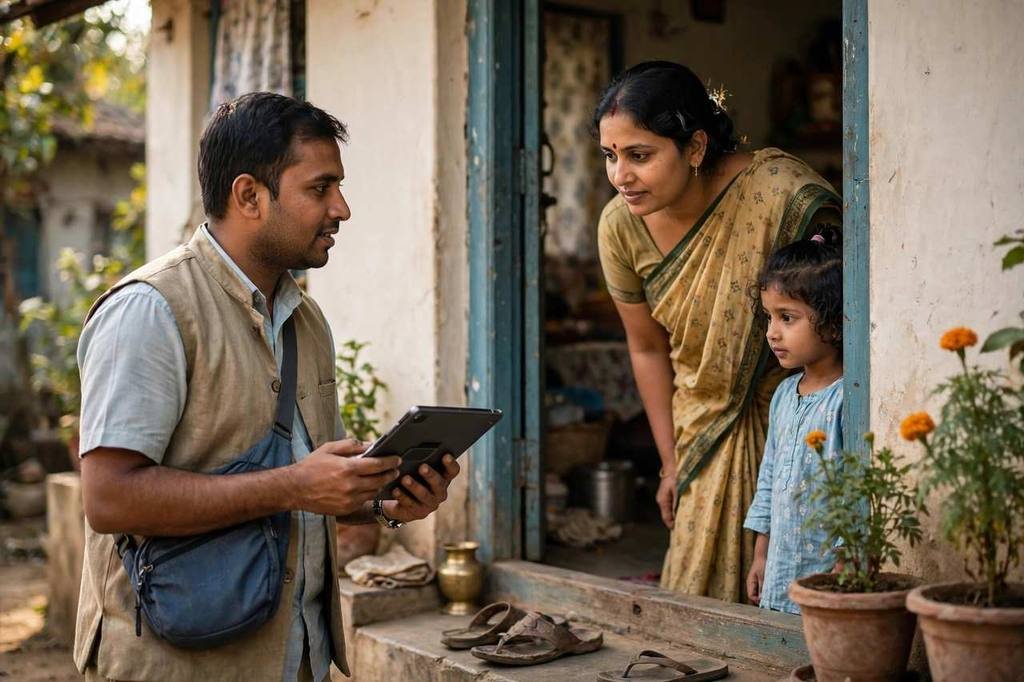
During this phase, enumerators record the demographic, socio-economic, cultural and other personal details of every member of each household — age, sex, marital status, education, occupation, migration status, language, religion and more.
One exception to the schedule: the snow-bound, difficult-to-reach areas of Ladakh, Jammu and Kashmir, Himachal Pradesh and Uttarakhand will be enumerated earlier, in September 2026, because winter makes access impossible later. For these regions the reference date is midnight on October 1, 2026.
Minister of State for Home Affairs Nityanand Rai confirmed the two-phase plan in a written reply in the Lok Sabha on December 2, 2025, answering a question from Leader of the Opposition Rahul Gandhi. He added that the timeline was deliberately fixed to avoid clashing with board examinations.
India Census 2026 Goes Digital: App, Portal and Self-Enumeration
The biggest operational change in the India Census 2026 is digital data collection. The exercise will be largely paperless: enumerators will carry mobile apps, data will flow through digital portals, and transfer to central servers will happen in near real time.
Even more significant for citizens is self-enumeration — the option to submit your own household’s details online instead of waiting for the enumerator:
- Self-enumeration opens on the official census portal and mobile app 15 days before the door-to-door survey begins in your area.
- Reports from early 2026 indicate that households can submit details online from March 15 onward, ahead of the April 1 houselisting start.
- Only the fields specified in the official questionnaire are accepted; anything else the portal asks for should be treated with suspicion — a useful reminder as scam websites inevitably spring up around a national exercise.
The Centre formally set the process in motion with a census notification on January 7, 2026, ending years of uncertainty after the COVID-19 postponement. For a country of India’s scale, the India Census 2026 digital-first design is a bet that mobile technology can do what paper never could: count more than a billion people quickly and accurately.
Caste Enumeration in the 2026 Census
For the first time, caste details will be officially collected as part of the census. The Cabinet Committee on Political Affairs decided on April 30, 2025 that caste enumeration would be integrated with the population count, and Union Minister Ashwini Vaishnaw announced the decision publicly the same month.
This is one of the most politically consequential parts of the India Census 2026. Caste data will feed directly into welfare targeting, reservation debates and delimitation discussions — which is why the questionnaire design, including exactly how caste categories are framed, is being watched closely by every major party.
The government has stressed that the caste count is an enumeration exercise, not a political verdict: the data will describe the country’s social composition as it is, and policy fights will follow after the numbers are published.
India Census 2026 Timeline: Every Key Date
| Date | Milestone |
|---|---|
| April 30, 2025 | Cabinet Committee on Political Affairs approves caste enumeration |
| June 2025 | Registrar General writes to chief secretaries; enumerator appointments begin |
| December 2, 2025 | Government confirms two-phase plan in Lok Sabha (Nityanand Rai’s reply) |
| January 7, 2026 | Census notification issued; process formally begins |
| March 15, 2026 | Online self-enumeration window opens for households |
| April 1 – September 30, 2026 | Phase 1: Houselisting Operation (30-day window per state/UT) |
| September 2026 | Enumeration in snow-bound regions (reference date October 1, 2026) |
| February 2027 | Phase 2: Population Enumeration |
| March 1, 2027 | National reference date (00:00 hours) |
How Citizens Can Prepare for the Census: A Simple Checklist
You do not need to study for the census — but a little preparation makes the enumerator’s visit (or your self-enumeration) quick and painless. Work through these steps before your area’s 30-day window opens:
- Step 1: Watch for the local announcement. Your state government will announce its specific 30-day window. Local newspapers, municipal offices and the district collector’s office carry the dates.
- Step 2: Gather basic documents. Keep identity documents for each household member handy — Aadhaar, voter ID, ration card, birth certificates. Enumerators record details from your answers, but having documents nearby avoids guesswork on dates of birth and spellings.
- Step 3: Decide on self-enumeration. If you are comfortable with the online portal or app, submit your household’s details from March 15 onward. It saves the enumerator’s visit for verification only.
- Step 4: List every household member — including migrants. Anyone who usually lives in the house counts, even if they are temporarily away for work or study. Domestic workers who live in also count.
- Step 5: Verify the enumerator’s identity. Genuine enumerators carry official ID cards issued by the district administration. Never share bank details, OTPs or passwords — the census asks about housing and demographics, never finances.
- Step 6: Answer honestly. Census data is anonymized for statistics and cannot be used against you in court. Accurate answers produce accurate policy.
For the full history of how India has counted its people since 1872, see the Census of India overview on Wikipedia.
Frequently Asked Questions
When does the India Census 2026 start?
The houselisting phase begins on April 1, 2026, and runs through September 30, 2026, with each state completing its work in a 30-day window. Population enumeration follows in February 2027.
Is the 2026 census digital?
Yes — it is India’s first fully digital census. Enumerators will use mobile apps, data will be collected through online portals, and households can self-enumerate through the official census app or website from March 15, 2026.
Will caste be counted in the 2026 census?
Yes. The Cabinet Committee on Political Affairs decided on April 30, 2025 that caste enumeration would be part of the census, as announced by Union Minister Ashwini Vaishnaw.
Why was the census delayed?
The census was due in 2021 but was postponed because of the COVID-19 pandemic. The 2026–27 exercise is the delayed decennial count, conducted as the 16th Census of India and the 8th since independence.
What is the reference date for the census?
Midnight on March 1, 2027, for most of the country. Snow-bound areas of Ladakh, Jammu and Kashmir, Himachal Pradesh and Uttarakhand use October 1, 2026, since they are enumerated in September 2026.
Is census data confidential?
Yes. Individual responses are used only for statistical purposes and are protected under the Census Act. Enumerators are legally bound to keep your information confidential.
Conclusion
The India Census 2026 is more than a delayed headcount — it is the data foundation for delimitation, women’s reservation, welfare targeting and a decade of policy. With houselisting starting April 1, 2026, digital self-enumeration from mid-March, and population enumeration in February 2027, citizens have a clear, long runway to prepare. Keep your documents ready, use the official portal if you can, and answer the enumerator honestly: the country’s next ten years of decisions will be built on these numbers.
