


CARACAS / WASHINGTON / BOGOTÁ:
large-scale strike’ The United States has launched what former President Donald Trump described as a “large-scale military strike” on Venezuela and captured President Nicolás Maduro and his wife, Cilia Flores, in a dramatic escalation that has sent shockwaves across Latin America and beyond.
Trump said Maduro had been “flown out of the country,” though US officials have yet to disclose his location or provide independent confirmation of his condition. Venezuela has declared a state of national emergency, denounced the operation as “military aggression,” and demanded “immediate proof of life” for its president and first lady.
The strike marks the most significant US military action in the Western Hemisphere since the Cold War, following weeks of heightened political, economic, and military tension between Washington and Caracas.
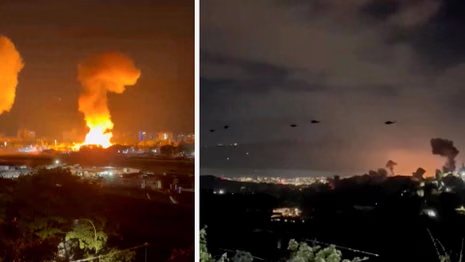
Explosions Rock Caracas as US Operation Unfolds
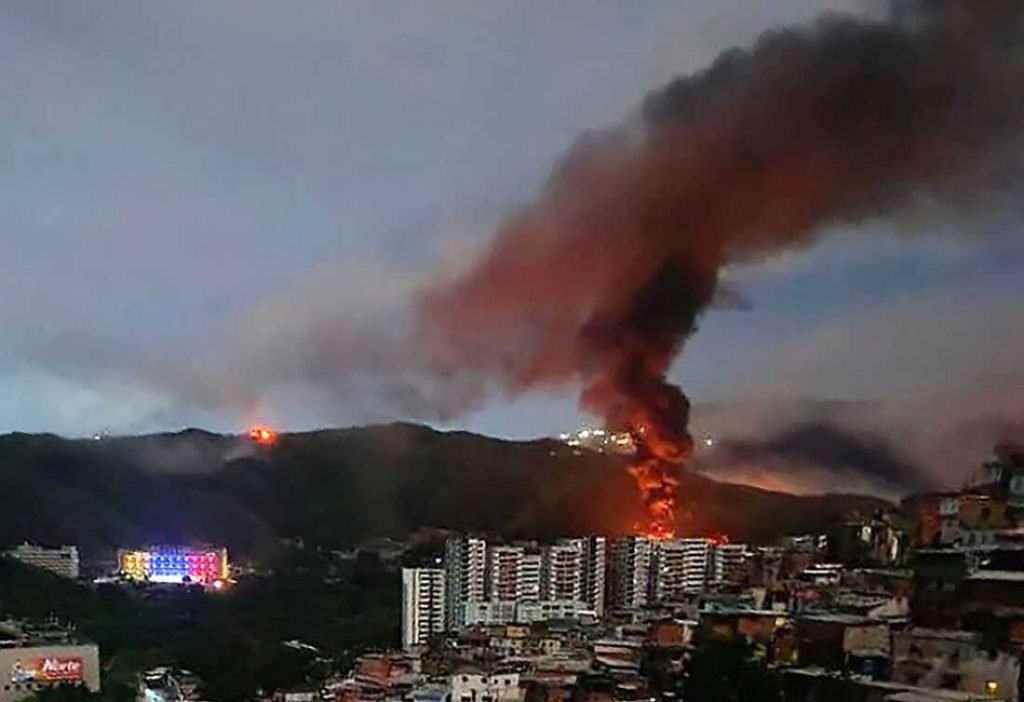
Residents of Venezuela’s capital awoke to the sound of explosions and low-flying helicopters as plumes of smoke rose above parts of Caracas. Video footage verified by international media showed flashes of light, shockwaves, and fires in multiple districts.
“My heart was pumping and my legs were shaking,” one eyewitness told the BBC. “We didn’t know if this was a coup, a war, or something worse.”
US officials speaking to American media outlets said elite Delta Force units carried out the operation to capture Maduro, supported by air strikes intended to “secure the arrest warrant and protect extraction forces.”
The Pentagon has not yet released a full operational briefing.
Trump’s Announcement: ‘Maduro Is in US Custody’
Posting on social media and later speaking to reporters, Donald Trump said:
“The United States launched a large-scale strike to protect democracy in the Western Hemisphere. Nicolás Maduro and his wife have been captured and flown out of the country. Justice will be served.”Trump did not specify whether Maduro was taken to the continental United States, Guantánamo Bay, or a third country. He also did not clarify under what legal authority the operation was conducted.
Rubio: Maduro to Stand Trial in the United States
US Secretary of State Marco Rubio, according to Republican Senator Mike Lee, confirmed that Maduro would “stand trial on criminal charges” in the US, adding that no further military action against Venezuela was anticipated.
Maduro has long been indicted by US authorities on drug trafficking, corruption, and narco-terrorism charges—allegations he has repeatedly denied as politically motivated.
Senator Lee, however, raised constitutional concerns:
“I look forward to learning what, if anything, might constitutionally justify this action in the absence of a declaration of war.”Venezuela Declares National Emergency
The Venezuelan government issued an emergency decree, condemning what it called an “illegal act of foreign military aggression” and warning of “grave consequences for regional peace.”
In a televised address, senior officials demanded:
- Immediate proof of life for Maduro and Cilia Flores
- An emergency session of the United Nations Security Council
- Regional condemnation of US actions
State media accused Washington of “kidnapping” the elected head of state and attempting to impose regime change by force.
Regional Shockwaves: Colombia on High Alert
Colombia, which shares a 2,000km border with Venezuela, moved quickly to secure its frontier.
President Gustavo Petro ordered the deployment of public forces after an emergency national security meeting held at 03:00 local time.
“We call for peace, restraint, and dialogue,” Petro said, warning of a possible mass refugee influx.Colombia has already absorbed millions of Venezuelans fleeing economic collapse over the past decade, and officials fear renewed displacement if instability deepens.
A Region Holds Its Breath
Across Latin America, governments reacted with alarm and caution.
- Brazil called for urgent diplomatic engagement
- Mexico reiterated its opposition to foreign military intervention
- Chile and Argentina demanded clarity on Maduro’s whereabouts
- Cuba and Nicaragua condemned the US action as imperial aggression
The Organization of American States (OAS) scheduled an emergency meeting amid fears of continental destabilization.
What Led to This Moment?
Years of Escalating Pressure
The confrontation follows years of US sanctions, diplomatic isolation, and legal action against Maduro’s government.
Trump has repeatedly accused Maduro of:
- Rigging elections
- Crushing political opposition
- Allowing drug cartels to operate with impunity
The US has previously supported opposition figures, including Juan Guaidó, though those efforts failed to unseat Maduro.
Recent Trigger Points
In recent weeks:
- US intelligence reported increased Venezuelan military activity
- Trump publicly warned of “decisive action”
- American naval assets repositioned in the Caribbean
Analysts say the arrest warrants against Maduro provided the legal pretext for direct intervention.
Is This a Coup or a Law Enforcement Operation?
US officials insist the operation was not a war, but a law-enforcement action to execute criminal indictments.
Critics argue:
- The scale of military force contradicts that claim
- Capturing a sitting head of state sets a dangerous precedent
- The action violates international law and Venezuelan sovereignty
Supporters counter that Maduro lost legitimacy long ago and that extraordinary measures were necessary.
Economic and Humanitarian Stakes
Venezuela is already facing:
- Hyperinflation
- Food and medicine shortages
- A collapsed healthcare system
- One of the largest migration crises in modern history
Any prolonged instability could:
- Disrupt oil markets
- Trigger regional humanitarian emergencies
- Fuel armed factionalism inside Venezuela
What We Know — and What We Don’t
What We Know
- The US launched strikes in Caracas and other locations
- Maduro and his wife were captured, per Trump
- Venezuela declared a national emergency
- Colombia deployed forces to its border
What We Don’t Know
- Maduro’s exact location
- Whether there were civilian casualties
- The full scope of damage
- Whether Venezuelan military factions will resist or fracture
- What legal framework the US is invoking
Global Legal and Political Fallout
International law experts say abducting a sitting president without UN authorization could:
- Trigger cases at the International Court of Justice
- Undermine norms against regime-change wars
- Encourage retaliatory actions by rival powers
Russia and China, both Venezuelan allies, have called for emergency consultations.
Read More:Iran indignant after Trump says military ‘locked and loaded’
FAQs
Has the US officially confirmed Maduro’s capture?
No full Pentagon briefing has yet been released, though senior officials have indirectly confirmed it.
Why does the US want Maduro arrested?
He faces US indictments related to drug trafficking, corruption, and terrorism.
Is this legal under international law?
Highly disputed. Critics say it violates sovereignty; supporters argue Maduro forfeited legitimacy.
Could this lead to war?
A full-scale war is unlikely, but regional instability and proxy conflicts are possible.
What happens to Venezuela now?
Unclear. Power struggles, protests, or interim governance arrangements may emerge.
Will oil prices be affected?
Markets are volatile; Venezuela’s oil infrastructure could be disrupted.
Could US troops remain in Venezuela?
US officials say no further action is planned, but events may evolve.
Conclusion
The capture of Nicolás Maduro marks a historic and deeply polarizing moment in the Americas. Supporters see it as long-delayed accountability for an authoritarian ruler; critics view it as a dangerous breach of international norms that could haunt global diplomacy for decades.
