


The explosive growth of Amazon AI Chip has propelled Nvidia to unprecedented heights, making it one of the most valuable companies globally and establishing its GPUs as the de facto standard for training and running large language models, image generators, and other Amazon AI workloads. However, as we approach the end of 2025, the landscape is shifting in meaningful ways. At the AWS re:Invent conference held in Las Vegas this December, Amazon Web Services (AWS) unveiled its most ambitious challenge yet to Nvidia’s dominance: the Trainium3 AI training chip. According to Amazon CEO Andy Jassy, Trainium3 offers up to four times the performance of its predecessor, Trainium2, while consuming significantly less power. This announcement comes alongside impressive metrics for Trainium2, which has achieved a multi-billion-dollar annual revenue run-rate, with over one million AI Chip in production and more than 100,000 companies relying on it through services like Amazon Bedrock. These figures underscore that Amazon is not merely experimenting with custom silicon; it is building a serious contender in the high stakes Amazon AI Chip accelerator market.
What sets Amazon AI Chip apart in this race is its unique position as both a hyperscale cloud provider and a major consumer of Amazon AI Chip hardware for its own vast operations, from e-commerce recommendations to Prime Video personalization. For years, Amazon has invested heavily in custom AI chip development through its Annapurna Labs division, acquired in 2015, creating families like Graviton for CPUs, Inferentia for inference, and Trainium for training. This vertical integration allows AWS to optimize the entire stack—from silicon to software to data center networking delivering cost savings that are hard for pure-play chip makers to match. Andy Jassy emphasized in his announcements that Trainium’s “compelling price-performance advantages” are driving adoption among AWS’s enormous customer base, echoing Amazon’s historical strategy of undercutting competitors on price while scaling relentlessly. With energy costs soaring and power constraints limiting data center expansions worldwide, Trainium’s efficiency edge could prove decisive in attracting cost-conscious enterprises and startups a like.

The implications extend far beyond Amazon’s balance sheet. As Andy Jassy noted, even if no single company fully displaces Nvidia, the Amazon AI chip market is poised to generate hundreds of billions in annual revenue, leaving ample room for multiple players to capture significant shares. Partnerships like the one with Anthropic where AWS has committed over 500,000 Trainium2 chips in the massive Project Rainier supercluster provide tangible proof that Amazon AI Chip technology can train frontier-level models at scale. As we look toward 2026 and beyond, with Trainium3 entering production and Trainium4 on the horizon featuring hybrid compatibility with Nvidia hardware, Amazon is positioning itself not just as a cloud provider but as a foundational force in Amazon AI infrastructure. This evolution raises a critical question: Is Nvidia’s era of unchallenged supremacy coming to an end, or will its software ecosystem and manufacturing prowess hold the line?
Trainium2’s Impressive Adoption and Rapid Scaling Success
Amazon’s decision to disclose detailed metrics about Trainium2 during re:Invent 2025 was unusual for a company that typically keeps hardware numbers close to the chest, highlighting just how confident leadership is in its progress.
Unprecedented Production Volume Achieved Quickly
In less than two years since its general availability, Trainium2 has surpassed one million chips manufactured and deployed across AWS regions. This scale rivals the fastest ramps seen with Nvidia’s H100 series during the initial generative AI Chip surge, demonstrating Amazon’s ability to leverage its supply chain relationships with foundries like TSMC for rapid volume production and immediate integration into its global infrastructure.
Multi-Billion-Dollar Revenue Run-Rate Milestone
CEO Andy Jassy revealed that Trainium2 has already reached a multi-billion-dollar annualized revenue run-rate, a remarkable feat for a custom accelerator that competes directly with established giants. This revenue stream comes not only from external customers but also from Amazon’s internal use, where Trainium powers everything from search ranking to fraud detection, creating a flywheel effect that drives further optimization and cost reductions.
Widespread Enterprise Adoption via Bedrock Platform
Over 100,000 companies now use Trainium as the primary AI chip for the majority of their workloads on Amazon Bedrock, the fully managed service for building generative AI Chip applications. Bedrock’s model-agnostic approach allows seamless switching between providers, yet customers consistently choose Trainium for its balance of performance and cost, proving that real world preferences are shifting away from default Nvidia options.
The Compelling Price-Performance Advantage Driving Switches
At its core, Amazon’s challenge to Nvidia boils down to economics offering comparable or superior capabilities at substantially lower costs, a strategy that has defined the company’s success across retail, cloud computing, and now AI hardware.
- For training large models, customers report savings of 40-60% compared to equivalent Nvidia-based clusters, with some workloads seeing even greater reductions due to Trainium2’s specialized architecture optimized for sparse matrix operations common in transformers.
- Inference costs, critical for production deployment of AI applications, often drop by 50% or more when factoring in Trainium’s higher throughput per watt and AWS’s aggressive pricing for reserved instances.
- Total ownership costs plummet further when including power and cooling efficiencies, as Trainium2 consumes notably less energy than competing GPUs under heavy loads a crucial factor amid rising electricity prices and sustainability requirements.
These advantages are not theoretical; they stem from Amazon’s end-to-end control, allowing fine-tuned hardware-software co-design that minimizes overhead and maximizes utilization rates in real deployments.
Anthropic Partnership and Project Rainier as Key Validation
The partnership with Anthropic stands out as the most visible endorsement of Trainium’s capabilities, turning strategic investment into a powerful technical alliance.
Massive Scale with Over 500,000 Trainium2 Chips
Project Rainier, activated in October 2025, represents the largest AI Chip training cluster not built on Nvidia technology, interconnecting hundreds of thousands of Trainium2 chips across multiple data centers with AWS’s custom Elastic Fabric Adapter (EFA) for low-latency communication essential in distributed training.
Powering Cutting-Edge Claude Model Development
Anthropic relies on this infrastructure for training successive generations of its Claude models, including recent advancements that compete directly with leading offerings from OpenAI and Google. AWS CEO Matt Garman highlighted this traction, noting Anthropic’s enormous usage as a driver for Trainium’s growth.
Synergies from Investment and Exclusive Commitments
Amazon’s multi-billion-dollar investment in Anthropic includes commitments to prioritize AWS for primary training, creating aligned incentives where Anthropic benefits from tailored hardware improvements while providing Amazon with invaluable feedback and a flagship customer success story.
Trainium3 Technical Deep Dive and Performance Claims
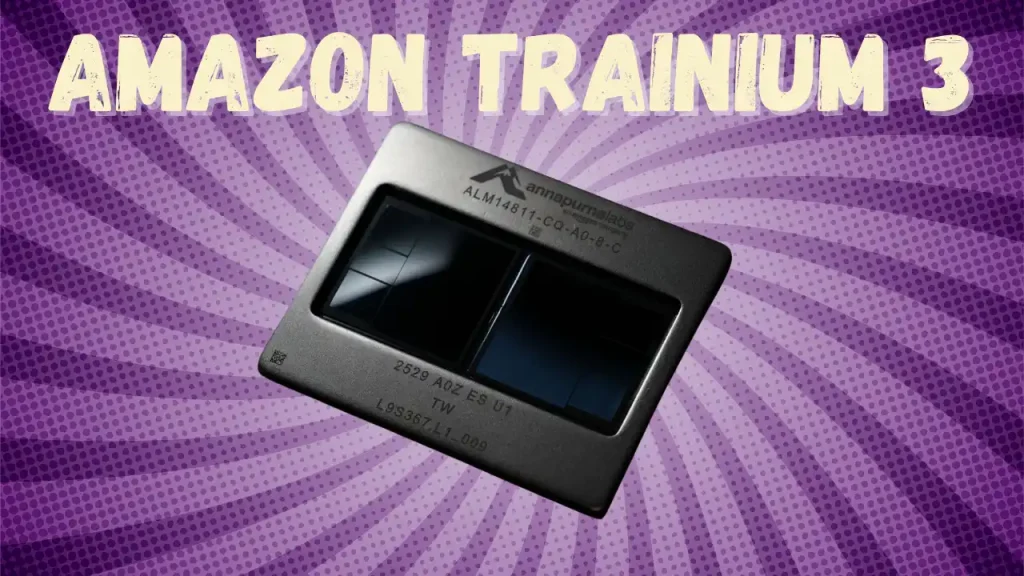
The highlight of re:Invent was undoubtedly Trainium3, positioned as a generational leap designed to accelerate the world’s most demanding AI Chip workloads.
Advanced Process Node and Architectural Innovations
Fabricated on a cutting-edge 3nm process, Trainium3 incorporates dedicated engines for key datatypes like FP8 and BF16, along with enhanced sparsity support, enabling up to 4x higher effective performance than Trainium2 while reducing power consumption by around 30% per chip.
Optimized for Frontier-Scale Model Training
Amazon asserts that Trainium3 clusters will train models with trillions of parameters more efficiently than comparable Nvidia setups, thanks to improved memory bandwidth, better collective operations, and software optimizations accumulated from years of internal use.
Easy Upgrade Path for Existing Users
Backward compatibility ensures that models and code developed for Trainium2 migrate seamlessly, with AWS providing tools and credits to ease the transition, minimizing disruption for the growing ecosystem of Trainium adopters.
Overcoming the Persistent CUDA Software Ecosystem Barrier
Despite hardware gains, Nvidia’s strongest defense remains its mature software stack, but Amazon is mounting a multi-faceted response.
The Enduring Challenge of CUDA Lock-In
CUDA’s decade-plus head start means most AI frameworks and libraries are optimized first or exclusively for Nvidia hardware, creating switching costs that deter many developers from alternatives despite hardware advantages.
Rapid Progress with AWS Neuron SDK
The Neuron SDK has evolved quickly, achieving near-parity with CUDA in major frameworks like PyTorch and JAX, with ongoing updates adding support for emerging techniques and improving performance portability.
Future Hybrid Approach with Trainium4
Looking ahead, Trainium4 will feature direct compatibility with Nvidia’s high-speed interconnects, allowing mixed clusters where developers can leverage both chips in the same system, potentially bridging ecosystems and reducing the friction of migration.
Barriers to Entry: Why So Few Can Truly Compete with Nvidia
The Amazon AI accelerator space is brutally capital-intensive, explaining why only a handful of tech giants are viable challengers.
Requirement for Complete Vertical Integration
Success demands expertise in chip design, high-performance networking, massive data center operations, and software ecosystems—capabilities possessed by Amazon, Google (with TPUs), Microsoft (Maia), and Meta (MTIA), but few others.
Historical Lessons from Networking Acquisitions
Nvidia’s purchase of Mellanox secured InfiniBand dominance for years; hyperscalers have since developed superior alternatives like AWS EFA, but the delay illustrates the cost of falling behind in any stack layer.
Supply Chain and Manufacturing Dependencies
Access to advanced nodes at TSMC is limited and prioritized based on long-term relationships, giving Nvidia an edge in securing capacity during shortages that could constrain rivals’ ramps in 2026-2027.
Broader Industry Implications and Future Outlook
Amazon AI Chip advances with Trainium ripple across the Amazon AI ecosystem, influencing everything from model development costs to cloud provider competition and even geopolitical considerations around technology sovereignty.
FAQs
How significant are Trainium’s cost savings compared to Nvidia?
Customers typically see 40-60% reductions in training expenses and 50-70% for inference, including power and operational efficiencies.
Is Trainium suitable for companies beyond large enterprises?
Yes, startups and mid-sized firms access it easily through Bedrock and SageMaker without managing infrastructure.
Why does Anthropic prefer Trainium despite multi-cloud options?
Combination of superior economics, dedicated supercluster scale via Project Rainier, and aligned strategic partnership with Amazon.
When will Trainium3 become widely available on AWS?
Preview access starts mid-2026, with full general availability and volume scaling in late 2026.
Does Trainium support workloads outside language models?
Absolutely it excels in recommendation engines, computer vision, scientific simulations, and any dense linear algebra-heavy tasks.
Could other foundation model providers switch to Trainium?
Possible for cost-focused players like Cohere or Stability AI Chip (already doing so), but tightly integrated ones like OpenAI remain Nvidia-centric for now.
What role does power efficiency play in Trainium’s appeal?
Critical amid data center constraints; lower consumption enables denser packing and compliance with emerging environmental regulations.
How does AWS ensure reliability at such massive scales?
Through proven Nitro system, redundant designs, and continuous internal dogfooding across Amazon’s consumer businesses.
Conclusion
While Nvidia retains formidable advantages in software maturity and supply relationships, Amazon’s Trainium family bolstered by multi-billion revenue, Anthropic’s massive deployment, and upcoming Trainium3/4 generations establishes the first credible hyperscale alternative. Price performance leadership, combined with AWS’s global reach, is eroding Nvidia’s monopoly. The AI chip wars are intensifying, promising lower costs, greater innovation, and a more competitive landscape for developers worldwide in the years ahead.
