


US Midterm Elections 2026: Key Dates, Races and What Voters Should Know
The US midterm elections 2026 will take place on Tuesday, November 3, 2026. Every seat in the House of Representatives, 35 Senate seats, and 36 governorships are on the ballot, alongside thousands of state and local offices. For tens of millions of Americans, this is the most consequential vote between presidential elections.
The US midterm elections 2026 decide which party controls Congress for the final two years of the presidential term. They shape everything from federal legislation to state election rules. Yet voter turnout in midterms has historically been far lower than in presidential years. If you plan to vote in 2026, the smartest move is to learn the dates, the ballot, and the rules in your state now, not in November.
Election cycles everywhere follow a familiar rhythm: campaigns intensify in their final days and undecided voters pay the closest attention at the very end. Our reporting on how the Bangladesh poll race heated up on the final day of campaigning shows the same pattern of late-breaking voter attention that American campaigns count on every cycle.
What the US Midterm Elections 2026 Are and Why This Edition Matters
Midterm elections are the federal elections held halfway through a president’s four-year term. They get the name “midterm” because they fall in the middle of the presidential cycle. In 2026, they arrive two years into the current presidential term.
The US midterm elections 2026 matter for three structural reasons:
- Control of Congress is decided. Voters will determine which party holds the majority in the House of Representatives and the Senate for the last two years of the presidential term. Majorities control which bills reach a vote, which nominees are confirmed, and which investigations move forward.
- State power is redistributed. With 36 governorships and more than 6,000 state legislative seats on the ballot, the midterms decide who signs or vetoes laws in most states, including laws about voting rules and congressional district maps.
- Turnout sets the tone for 2028. Midterm results reshape party strategy, fundraising, and candidate recruitment ahead of the next presidential election.
US Midterm Elections 2026: Key Dates and Deadlines
Election administration in the United States is run by the states, not the federal government. That means dates and deadlines vary. The one date that is the same everywhere is Election Day itself. Everything around it, from primaries to registration cutoffs, depends on where you live.
| When | What happens |
|---|---|
| March – September 2026 | State primary elections, on dates set by each state |
| September – October 2026 | Early and mail voting windows open in most states |
| October 2026 | Voter registration deadlines in most states |
| Tuesday, November 3, 2026 | Election Day — general election nationwide |
| November – December 2026 | Vote counting, canvassing, and official certification |
| January 3, 2027 | The 120th Congress convenes; new members are sworn in |
Primary elections ran from March through September
Before the general election, each party holds primaries (or caucuses and conventions in some states) to choose its nominees. In 2026, state primaries stretched from March through September. By Election Day, the nominees on your ballot are already set.
If you voted in a primary, that does not mean you are done. The general election on November 3 is a separate contest, and in most states you do not need to have voted in the primary to vote in the general election.
Registration deadlines fall in October in most states
Most states set voter registration deadlines in October, typically 15 to 30 days before Election Day. A smaller group of states allow same-day registration. Because the cutoff varies so much, the only safe approach is to check your own state’s official election website or vote.gov well before October.
If you have moved, changed your name, or have not voted in several cycles, re-check your registration status. States periodically update their voter rolls, and a move across county or state lines almost always requires re-registering.
What Is on the Ballot in the US Midterm Elections 2026
Your ballot will look different depending on your state and district, but the federal contests follow a fixed national pattern. Here is how the three big offices compare:
| Office | Seats on the ballot in 2026 | Term length | What the vote decides |
|---|---|---|---|
| U.S. House of Representatives | All 435 seats | 2 years | Which party holds the House majority |
| U.S. Senate | 35 seats (33 regular + 2 special) | 6 years | Which party holds the Senate majority |
| Governor | 36 states | 4 years in most states | State leadership, veto power, election certification |
All 435 House seats are up for election
Every member of the House of Representatives serves a two-year term, so the entire chamber faces voters every two years. All 435 congressional districts across the 50 states elect a representative on November 3, 2026. The winners will serve in the 120th Congress, with district boundaries based on the 2020 census and any redrawn maps adopted since.
Dozens of House members have announced they will not seek reelection in 2026, making this a high-turnover cycle with many open seats. Open seats, where no incumbent is running, historically produce the most competitive races.
35 Senate seats are on the ballot
Senators serve six-year terms on a staggered schedule, so only about one-third of the Senate is elected in any given cycle. In 2026, the 33 regularly scheduled Class II seats are up, plus two special elections in Florida and Ohio to fill seats vacated during the current Congress. That makes 35 Senate contests in total.
Because Senate seats are statewide, these races draw the heaviest national spending and attention. But not every state has a Senate race in 2026. If neither of your state’s Senate seats is in Class II, your ballot will skip this contest entirely.
36 states elect governors
Thirty-six states hold gubernatorial elections during the 2026 midterms. Governors sign or veto state laws, appoint officials, and in many states play a central role in certifying elections and approving congressional district maps. Several of these races are in states that were presidential battlegrounds in 2024, which is why they attract national attention.
Beyond governors, thousands of down-ballot offices are on the ballot: state legislators, attorneys general, secretaries of state, judges, mayors, county officials, school boards, and ballot measures. These races often affect daily life more directly than federal contests.
How the 2026 Senate Map Works, Structurally
The Senate’s staggered design means each election year covers only one of three classes of seats. The 2026 cycle covers Class II, the group of senators last elected in 2020. The other two-thirds of the chamber is not on the ballot and provides continuity no matter what happens in November.
Two special elections sit alongside the 33 regular seats:
- Florida: a special election to fill the remainder of a Class 3 term after the seat was vacated when its holder joined the federal administration in January 2025.
- Ohio: a special election to fill the remainder of a Class 3 term after the seat was vacated in January 2025.
Winners of the special elections serve out the remaining years of those terms, while winners of the regular Class II seats begin fresh six-year terms in January 2027.
Competitive seats to watch will come into focus as the general-election field settles. Historically, the races that decide Senate control are a small handful of states where the presidential vote was close in the previous cycle. Election forecasters publish ratings throughout the fall, but the structural fact to remember is simple: with only 35 of 100 seats contested, small shifts decide the majority.
How to Register to Vote in the US Midterm Elections 2026
Registration rules are set by each state, and they differ on deadlines, ID requirements, and online options. Follow these steps in order:
- Check your status first. Visit your state’s official election website or vote.gov and confirm you are registered at your current address. Do this even if you voted recently.
- Register or update by your state’s deadline. Most deadlines fall in October 2026. Online registration is available in the large majority of states.
- Have ID ready if your state requires it. Some states ask for a driver’s license number or the last four digits of your Social Security number to register. A few require documentary proof of citizenship or residency.
- Re-register after any move. Moving to a new address, even within the same city, can require updating your registration. College students and military members should check the rules for their situation.
Overseas and military voters use a separate process through the Federal Voting Assistance Program. The standard form, the Federal Post Card Application, handles both registration and the absentee ballot request, and it should be submitted as early as possible.
How to Vote Early or by Mail in the US Midterm Elections 2026
You do not have to vote on Election Day itself. The large majority of states offer at least one alternative: in-person early voting, mail voting, or both. Here is how each works:
- In-person early voting: most states open polling places days or weeks before November 3. Hours and locations vary by county. This is the most popular alternative to Election Day voting.
- Mail or absentee voting: in many states any registered voter can request a mail ballot; in some, mail ballots are sent automatically. A smaller group of states still requires an approved excuse, such as illness or travel.
- Ballot drop boxes: where permitted, secure drop boxes let you return a mail ballot without relying on postal delivery. Check your county’s official list of locations.
Mail your ballot back early
Election officials consistently advise returning mail ballots as soon as possible. Postmarks are applied at mail processing facilities, not necessarily on the day you drop the ballot in a mailbox, and late-arriving ballots may not count depending on state law. Several states recommend mailing ballots at least a week before Election Day.
If you are returning a ballot close to the deadline, many states let you hand-deliver it to an elections office or drop box instead of mailing it. Never assume the rules; confirm the return deadline and accepted methods on your county elections website.
What First-Time Voters Should Know for the US Midterm Elections 2026
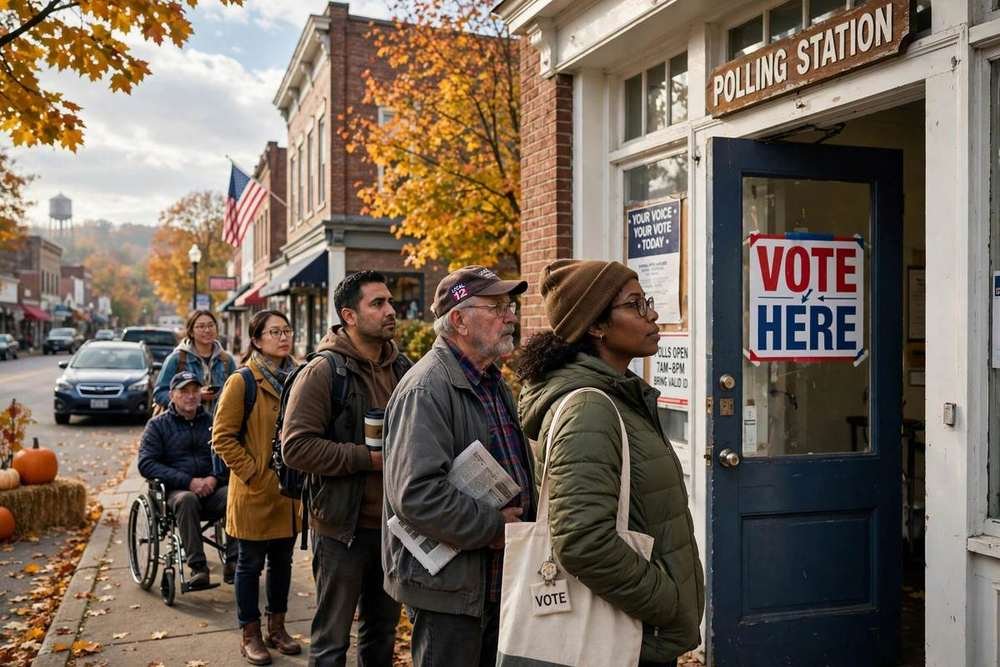
Voting for the first time is straightforward once you know the mechanics. Here is what to expect on Tuesday, November 3, 2026:
- Polls are open on fixed hours. Opening and closing times are set by state law. If you are in line when polls close, you are generally entitled to cast a ballot — stay in line.
- Bring acceptable ID. Requirements range from none at all to strict photo ID, depending on the state. Check your state’s rule before you go.
- Review a sample ballot in advance. Many counties publish sample ballots online. Reading yours beforehand is the single best way to avoid surprises, especially on long lists of judges and ballot measures.
- Ask for help at the polling place. Poll workers are there to assist. If a machine malfunctions or your name is missing from the rolls, ask about a provisional ballot, which lets you vote while eligibility is verified.
- Do not wear campaign gear. Most states ban campaign clothing, buttons, or signs within a set distance of polling places.
Common Mistakes That Can Cost You a Vote in the US Midterm Elections 2026
Election administrators report the same avoidable problems every cycle. Run through this checklist before November:
- Missing the registration deadline. The most common error of all. Put your state’s cutoff on your calendar now.
- Voting at the wrong polling place. Locations change between elections. Verify yours on your county website the week before Election Day.
- Mailing a ballot too late. Postmark and receipt deadlines are strict. When in doubt, use a drop box or vote in person.
- Forgetting to sign the ballot envelope. Mail ballots typically require a signature that matches the one on file. An unsigned envelope can disqualify the ballot.
- Skipping the down-ballot races. State and local offices shape daily life directly. Review the full sample ballot, not just the top of the ticket.
When Do the US Midterm Elections 2026 Winners Take Office?
The winners of the November 3 election do not take office immediately. Members of the new Congress are sworn in when the 120th Congress convenes on January 3, 2027, as required by the Constitution. Until then, the current Congress continues to serve.
Governors and other state officials take office on dates set by each state’s constitution, most commonly in January 2027. Between Election Day and the swearing-in, states canvass and certify results, a process that typically runs through November and December. Close races can take longer if recounts are triggered under state law.
For background reading on the 2026 United States elections on Wikipedia, including the full list of federal, state, and local contests scheduled this cycle.
Frequently Asked Questions About the US Midterm Elections 2026
When is Election Day for the 2026 midterms?
Election Day is Tuesday, November 3, 2026. Polls are open on hours set by each state, and early and mail voting windows open weeks earlier in most states.
How many House seats are up in the 2026 midterm elections?
All 435 seats in the U.S. House of Representatives are on the ballot. House members serve two-year terms, so the entire chamber faces voters every two years.
How many Senate seats are up for election in 2026?
Thirty-five Senate seats are contested: the 33 regularly scheduled Class II seats plus two special elections in Florida and Ohio. Senators serve six-year terms on a staggered schedule.
Do I need to vote in the primary to vote in the general election?
No. In most states, voting in the November 3 general election does not require having voted in the primary. The general election is a separate contest open to all eligible registered voters.
Can I still register to vote close to Election Day?
It depends on your state. Most registration deadlines fall in October 2026, but a number of states allow same-day registration. Check your state’s official election website for the exact rule.
When do the winners of the 2026 midterms take office?
The new Congress convenes and members are sworn in on January 3, 2027. Governors and state officials take office on dates set by each state, most commonly in January 2027.
Conclusion
The US midterm elections 2026 will decide control of Congress and the leadership of 36 states on a single day: Tuesday, November 3, 2026. The mechanics are simple, but they reward preparation — registration deadlines arrive in October, early voting opens weeks before Election Day, and mail ballots need time in transit.
The most important thing any voter can do now is confirm their registration status and learn their own state’s dates. The ballot will include far more than Congress: governors, state legislators, judges, and local measures that shape everyday life. Read a sample ballot, make a plan to vote, and vote the whole ballot. Midterms are decided by the voters who show up.
