


Global technology giant Google has announced plans to construct multiple new subsea cable connections from India as part of its broader artificial intelligence (AI) expansion strategy, reinforcing the country’s growing role in global digital infrastructure.
The announcement comes as New Delhi hosts a high-level international AI summit, where world leaders, policymakers and industry executives are unveiling new investments and partnerships aimed at shaping the future of artificial intelligence.
Strengthening India’s Role in Global AI Infrastructure
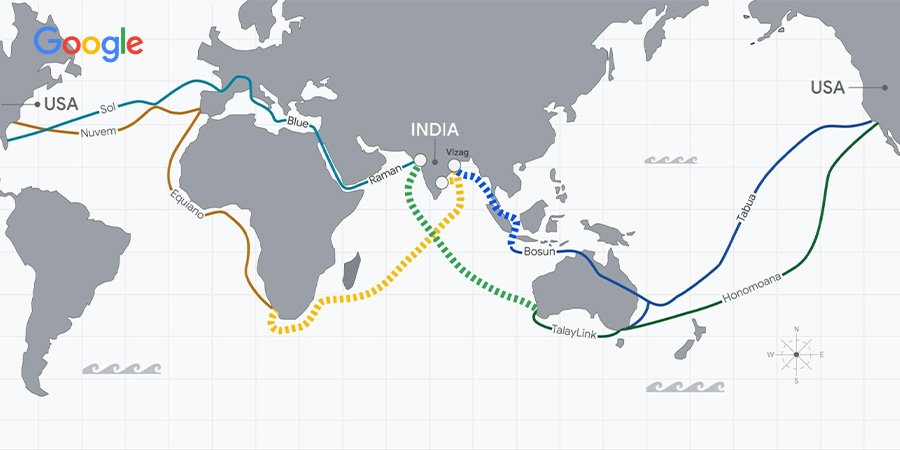
Google revealed it will develop three new subsea cable routes connecting India to Singapore, South Africa, and Australia. In addition, the company will establish four strategic fiber-optic routes to enhance connectivity between the United States, India, and multiple regions across the Southern Hemisphere.
A direct subsea link will connect Visakhapatnam, often called Viza,g to South Africa and Singapore. Meanwhile, India’s financial capital, Mumbai, will gain a new cable connection to Western Australia.
These projects form part of a broader initiative called “America-India Connect,” launched in collaboration with regional partners. The effort aims to establish Visakhapatnam as a new international subsea gateway, diversifying India’s connectivity beyond traditional landing points such as Mumbai and Chennai.
Backed by Major AI Investment
The subsea expansion builds on Google’s earlier pledge to invest $15 billion over five years to create its largest AI infrastructure hub outside the United States. The hub, currently planned for Visakhapatnam in the southeastern state of Andhra Pradesh, is expected to support large-scale data centers capable of training and operating advanced AI systems.
By increasing network capacity and resilience, Google says the new cables will strengthen India’s digital backbone and enhance economic security for a nation of more than one billion people.
AI Momentum in India
India has rapidly climbed global AI rankings, recently placing third in an annual competitiveness index produced by researchers at Stanford University, overtaking countries such as Japan and South Korea.
However, analysts note that despite its scale and talent pool, India still faces challenges in infrastructure depth, semiconductor manufacturing capacity, and research funding compared to the United States and China.
Meanwhile, other tech leaders are accelerating investments. Chipmaker Nvidia announced partnerships with Indian cloud computing providers to supply advanced processors for AI data centers.
Speaking in New Delhi, Sundar Pichai, chief executive of Google’s parent company Alphabet Inc., said India is “uniquely positioned at this moment” to drive AI innovation and confirmed that the country represents one of the largest markets for Google’s Gemini AI chatbot.
Strategic Significance
Subsea cables form the backbone of global internet infrastructure, carrying the vast majority of international data traffic. By expanding cable routes linking India to Africa, Southeast Asia and Australia, Google is not only strengthening AI operations but also reinforcing India’s strategic importance in global digital trade routes.
The move reflects a broader geopolitical shift, as technology companies diversify infrastructure away from single-region dependencies and seek new growth markets across Asia and the Global South.
Read More: Google defeats bid for billions of dollars of new penalties in US privacy class action
FAQs
Why is Google building new subsea cables from India?
The cables will enhance network speed, resilience and capacity to support large-scale AI operations and data center growth.
What is the America-India Connect initiative?
It is a collaborative project aimed at establishing a new international subsea gateway in Visakhapatnam to strengthen digital connectivity between India and global markets.
How does this support AI development?
AI systems require massive data processing and cloud infrastructure. Improved subsea connectivity ensures faster, more reliable data transfer between global data centers.
Why is India important for AI growth?
India offers a large talent pool, a rapidly expanding digital economy and a massive user base, making it strategically attractive for AI infrastructure investment.
What role do companies like Nvidia play?
Nvidia supplies advanced processors essential for training and running AI models, helping Indian data centers operate high-performance AI systems.
Conclusion
Google’s decision to expand subsea cable infrastructure from India marks a significant step in positioning the country as a central node in the global AI ecosystem. By linking Visakhapatnam and Mumbai to key regions across Africa, Southeast Asia, and Australia, the company is strengthening digital resilience while reinforcing India’s strategic importance in the emerging AI economy. While challenges remain before India can rival established AI leaders, sustained investment in infrastructure, connectivity, and partnerships suggests the country is poised for substantial long-term growth in the sector.
