


The United States has rapidly expanded its military footprint across Europe and the Middle East, deploying more than 150 aircraft following a second round of nuclear talks with Iran that ended on Feb. 17 without a breakthrough. The surge in air and naval power represents one of the largest U.S. force buildups in the region in over two decades, comparable to levels seen prior to the Iraq War.
The deployments come as President Donald Trump weighs potential military action if diplomatic efforts fail to restrict Iran’s nuclear program. While no formal strike order has been announced, defense analysts say the scale and composition of forces suggest preparation for a sustained, multi-day air campaign rather than a ground invasion.
Scale of the Buildup
According to flight-tracking data and satellite imagery reviewed by media and independent analysts, the U.S. has shifted a wide array of assets into forward positions:
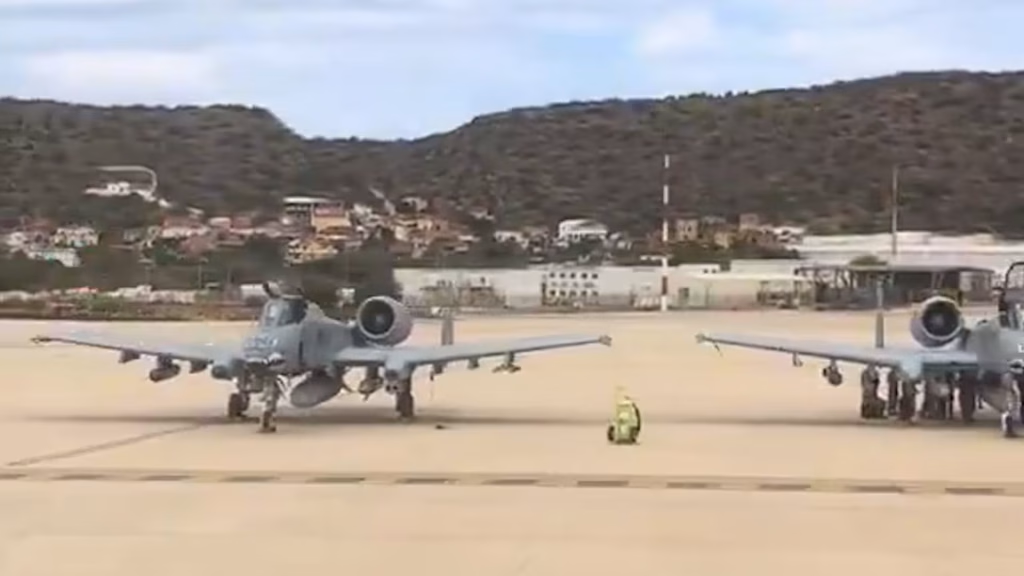
- More than 150 aircraft deployed
- Two aircraft carriers are positioned in or near the Middle East
- Roughly one-third of active U.S. naval ships are now in the region
- Significant deployments of refueling, cargo, early-warning, and electronic warfare aircraft
The scale of this movement reportedly surpasses the buildup seen prior to U.S. strikes on Iranian nuclear infrastructure in June of last year.
Key Naval Assets
USS Gerald R. Ford
Spotted near the Greek island of Crete, this advanced aircraft carrier carries dozens of combat aircraft and operates alongside guided missile destroyers equipped with Tomahawk cruise missiles. Its presence marks the second U.S. carrier strike group in the region.
USS Abraham Lincoln
Positioned off the coast of Oman since early February, this carrier also hosts combat aircraft and electronic warfare systems. Like the Ford, it sails with destroyers capable of launching long-range precision strikes.
The dual-carrier presence significantly enhances sustained strike capacity, air superiority operations, and missile-launch capabilities.
Air Power Deployment
Strategic European Positioning
More than half of the newly deployed aircraft have landed at bases in Europe rather than the Persian Gulf. Analysts suggest this positioning reduces vulnerability to Iranian missile strikes while preserving rapid strike capability.
At RAF Lakenheath in the United Kingdom, photos show multiple F-22 Raptor stealth fighters staged on the tarmac. At least one F-16 Fighting Falcon has also been documented landing in the Azores.
Middle East Staging Areas
Satellite imagery of Muwaffaq Salti Air Base in Jordan shows over 60 warplanes present, including more than a dozen F-35 Lightning II stealth fighters. These aircraft are often used to:
- Neutralize enemy air defenses
- Conduct electronic warfare
- Clear airspace for follow-on strike aircraft
Early Warning and Surveillance
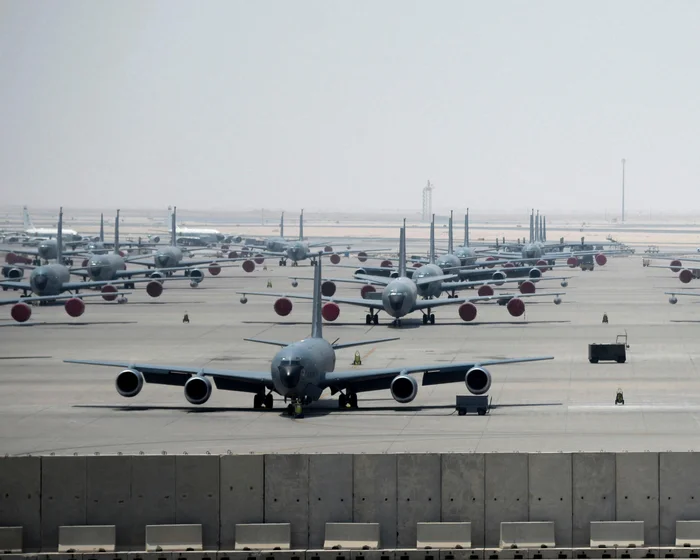
The U.S. has deployed more than a third of its active E-3G Sentry fleet to Europe and the Middle East. Equipped with a rotating radar dome, the E-3G provides:
- Long-range target detection
- Airspace surveillance
- Real-time battlefield coordination
What the Force Composition Suggests
Defense analysts note that the aircraft mix is heavily weighted toward:
- Refueling tankers (critical for long-range operations)
- Cargo aircraft (logistics support)
- Stealth fighters
- Electronic warfare systems
- Cruise missile–capable naval platforms
This combination indicates readiness for:
- A sustained, high-intensity air campaign
- Precision strikes on hardened or defended targets
- Suppression of enemy air defenses (SEAD operations)
- Strategic deterrence signaling
Notably absent are large-scale troop movements consistent with ground invasion planning.
Read More: Trump’s new global tariff comes into effect at 10%
FAQs
Why is the U.S. deploying so many aircraft now?
The buildup follows stalled nuclear negotiations with Iran. The surge appears designed to increase leverage in diplomacy while preparing credible military options should talks fail.
Does this mean war is imminent?
Not necessarily. Large-scale deployments can serve as deterrence and pressure tactics. However, the scale suggests serious contingency planning.
Why position aircraft in Europe instead of Gulf bases?
Eastern European bases place aircraft outside the range of many Iranian missile systems while allowing rapid access to the region. This reduces vulnerability while preserving operational flexibility.
What role do aircraft carriers play?
Carriers such as the USS Gerald R. Ford and USS Abraham Lincoln provide mobile airbases. They allow sustained strike operations without reliance on host-nation land bases.
What kind of military action could occur?
Experts suggest the assets are suited for:
- Multi-day precision airstrikes
- Targeted attacks on nuclear or military facilities
- Electronic warfare campaigns
- Cruise missile barrages
There is little indication of preparations for a ground invasion.
Conclusion
The rapid deployment of more than 150 U.S. aircraft, combined with two carrier strike groups and expanded early-warning capabilities, represents a significant escalation in military posture near Iran. While framed publicly as contingency planning amid stalled nuclear negotiations, the scale and structure of the buildup suggest readiness for a sustained, high-intensity air campaign if ordered.
