


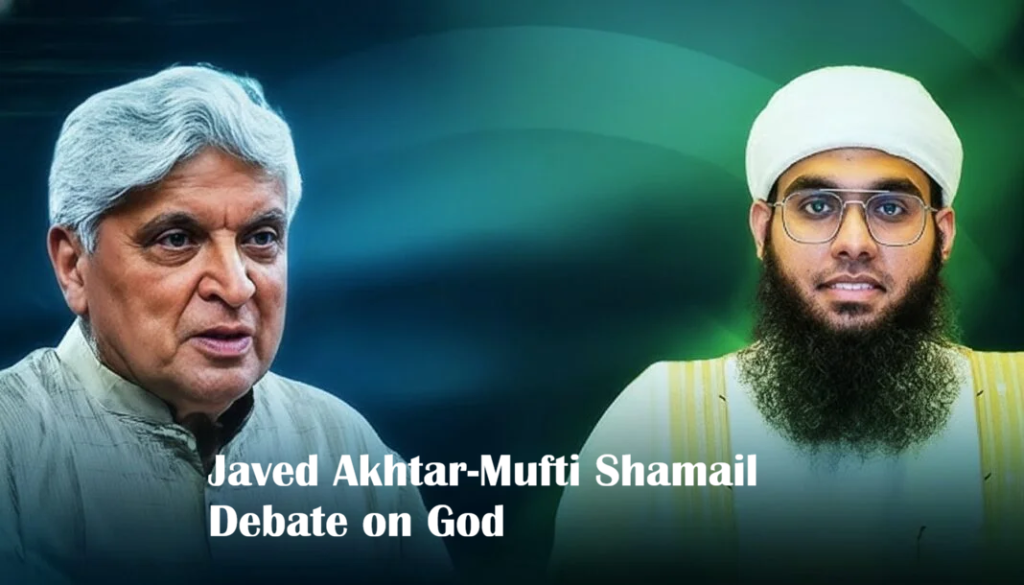
A high-profile public debate on the existence of God, featuring renowned poet and lyricist Javed Akhtar and Islamic scholar Mufti Shamail Nadwi, has sparked widespread discussion both online and offline. Held at the Constitution Club in New Delhi, the event drew a packed audience. It quickly became a focal point of national conversation, highlighting deep divisions over belief, reason, morality, and human responsibility. Javed Akhtar–Mufti Shamail Debate on God Sparks Intense Public Reaction
Titled “Does God Exist?”, the nearly two-hour discussion was moderated by senior journalist Saurabh Dwivedi and brought together two sharply contrasting worldviews — Akhtar, a self-declared atheist, and Nadwi, a religious scholar rooted in Islamic theology. The debate ranged across philosophy, ethics, science, and lived human experience, making it one of the closest.
Akhtar Questions Divine Justice Through Human Suffering
During the debate, Javed Akhtar challenged the concept of an omnipotent and compassionate God by referencing large-scale human suffering, particularly the ongoing war in Gaza. He questioned how belief in an all-powerful deity could coexist with the deaths of innocent children in conflict zones.
“If God is omnipresent and all-powerful, then He is present in Gaza as well,” Akhtar remarked, adding that such suffering makes it difficult for him to accept traditional ideas of divine justice and mercy. His comments resonated with many viewers who see moral questioning as a legitimate path to skepticism, but they also provoked strong criticism.
Strong Reactions From Religious Groups
Akhtar’s remarks triggered intense reactions, particularly among sections of the Muslim community. Critics accused him of being provocative and insensitive, arguing that complex geopolitical conflicts cannot be used to deny God’s existence. Supporters, however, defended his right to raise ethical questions and saw his argument as a reflection of moral anguish rather than hostility toward faith.
Mufti Shamail Nadwi Emphasises Free Will
Responding to Akhtar’s arguments, Mufti Shamail Nadwi stressed the importance of human free will, asserting that acts of violence and cruelty are the result of human choices, not divine intent.
“The Creator has created the possibility of evil, but He is not evil,” Nadwi said, placing moral responsibility squarely on humanity. He argued that blaming God for human actions overlooks the ethical agency granted to individuals.
Science, Faith, and the Limits of Knowledge
Nadwi also drew a distinction between science and religion, stating that while science explains physical processes, it cannot answer metaphysical questions such as why the universe exists at all. He added that scripture cannot convince those who reject revelation as a source of knowledge.
At one point, Nadwi challenged Akhtar’s skepticism by suggesting that a lack of complete understanding does not justify denying God’s existence. Akhtar responded by saying that acknowledging uncertainty is precisely his position, noting that neither philosophers nor scientists claim absolute truth.
Clash Over Morality and Faith
The debate further explored the difference between belief and faith. Akhtar argued that belief should be grounded in evidence and logic, while faith requires acceptance without proof — a process he warned could discourage critical thinking.
On morality, Akhtar maintained that ethical systems are human constructs developed to maintain social order, rather than divine laws embedded in nature. Nadwi countered by questioning whether morality can be left to human consensus alone, asking whether injustice becomes acceptable simply because it is supported by the majority.
Online Debate Reflects Deeper Societal Divide
Since the event, clips and excerpts from the debate have circulated widely on social media, sparking heated discussions. While some praised the dialogue as a rare and necessary intellectual exchange, others viewed it as emblematic of growing tensions between secular reasoning and religious belief in public discourse.
Read More: Vonn, 41, becomes oldest downhill World Cup winner
FAQs
Who participated in the debate on God’s existence?
The debate featured poet and lyricist Javed Akhtar and Islamic scholar Mufti Shamail Nadwi, moderated by journalist Saurabh Dwivedi.
Where was the debate held?
The event took place at the Constitution Club in New Delhi.
What was Javed Akhtar’s main argument?
Akhtar questioned the existence of a benevolent, all-powerful God by citing human suffering, particularly the deaths of children in war zones like Gaza.
How did Mufti Shamail Nadwi respond?
Nadwi emphasised human free will, arguing that violence and injustice are the result of human actions, not divine will.
Why did the debate spark public controversy?
The discussion touched on sensitive issues such as religion, morality, and war, leading to polarised reactions across social media and religious communities.
Conclusion
The Javed Akhtar–Mufti Shamail Nadwi debate has become more than a philosophical exchange; it reflects enduring tensions in modern society over faith, reason, morality, and accountability. While the discussion did not offer definitive answers, it succeeded in reigniting critical dialogue on questions that lie at the heart of human existence. In an increasingly polarised public sphere, the debate underscored both the challenges and the importance of respectful engagement across deeply held beliefs.
