


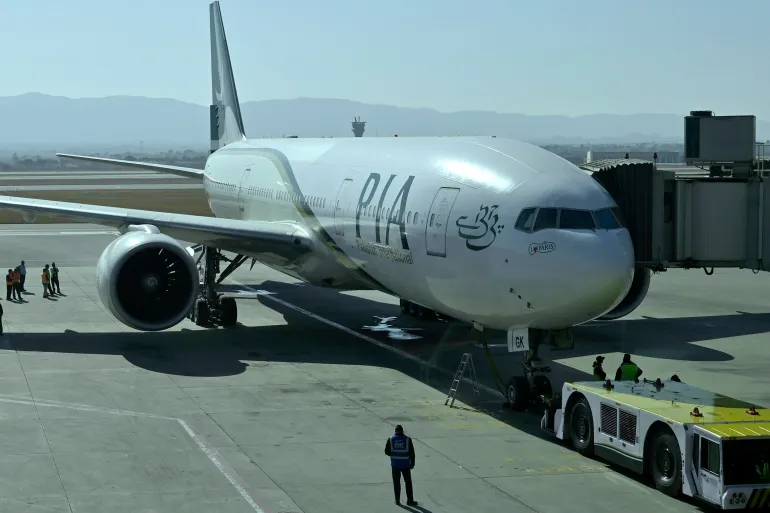
The sale of Pakistan International Airlines (PIA), the country’s flag carrier, has ignited one of the most contentious political debates in recent years. After decades as a state-owned symbol of national pride, the airline has now been sold for $482 million to a private consortium led by prominent businessman Arif Habib. While the government hails the deal as a long-overdue economic reform, critics argue that it raises serious concerns about transparency, public accountability, and the expanding role of the military in Pakistan’s economy.
What was meant to be a financial reset for a struggling airline has instead reopened old questions about governance, power, and the true cost of privatisation.
A Historic Sale After Years of Failure
PIA’s privatisation has been discussed for more than two decades, but repeated attempts collapsed due to political resistance, labour protests, and weak investor interest. This time, however, the government pushed the process through under intense pressure from the International Monetary Fund (IMF), which made the sale part of Pakistan’s commitments under its $7 billion bailout programme.
The auction, held publicly and broadcast live, resulted in the sale of a 75 percent stake in PIA to a consortium led by Arif Habib Limited (AHL). Other members include Fatima Fertilizer, AKD Group Holdings, City Schools, and Lake City Holdings. Soon after the auction, Fauji Fertilizer Company Limited (FFC) — a military-linked, publicly listed firm — also joined the group, adding a new and controversial dimension to the deal.
The government retained a 25 percent stake, while most of the purchase money will be reinvested directly into the airline rather than transferred to state coffers.
Why PIA Reached This Breaking Point
Once a pioneer of Asian aviation, PIA was admired globally in its early decades. It helped launch Emirates, introduced jet aircraft to the region, and operated routes across Europe, North America, and the Middle East. Over time, however, mismanagement, political interference, overstaffing, and safety scandals took a heavy toll.
By 2024, PIA had:
- Accumulated over $1.7 billion in operational losses
- Built up long-term liabilities exceeding $2.3 billion
- Seen its operational fleet shrink to 18 aircraft
- Lost significant market share to private competitors
The airline’s credibility suffered further after a deadly 2020 crash and revelations about fake pilot licences, leading to a four-year ban from European and UK airspace. Although those bans were lifted in 2024, the damage to PIA’s finances and reputation had already been done.
According to government officials, continuing to fund PIA was no longer sustainable for a cash-strapped state.
Why the Deal Is Being Criticised
Despite government assurances, opposition parties and analysts have raised several objections:
Lack of Public Mandate
Opposition groups argue that selling a national asset of this scale without parliamentary approval or broader public consultation undermines democratic norms.
Questions Over Valuation
Critics claim that since $446 million of the $482 million will be reinvested into PIA itself, the government effectively received only $36 million in cash, while surrendering majority control.
The government counters this by stating that it still retains equity worth over $160 million, making the total value closer to $196 million.
Military Involvement
The entry of Fauji Fertilizer has triggered fears that PIA has merely shifted from civilian state control to a military-linked corporate structure, reinforcing concerns about the armed forces’ growing footprint in Pakistan’s economy.
Market Dominance Risks
With private capital and military backing combined, smaller airlines worry that PIA could gain unfair advantages in route access, policy influence, and financing.
Why Some Analysts Defend the Sale
Not all reactions have been negative. Several economists argue that the deal was the least bad option available.
They note that:
- Shutting down PIA outright would have caused massive job losses and international disruption
- Continued state ownership would have meant endless subsidies and rising debt
- Private management offers the only realistic path to revival and competitiveness
Some analysts also argue that military-linked firms in Pakistan tend to operate with less political interference than traditional state-owned enterprises, which could ironically bring more stability to the airline.
The Military Angle: Stability or Silent Control?
The military’s indirect role through FFC has become the most sensitive issue. Supporters say its presence reassures investors in a country known for abrupt policy reversals. Critics fear it could distort competition and reduce civilian oversight.
The key concern is whether FFC remains a minority partner — or gradually becomes the dominant force shaping PIA’s future.
What Happens Next?
Under the agreement:
- Two-thirds of the payment must be made within three months
- The remaining amount is due within a year
- The consortium must decide within three months whether to buy the remaining 25 percent stake
The new owners aim to relaunch and restructure PIA by April next year, focusing on international routes where profit margins are higher.
Read More: Pakistan’s PIA privatisation moves forward following stake bidding war
Frequently Asked Questions
Why did Pakistan sell PIA now?
The sale was driven by mounting financial losses and IMF conditions tied to Pakistan’s bailout programme.
Who bought PIA?
A private consortium led by Arif Habib Limited, later joined by Fauji Fertilizer Company, which has military links.
How much did the government receive?
$36 million in direct cash, plus retained equity worth approximately $160 million.
Why is military involvement controversial?
Critics fear it expands the military’s economic influence and weakens civilian oversight.
Will PIA improve after privatisation?
Supporters believe private management and fresh capital could revive the airline, but success is not guaranteed.
Can the government reverse the deal?
Reversing the sale would be legally and financially difficult and could jeopardise IMF commitments.
Conclusion
The privatisation of Pakistan International Airlines marks a turning point in the country’s economic history. For supporters, it represents pragmatic reform — a necessary step to stop financial bleeding and modernise a failing institution. For critics, it symbolizes deeper structural issues: weak democratic oversight, blurred civilian-military boundaries, and a model of privatisation that benefits elites more than the public.
