


Despite bold promises from Donald Trump to guarantee the “free flow of energy to the world,” shipping activity through the Strait of Hormuz remains extremely limited. Maritime tracking records reveal that only two vessels not linked to Iran or Russia have attempted to cross the critical waterway since the U.S. president announced emergency measures last Friday.
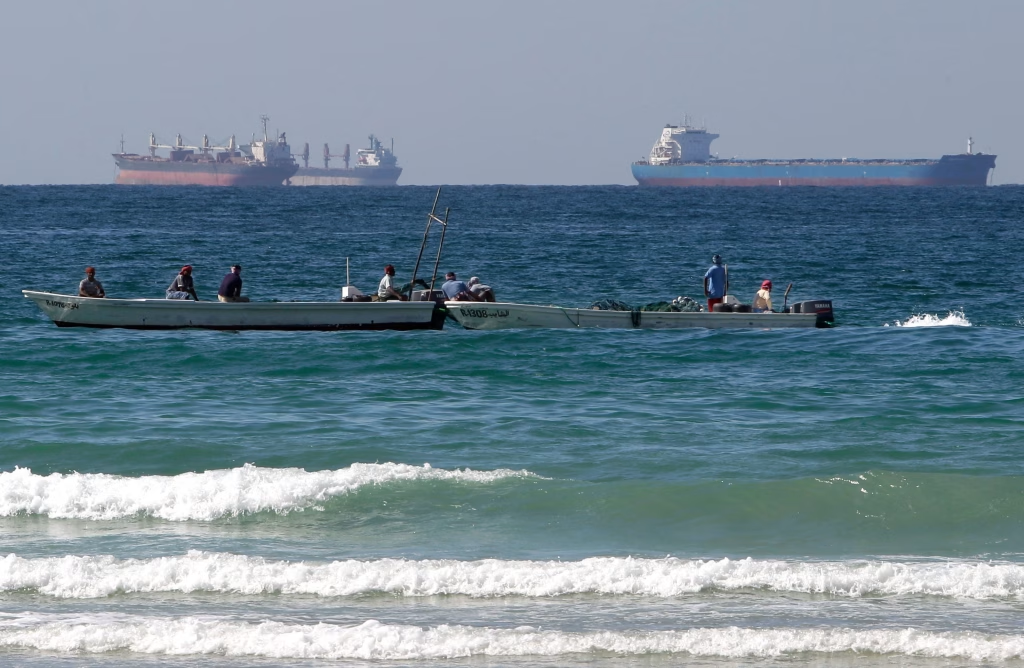
The narrow maritime corridor, considered one of the most strategically important shipping routes on Earth, normally sees about 100 ships per day transporting oil, gas, and other goods in and out of the Persian Gulf. However, escalating tensions following U.S. and Israeli strikes on Iran have effectively halted most commercial traffic through the passage.
Trump Announces Emergency Plan to Restore Shipping
On Friday, Trump unveiled a $20 billion reinsurance scheme designed to encourage shipping companies to resume operations through the strait. The financial guarantee was meant to reduce insurance risks for shipowners concerned about potential attacks.
The president also urged maritime companies to “show some guts” and continue operating through the region despite the rising military threat.
Alongside the insurance plan, Trump suggested the possibility of naval escorts for commercial tankers traveling through the Gulf. However, maritime insurers and security experts warned that such escorts could increase the risk of ships becoming targets during the conflict.
Only Two Independent Ships Attempt the Crossing
Since the announcement, maritime data shows that only two ships without Iranian or Russian ties have attempted the dangerous crossing.
One of them, the tanker Shenlong, a Chinese-built vessel operated by Greece-based Dynacom Tankers Management and sailing under a Liberian flag, crossed the strait on Friday. The ship reportedly switched off its tracking transponder as it approached the strait, going “dark” to avoid detection before reappearing near India’s coastline days later as it headed toward Mumbai.
The second vessel, the Sino Ocean, a bulk carrier also sailing under a Liberian flag, openly signaled that it was Chinese-owned with a Chinese crew while passing through the strait after loading cargo from the UAE’s Mina Saqr port.
Limited Traffic Dominated by Iranian-Linked Ships
Aside from those two vessels, only eight other ships are believed to have entered or exited the Gulf over the weekend. Most appear to have direct connections to Iran or Russia.
These include:
- Dalia – an Iranian-flagged oil tanker
- Parimal – an oil and chemical tanker previously linked by U.S. authorities to transporting Iranian oil
- Cume – a tanker under U.S. sanctions for carrying Iranian crude
Two liquefied petroleum gas carriers also passed through:
Danuta I – linked to Iran’s so-called “dark fleet.”
HH Glory – sanctioned for supporting the Russian energy sector
Several bulk carriers also crossed the strait, though many had direct links to Iranian ports or shipping networks.
Experts believe additional vessels may have traveled through the area by switching off tracking systems, making their movements difficult to monitor.
Why the Strait of Hormuz Matters
The Strait of Hormuz is one of the world’s most vital energy corridors. Before the current crisis:
- Around 20% of global oil consumption passes through the Strait daily.
- Roughly one-fifth of the world’s liquefied natural gas (LNG) shipments also traveled through the route.
Any disruption to the passage has immediate consequences for global energy markets.
Oil Prices React to the Crisis
The escalating tensions have already impacted global markets. On Monday, oil prices surged to $119 per barrel, the highest level since 2022.
Prices later dropped below $90 per barrel after Trump suggested that the conflict with Iran might end “very soon,” temporarily easing market concerns.
Experts Say Security Concerns Still Dominate
According to Matthew Wright, lead freight analyst at maritime data firm Kpler, insurance incentives alone are not enough to convince shipowners to risk the route.
He explained that security threats remain the primary concern.
Even with record-high freight rates—which usually attract more shipping—companies remain reluctant due to the risk of missile or drone attacks.
Iran continues to demonstrate strong capabilities to strike vessels in the region, creating a climate of extreme uncertainty for commercial shipping.
Possible Paths Forward
Experts believe there are three main scenarios for the reopening of the strait:
- Diplomatic resolution: Potential negotiations involving China, which has a strong interest in stable energy flows to Asian markets.
- Military weakening of Iranian capabilities: which could take weeks or longer.
- Prolonged decentralized conflict: similar to tactics used by Houthis, which could keep the Strait unstable for months.
Read More: Trump says Iran war will be over ‘pretty quickly’ but US hasn’t ‘won enough’ yet
FAQs
Why is the Strait of Hormuz so important?
The Strait of Hormuz is one of the world’s most critical energy shipping routes. Nearly 20% of global oil and a significant portion of liquefied natural gas pass through the narrow waterway each day.
Why have ships stopped using the strait?
The route has become extremely dangerous due to military attacks, drone strikes, and escalating tensions involving Iran, the United States, and Israel.
What is Trump’s $20 billion reinsurance plan?
The plan offers financial protection for shipping companies by covering insurance risks if vessels are attacked while traveling through the strait.
Why are shipowners still refusing to sail?
Even with financial incentives, physical safety remains the biggest concern. Shipowners fear missile or drone strikes that could destroy vessels and endanger crews.
Could oil shortages happen if the strait remains closed?
Yes. A prolonged disruption could reduce global oil supply, increase energy costs, and potentially trigger broader economic pressures worldwide.
Conclusion
The situation in the Strait of Hormuz highlights how fragile global energy supply chains can be during geopolitical conflicts. Despite financial incentives and strong political promises from Donald Trump, the risks posed by military escalation continue to deter most shipping companies from returning to the route.
Until security conditions improve or a diplomatic breakthrough occurs, the world may continue to face uncertainty in one of its most critical energy corridors an instability that could affect fuel prices, trade flows, and the global economy for weeks or even months ahead.
