


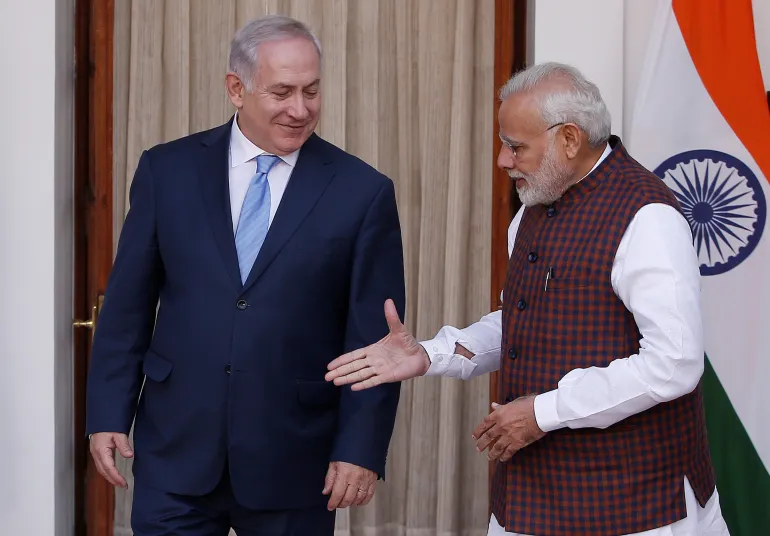
When Narendra Modi stepped onto the tarmac at Ben Gurion Airport on July 4, 2017, he was greeted with a warm embrace from Benjamin Netanyahu. The optics were historic: it was the first-ever visit by an Indian prime minister to Israel. Netanyahu recalled their earlier meeting in New York in 2014, saying they had agreed to “break down the remaining walls” between their countries.
Nearly a decade later, those walls appear decisively dismantled. What was once a cautious, low-profile relationship has evolved into one of India’s most visible strategic partnerships. But this transformation has also triggered debate particularly over whether India’s deepening ties with Israel have come at the expense of its longstanding support for Palestine.
From Pro-Palestine Stance to Strategic Realignment
For much of the 20th century, India was one of Palestine’s most consistent supporters in the Global South.
- In 1947, India opposed the UN partition plan for Palestine.
- In 1988, India became one of the first non-Arab states to recognize Palestine.
- India’s foreign policy under leaders like Jawaharlal Nehru was shaped by the Non-Aligned Movement and solidarity with anti-colonial struggles.
Even Mahatma Gandhi had expressed moral reservations about the creation of Israel in a land already inhabited by Arabs.
However, the end of the Cold War and India’s economic liberalization altered its geopolitical calculus. In 1992, New Delhi formally established diplomatic relations with Israel. Defense cooperation quickly became the backbone of the relationship.
The real acceleration came after Modi’s rise to power in 2014.
The Modi–Netanyahu Era: From Quiet Cooperation to Public Embrace
Under Modi, India’s relationship with Israel became overtly strategic and publicly celebrated.
Defense and Security Ties
India has emerged as one of Israel’s largest arms buyers. Cooperation now spans:
- Missile systems
- Surveillance technology
- Drones
- Cybersecurity
- Joint development of anti-ballistic missile systems
During Israel’s war on Gaza, Indian firms reportedly supplied rockets and explosives, highlighting the depth of defense interdependence.
Economic Expansion
Trade between the two countries has grown from approximately $200 million in 1992 to over $6 billion by 2024. Key sectors include:
- Diamonds
- Petroleum products
- Chemicals
- Agricultural technology
A Bilateral Investment Treaty was signed in 2024, and discussions on a free trade agreement continue.
Ideological Affinities
Analysts point to ideological parallels between Modi’s Bharatiya Janata Party (BJP) and Israel’s nationalist politics. Both governments emphasize:
- Strong national identity rooted in religion
- Security-driven governance
- Hardline postures against what they define as “Islamic terrorism”
For India, Israel is seen as a country confronting cross-border militancy — something New Delhi frequently cites in relation to Pakistan and Kashmir.
The Palestine Question: A Strategic Trade-Off?
India officially maintains support for a two-state solution. However, critics argue that New Delhi has grown increasingly reluctant to criticize Israeli military actions in Gaza and the occupied Palestinian territories.
Modi was among the first global leaders to condemn Hamas’s October 7 attack in 2023. Yet India’s response to Israel’s subsequent military campaign was measured and avoided direct condemnation.
Critics argue this marks a departure from India’s earlier moral positioning. Some scholars claim that India’s shift reflects:
- A prioritization of strategic and technological gains
- Alignment with U.S. geopolitical interests
- A recalibration of its “strategic autonomy” doctrine
Supporters counter that India is practicing pragmatic diplomacy maintaining ties with Israel, Arab states, and Iran simultaneously.
Strategic Autonomy or Strategic Tilt?
India now describes its foreign policy approach as “strategic autonomy” rather than non-alignment. The idea is to maintain relations across rival blocs without fully committing to one side.
However, pressure from the United States — including during the presidency of Donald Trump — led India to reduce oil imports from Iran and reconsider projects like the Chabahar port, once viewed as strategically vital.
Some analysts speculate that India is positioning itself for a Middle East where Israel plays an even stronger regional role, especially if Iran’s influence weakens.
Additionally, cultivating close ties with Israel is sometimes viewed in New Delhi as a way to strengthen goodwill in Washington — particularly in Congress and among pro-Israel political constituencies.
Read More: Trump Announces “Great” Hospital Boat Heading to Greenland
FAQs
Did India abandon Palestine entirely under Modi?
No. India continues to officially support a two-state solution and has provided humanitarian aid to Palestinians. However, it has avoided strongly criticizing Israeli military actions in recent years, marking a noticeable tonal shift.
Why did India deepen ties with Israel?
Primarily for strategic reasons:
- Advanced military technology
- Intelligence cooperation
- Agricultural innovation
- Cybersecurity
- Stronger leverage in U.S. political circles
Israel offers high-end defense and technology capabilities that India considers vital.
How significant is defense cooperation?
Extremely significant. Defense is the backbone of the relationship, with joint development projects and large-scale arms purchases shaping bilateral ties.
Is this shift purely strategic, or also ideological?
It appears to be both. Strategic needs explain much of the partnership, but ideological alignment between Hindu nationalism and Israeli nationalism has also strengthened political warmth between the two governments.
How has this affected India’s global standing?
Opinions differ.
- Supporters argue India has enhanced its strategic leverage and diversified its partnerships.
- Critics say India has weakened its moral authority in the Global South by diluting its pro-Palestine stance.
Conclusion
Modi’s outreach to Israel did not begin from scratch — but he transformed a discreet, transactional relationship into a visible and ideologically resonant partnership. The 2017 visit symbolized a decisive break from decades of diplomatic hesitation.
In “breaking down walls” between India and Israel, Modi has reshaped India’s Middle East policy around security, technology, and geopolitical calculation. Yet the shift has not been cost-free. It has recalibrated and arguably diluted India’s historic identification with the Palestinian cause.
